

Can you put a toddler seat on any bike
No, you cannot put a toddler seat on every bike. The bicycle, seat and mounting system must match, and both manuals must permit the installation.
What determines whether a toddler seat will fit?
A child passenger seat is designed around a particular mounting method. Depending on the model, it may attach to a compatible rear rack, mount directly to the frame, or sit at the front of the bicycle. A bike is suitable only when its construction, available mounting space and permitted loads meet every requirement in the seat and bicycle manuals.
Do not assume that visible space above a wheel means a seat will fit. Cables, frame shapes, suspension movement, racks and other components can interfere with the mount or the child seat. Some bicycles may also lack the attachment points required by a particular system.
Measure and compare before buying
Identify the exact bicycle model and the exact toddler-seat model, then find both manufacturers’ compatibility instructions. Measure only where their diagrams tell you to measure. Record these details:
- The frame tube or rack dimensions at the proposed mounting location.
- The clear space around the mount, wheel, saddle and handlebar.
- For a rack-mounted seat, the rack model and its stated compatibility and load limit.
- The bicycle’s permitted total load, including the adult, child, seat and anything else carried.
- The child’s measurements and whether they fall within the seat manufacturer’s stated limits.
Compare the measurements directly with the approved ranges in the toddler-seat manual. Compatibility cannot be established by wheel size, bicycle appearance or age recommendations alone. If a required dimension or load limit is missing, contact the manufacturer or ask a qualified bicycle mechanic rather than estimating.
A practical compatibility check
- Confirm permission: Check that the bicycle manual allows a child passenger seat and that the seat manual lists the bike or mounting arrangement as compatible.
- Match the mount: Verify the required frame area, rack specification or attachment points using the manufacturers’ instructions.
- Check clearance: Make sure the installed position will not obstruct steering, pedaling, braking, cables or moving components.
- Check every load limit: The seat, mount, rack and bicycle may have separate limits. Follow the lowest applicable limit and include all carried weight.
- Plan professional help: If the manuals are unclear, conflict, or require procedures you cannot verify, use a qualified bicycle mechanic.
Follow the exact product manual for assembly, fasteners, torque, maintenance and compatibility. Do not improvise brackets, modify the seat or substitute hardware.
Fit and handling still matter
Even a technically compatible seat changes the bicycle’s balance and handling. The adult rider should be able to mount, start, steer, brake and stop with control while keeping the bicycle stable. If the added seat position prevents confident control or safe clearance, that bike-and-seat combination is not appropriate.
The child also needs the restraint and support specified by the seat manufacturer. Use the seat only within its stated developmental, size and load requirements. A properly fitting bicycle helmet should sit level and have its straps adjusted according to the helmet manufacturer’s instructions.
Is the supplied kids’ bike relevant?
The XJD Boys 12/14/16" Training Wheel Bike – Blue is a child’s training-wheel bicycle offered in 12 Inch, 14 Inch and 16 Inch labels. It does not provide evidence that it can carry a toddler passenger seat. Instead, these options are useful only if the real question is whether a young child should ride a correctly fitted bicycle of their own.

As starting points, XBikes associates 12 Inch with heights of 34–40 in / 86–102 cm and ages 3–4; 14 Inch with 37–45 in / 94–114 cm and ages 3–6; and 16 Inch with 40–48 in / 102–122 cm and ages 4–7. These ranges overlap, so age does not decide the size.
Have the child try the bicycle. Prioritize measured height, inseam, reach, stand-over clearance, brake control and current confidence, and do not choose an oversized bike merely for future growth. The XJD model is therefore a comparison for independent riding, not a substitute for a compatible adult bicycle and passenger seat.
What to do next
Locate the exact manuals, identify the proposed mounting system, and compare the specified dimensions, clearances and load limits. Proceed only when both manufacturers permit the complete combination and the adult can control the loaded bicycle. If any requirement remains uncertain, take the bicycle, seat and mounting parts to a qualified bicycle mechanic before carrying the toddler.
Bikes for your next adventure
-
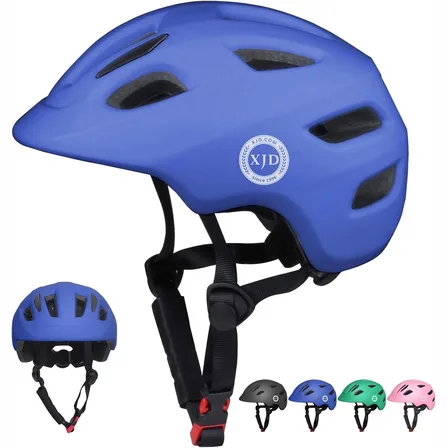
Blue XJD Kids' Bike Helmet, Adjustable Fit – Sizes XS & S
The Blue XJD Kids' Bike Helmet is a lightweight, adjustable helmet for toddlers …$20.39
-

Kids Bike Helmet by XJD for Boys & Girls – Black, Blue, Green, Pink, Purple
The XJD Kids Bike Helmet covers a wide 2-to-8-year age range thanks to two head-…$59.99
-

Kids Bike Helmet by XJD for Girls – Pink
The XJD Kids Bike Helmet in Pink is a lightweight multi-sport helmet for girls r…$59.99
$99