

Can you put a child seat on any bike
No—you cannot put a child seat on just any bike. The bike, seat and mounting system must be compatible, with enough clearance and an approved load capacity.
What determines whether a child seat will fit?
Start with the instructions for both the bicycle and the child seat. The bicycle manual must permit the intended passenger or carrier setup, while the seat manual must identify compatible frame tubes, racks or mounting points. If either manual rules out the combination—or provides no way to verify it—do not attach the seat.
Child seats generally use a frame, rear rack or front mounting system. These methods are not interchangeable. A rear rack being present does not by itself mean that it can support a child seat, and a frame that looks spacious may still have unsuitable tube shapes, cable routing or clearances.
Measure and compare before buying
Record the bicycle model and wheel size, then inspect the proposed mounting area. Compare these details with the exact child-seat manual:
- Frame or mounting-point dimensions: Measure the relevant tube diameter, tube shape and usable mounting length. Check for cables, clamps, batteries or accessories in that space.
- Rack compatibility: For a rack-mounted seat, confirm that the rack and bicycle are approved for that seat system and passenger use. Check the stated load limits in every applicable manual.
- Clearance: Allow for the wheel, tyre, saddle, rider’s legs, brakes and steering throughout their full movement. The seat and a child’s feet must remain clear of moving parts.
- Total permitted load: Compare the child, seat, rack and any luggage with the limits specified by the bicycle, rack and seat manufacturers. The lowest applicable limit controls.
- Rider control: The adult must be able to mount, stop, steer and balance the loaded bicycle confidently.
Do not guess at compatibility, substitute a different clamp or improvise an attachment. Follow the exact manuals for assembly, fastener torque, maintenance and load limits, or ask a qualified bicycle mechanic to inspect the complete combination.
When the supplied XBikes products are relevant
These catalog options help clarify an important distinction: they are wheel-size comparisons for a child’s own bicycle, not verified hosts for an adult-mounted child seat. One includes a rear rack, but the supplied facts do not establish passenger-seat compatibility.
 XJD Boys & Girls BMX Bike with Training Wheels, 12/14/16" – Blue
Available in 12, 14 and 16 Inch sizes, this kids' BMX bike is relevant as a child’s own-bike comparison; supplied facts do not establish compatibility with a passenger child seat.
 XJD Pink Beach Cruiser for Girls – Rear Rack & V-Brake
The exact title confirms a rear rack and V-brake, with 20, 24 and 26 Inch options. A rack alone does not verify child-seat compatibility; consult the bicycle, rack and seat manuals.
 Girls' Training Wheel Bike by XJD with Basket – Purple
Offered in 14, 16 and 20 Inch sizes, this training-wheel bike helps compare own-bike fit. The supplied catalog details do not verify it as a host for a passenger child seat.
XJD Boys & Girls BMX Bike with Training Wheels, 12/14/16" – Blue is offered in 12, 14 and 16 Inch sizes. Girls' Training Wheel Bike by XJD with Basket – Purple is offered in 14, 16 and 20 Inch sizes. These are relevant when the real decision is whether a child is ready for an individually fitted bike rather than riding as a passenger.
XJD Pink Beach Cruiser for Girls – Rear Rack & V-Brake is offered in 20, 24 and 26 Inch sizes. Its catalog title confirms a rear rack, but not the rack’s load limit, construction, mounting standard or approval for a child seat. Treat it only as a comparison point until its exact manuals confirm the proposed seat and load.
If the child will ride their own bike
Use wheel size only as a starting point, then have the child try the bicycle. XBikes uses these fit references:
| Wheel size | Starting age | Rider height |
|---|---|---|
| 12 Inch | 3–4 | 34–40 in / 86–102 cm |
| 14 Inch | 3–6 | 37–45 in / 94–114 cm |
| 16 Inch | 4–7 | 40–48 in / 102–122 cm |
| 18 Inch | 5–9 | 43–52 in / 109–132 cm |
| 20 Inch | 7–12 | 48–60 in / 122–152 cm |
| 24 Inch | 10–14 | 54–64 in / 137–163 cm |
| 26 Inch | Youth and adults | Over 60 in / 153 cm |
Measured height, inseam, reach, brake control and current confidence matter more than age alone. Check stand-over clearance and make sure the child can control the bicycle and reach its brakes. Do not buy an oversized bike merely to allow room for growth.
Checks before carrying a child
- Confirm in writing that the bicycle permits the intended child-seat mounting method.
- Match every mounting dimension and attachment requirement to the seat manual.
- Verify all bicycle, rack and seat load limits without estimating missing figures.
- Have a qualified bicycle mechanic resolve any unclear fit, clearance or structural question.
- Use a properly fitting bicycle helmet that sits level, with straps adjusted according to its manufacturer’s instructions.
If the manuals positively match and the loaded bike remains controllable, proceed exactly as instructed. If compatibility, clearance or capacity cannot be confirmed, the answer for that bike is no—choose a documented compatible setup instead.
Bikes for your next adventure
-
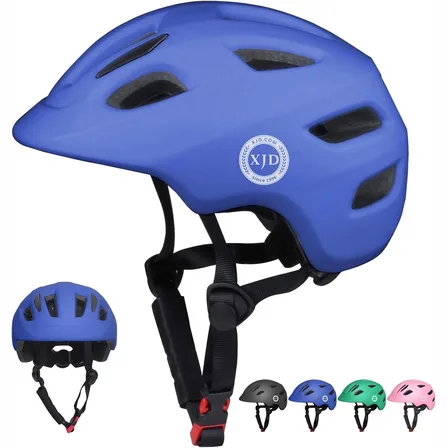
Blue XJD Kids' Bike Helmet, Adjustable Fit – Sizes XS & S
The Blue XJD Kids' Bike Helmet is a lightweight, adjustable helmet for toddlers …$20.39
-

Kids Bike Helmet by XJD for Boys & Girls – Black, Blue, Green, Pink, Purple
The XJD Kids Bike Helmet covers a wide 2-to-8-year age range thanks to two head-…$59.99
-

Kids Bike Helmet by XJD for Girls – Pink
The XJD Kids Bike Helmet in Pink is a lightweight multi-sport helmet for girls r…$59.99
$99