

Can you ride a bike while baby wearing
No. Do not ride a bicycle while wearing a baby in a sling, wrap or body carrier. A fall or sudden stop can expose the baby to crushing, impact and neck injury, while the carrier can restrict your balance, steering and view.
Why baby wearing and cycling do not mix
A baby carrier is designed for carrying a child on foot; it is not a bicycle restraint. It does not provide the protected seating, secure bicycle attachment or independent head protection needed for riding. Your body may also land on the baby during a fall.
Even a careful rider cannot eliminate potholes, loose surfaces, opening vehicle doors, mechanical problems or another road user’s mistake. Hard braking and evasive steering create forces that an infant cannot manage as an adult can. Wearing the baby on your back instead of your front does not resolve these hazards.
A bicycle helmet is not a workaround. A helmet must fit its individual wearer, sit level and have its straps adjusted according to the manufacturer’s instructions. An adult helmet cannot protect a baby carried against the adult’s body, and a carrier must not interfere with the rider’s helmet, vision or movement.
What to compare before carrying a child by bicycle
If you want to cycle with a young passenger, stop first and compare purpose-built child-transport options rather than adapting a body carrier. Measure or verify the following:
- Child readiness: confirm that the child meets every developmental, age and size condition stated by the transport product’s manufacturer. If the manual does not permit your child’s current stage, do not use it.
- Rider control: check that the passenger system does not prevent you from mounting, dismounting, steering, braking or placing a foot down securely.
- Bicycle compatibility: match the bicycle, mounting points and child-transport system exactly as their manuals require.
- Limits and setup: follow the stated load limits, assembly instructions, fastener requirements and maintenance schedule. Do not estimate missing specifications.
- Helmet fit: use a properly fitting bicycle helmet for each person when appropriate, positioned level and strapped as its manufacturer directs.
If compatibility, assembly, load limits or torque values are unclear, use the exact manuals or ask a qualified bicycle mechanic. Until all requirements are satisfied, choose walking or another suitable form of transport.
When the supplied kids bike is relevant
The Black XJD Kids Bike for Boys – 12, 14 & 16 Inch Sizes is a training-wheel bike offered in 12 Inch, 14 Inch and 16 Inch labels. It is relevant only when an older child is ready to try and control a bicycle independently. It is not a baby carrier, passenger seat or solution for cycling while baby wearing.
These catalog options help answer the title by separating two different decisions: transporting a baby and fitting an independent child rider. The product can be considered for the second decision only, using its three available wheel sizes as starting points followed by an individual fit check.

Measure the child before choosing 12, 14 or 16 Inch
Measure the child’s standing height and inseam in the shoes normally worn for riding. Then have the child try the bicycle. Compare stand-over clearance, comfortable reach to the controls, ability to operate the brakes and current confidence. Never buy an oversized bicycle merely to allow room for growth.
| Wheel label | XBikes starting age | Rider-height starting point |
|---|---|---|
| 12 Inch | 3–4 | 34–40 in / 86–102 cm |
| 14 Inch | 3–6 | 37–45 in / 94–114 cm |
| 16 Inch | 4–7 | 40–48 in / 102–122 cm |
Overlapping ranges are comparison starting points, not proof that multiple sizes fit equally well. Height carries more weight than age, and the final choice depends on inseam, stand-over, reach, brake control and confidence. Treat “Kids” and “for Boys” in the exact catalog title as labeling, not evidence of fit or a restriction on who can ride it.
Make the next decision in the right order
- For today’s trip, leave the baby carrier off the bicycle and use a suitable alternative.
- If considering purpose-built bicycle transport later, check the child’s readiness and every manufacturer requirement before buying or riding.
- If the child is learning to ride independently, measure height and inseam, compare the 12, 14 and 16 Inch starting points, and arrange a real fit check.
- Reject any setup that compromises stand-over, reach, braking, balance or confidence; consult a qualified bicycle mechanic when the manuals do not give a clear answer.
The title-specific decision is straightforward: do not cycle while wearing your baby. Revisit cycling together only through equipment intended for child bicycle transport, or choose the listed training-wheel bike when the child—not the baby—is ready and properly fitted to ride independently.
Bikes for your next adventure
-
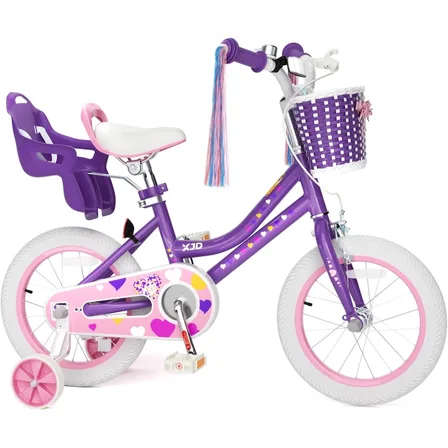
Purple XJD Girls' Bike with Doll Seat & Basket
For girls 71–122 cm tall (about ages 3–7), this XJD girls' bike in Purple pairs …$75.99
$99.99 -

Flower Pink XJD Girls Bike with Doll Seat & Basket
The XJD Flower Pink girls' bike is made for riders 71–122 cm tall (roughly ages …$69.99
-

XJD Pink Beach Cruiser for Girls – Rear Rack & V-Brake
The XJD Pink Beach Cruiser for girls is the step-up bike for riders who've outgr…$179.99
$209.99