

Can you safely ride a bicycle with an infant
You should ride a bicycle with an infant only when the child has the necessary head and neck control, a properly fitted helmet, and an approved child seat or trailer that is compatible with your bicycle. If any requirement is uncertain, do not ride yet.
Start with the infant, not the bicycle
“Infant” is not a sufficient readiness test. Children develop at different rates, so ask the child’s pediatrician whether the infant can tolerate the posture, vibration and duration involved. A child who cannot maintain a stable seated position and control the head while wearing a helmet is not ready for an upright bicycle seat.
Also check the minimum passenger requirements in the exact carrier manual and any applicable local helmet or passenger laws. Do not substitute a general age recommendation for those instructions. If the medical advice, law and manufacturer’s requirements do not all support the ride, wait.
Measure and compare before buying equipment
Measure the infant’s current weight and seated dimensions as directed by the proposed seat or trailer manufacturer. Compare them with that exact product’s passenger limits and harness adjustments. Measure head circumference according to the helmet maker’s fitting method, then try the helmet on the child.
A bicycle helmet should sit level, fit properly and use its straps according to the manufacturer’s instructions. It should remain secure without obstructing vision. Do not add padding, clothing or accessories that the helmet manufacturer does not permit.
For the adult bicycle, identify its exact model and size. Compare its frame, rack or axle configuration with the carrier manufacturer’s compatibility list. Confirm all mounting hardware, load limits and required clearances in both manuals. When compatibility, assembly or torque information is missing, use a qualified bicycle mechanic rather than improvising.
Choose between a child seat and a trailer carefully
A bicycle-mounted child seat changes the bicycle’s balance, starting, stopping and mounting behavior. A trailer changes its width, turning path and stopping distance. Neither format is automatically appropriate for every infant, bicycle or route.
- Child seat: confirm the child meets its passenger requirements, the bicycle accepts its mounting system, and the rider can hold and control the loaded bicycle.
- Trailer: confirm its infant-passenger rules, hitch compatibility, harness use and helmet instructions in the exact manual.
- Either choice: never exceed a stated limit, substitute unapproved mounting parts or assume visual similarity proves compatibility.
Before carrying the child, practice mounting, starting, steering, braking and stopping with equivalent permitted cargo secured according to the carrier instructions. Choose a short, low-traffic route and avoid conditions that exceed your current confidence or control.
Perform a check before every ride
- Inspect the bicycle, carrier attachment and restraint system using their manuals.
- Confirm the infant still meets the carrier’s stated passenger requirements.
- Fit the helmet level and secure its straps as instructed.
- Check that clothing, straps and loose items cannot reach wheels or moving parts.
- Test the brakes and steering before placing the child aboard.
- Stop immediately if the child’s posture changes, the equipment shifts or bicycle control feels uncertain.
Periodic maintenance matters because fasteners, tires and attachment points can change with use. Follow the maintenance intervals and procedures in the exact manuals. Ask a qualified bicycle mechanic to inspect anything loose, damaged, unfamiliar or difficult to assemble.
Why the supplied kids’ bicycle is not an infant carrier
The catalog option below helps separate two different questions: transporting an infant on an adult-controlled bicycle and fitting an older child to a bicycle they operate. The supplied product is a training-wheel bicycle offered in 12-, 14- and 16-inch sizes; it is not presented in the supplied facts as an infant seat, trailer or passenger-carrying solution.
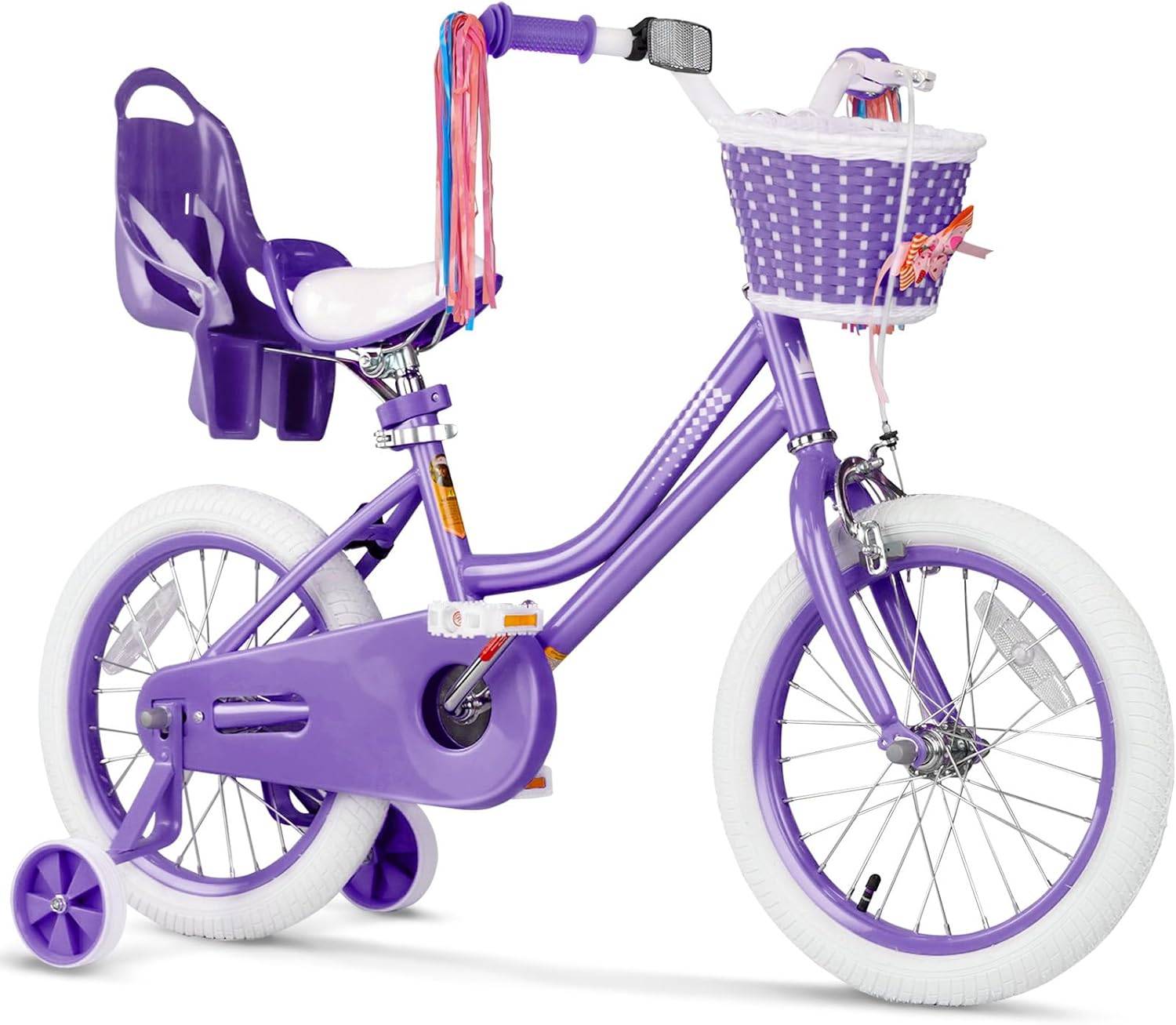
XJD Girls Bike for Kids Ages 3-8, 12/14/16 Inch with Training Wheels – Purple can serve only as a future child-rider comparison. Its title’s age wording is a catalog label, not evidence that it fits a particular child. XBikes’ starting points are: 12 inch for heights 34–40 in (86–102 cm), 14 inch for 37–45 in (94–114 cm), and 16 inch for 40–48 in (102–122 cm).
Those ranges never replace a physical fit check. For a future independent rider, measure height and inseam, then check stand-over clearance, reach, brake control and current confidence. Have the child try the bicycle, and do not buy an oversized model merely for growth. This product should not be treated as a substitute for infant-transport equipment.
Make the go-or-wait decision
Ride with the infant only after the pediatrician, applicable rules, carrier manual, helmet fit, bicycle compatibility and your loaded-bike control all support the plan. If one check fails or remains unknown, the appropriate next action is to wait, obtain the exact manuals, and have the setup assessed by a qualified bicycle mechanic.
Bikes for your next adventure
-

Kids Bike Helmet by XJD for Boys & Girls – Black, Blue, Green, Pink, Purple
The XJD Kids Bike Helmet covers a wide 2-to-8-year age range thanks to two head-…$59.99
-

Kids Bike Helmet by XJD for Girls – Pink
The XJD Kids Bike Helmet in Pink is a lightweight multi-sport helmet for girls r…$59.99
$99 -

XJD Kids Bike for Girls – Pink, 12/14/16/20 Inch with Training Wheels
The XJD Kids Bike for Girls in Pink is a training-wheel bike built to carry your…$139
$159