

Can you wear a baby carrier while riding a bike
No. Do not wear a baby carrier while riding a bike. A fall, sudden stop or collision could expose the baby to crushing, impact or ejection risks.
Why a wearable carrier is not suitable on a bike
A baby carrier is designed around an adult who is walking, not balancing and controlling a bicycle. On a bike, the carrier can change your balance, restrict your movement and make it harder to look behind you or react quickly. The baby also occupies part of the space your body may need during an emergency dismount.
A front carrier can interfere with steering posture and your view of the controls. A back carrier places the child where you cannot monitor their position and may shift your center of gravity. Either arrangement leaves the baby attached to your body if you fall. Wearing a bicycle helmet yourself does not remove these risks, and an adult helmet cannot protect the baby.
What to do instead
Do not improvise by strapping a wearable carrier to the rider or bicycle. If you are considering equipment made specifically to carry a child by bicycle, first check its manual for the child’s minimum requirements, permitted bicycle types, mounting instructions and load limit. Confirm that the bicycle and carrying equipment are explicitly compatible. Have a qualified bicycle mechanic check the installation if any requirement is unclear.
Before riding, compare the child’s current measurements and developmental readiness with every requirement in the exact equipment manual. Also check local rules governing child passengers, helmets and where cycling with a passenger is permitted. If the child does not meet every stated requirement, choose another form of transport.
What to measure and compare
- Child measurements: Measure current height and weight, then compare them with the child-carrying equipment manual. Do not estimate from age alone.
- Rider control: Check that you can mount, dismount, steer, stop and put a foot down without the carrying setup obstructing you.
- Bicycle compatibility: Use only the mounting points, bicycle types and configurations permitted by both manuals.
- Helmet fit: Each rider who uses a bicycle helmet needs one that fits properly, sits level and has straps adjusted according to its manufacturer’s instructions.
- Condition and installation: Follow the manuals for inspection, assembly, maintenance and tightening. Use a qualified bicycle mechanic rather than inventing a procedure or torque value.
When these XBikes products are relevant
The supplied catalog products are children’s bicycles, not baby-passenger equipment, so none makes it appropriate to wear a baby carrier while cycling. They become relevant later as comparison points when a child is ready to ride independently: their available wheel-size labels can be compared with the child’s measured height, inseam, reach, brake control and confidence.
 XJD Boys & Girls BMX Bike with Training Wheels, 12/14/16" – Blue
A children’s BMX bike offered in 12 Inch, 14 Inch and 16 Inch options. It is relevant only when comparing sizes for a child ready to ride independently, not as equipment for carrying a baby.
 XJD Pink Beach Cruiser for Girls – Rear Rack & V-Brake
Available in 20 Inch, 24 Inch and 26 Inch options for independent-rider fit comparisons. Its listed rear rack must not be treated as proof of compatibility with a child seat or carrier.
 Girls' Training Wheel Bike by XJD with Basket – Purple
A training-wheel bicycle offered in 14 Inch, 16 Inch and 20 Inch options. It can inform a later independent-riding fit check but does not address or enable carrying a baby on an adult rider.
XJD Boys & Girls BMX Bike with Training Wheels, 12/14/16" – Blue is listed in 12 Inch, 14 Inch and 16 Inch options. Girls' Training Wheel Bike by XJD with Basket – Purple is listed in 14 Inch, 16 Inch and 20 Inch options. These ranges provide several starting points for a younger independent rider, but the individual fit check decides whether any option is appropriate.
XJD Pink Beach Cruiser for Girls – Rear Rack & V-Brake is listed in 20 Inch, 24 Inch and 26 Inch options. Its rear rack must not be assumed to accept a child seat or baby carrier: compatibility and load information were not supplied. Follow the exact product manual or ask a qualified bicycle mechanic before attaching anything.
Wheel size is only a starting point
| Wheel label | XBikes starting age | Rider-height starting point |
|---|---|---|
| 12 Inch | 3–4 | 34–40 in / 86–102 cm |
| 14 Inch | 3–6 | 37–45 in / 94–114 cm |
| 16 Inch | 4–7 | 40–48 in / 102–122 cm |
| 20 Inch | 7–12 | 48–60 in / 122–152 cm |
| 24 Inch | 10–14 | 54–64 in / 137–163 cm |
| 26 Inch | Youth and adults | Over 60 in / 153 cm |
Measure the child barefoot from floor to the top of the head. Measure inseam from the floor to the crotch while the child stands naturally. Then have the child try the bicycle. Check stand-over clearance, comfortable reach to the handlebar, reliable access to the brakes and the ability to start, stop and steer with current confidence. Do not buy an oversized bicycle merely to allow room for growth.
Make the decision before the ride
- Remove the wearable baby carrier from the cycling plan.
- If transporting the baby by bicycle is still being considered, identify purpose-built child-passenger equipment and read its complete requirements.
- Verify the child, bicycle and equipment against those requirements and applicable local rules.
- If any measurement, compatibility point or installation instruction is missing, do not ride until the manufacturer or a qualified bicycle mechanic resolves it.
For today’s decision, the answer remains no: do not wear the baby carrier on the bike. Use another transport option unless a purpose-built setup is confirmed suitable for the particular child and bicycle.
Bikes for your next adventure
-
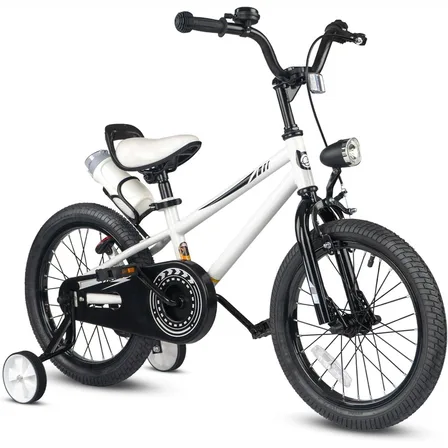
XJD Kids' Training Wheel Bike for Boys & Girls, 12/14/16 Inch – White
The XJD kids' training wheel bike in White is made for riders ages 3–8 (roughly …$169
$199 -

XJD Pink Beach Cruiser for Girls – Rear Rack & V-Brake
The XJD Pink Beach Cruiser for girls is the step-up bike for riders who've outgr…$179.99
$209.99 -

Kids Bike Helmet by XJD for Boys & Girls – Black, Blue, Green, Pink, Purple
The XJD Kids Bike Helmet covers a wide 2-to-8-year age range thanks to two head-…$59.99