

How big a bike for 9 year old
For most 9-year-olds, start with an 18-inch or 20-inch bike: compare the child's measured height, then confirm inseam clearance, reach, brake control and confidence in person. An 18-inch bike starts at 43–52 in (109–132 cm); a 20-inch bike starts at 48–60 in (122–152 cm).
Choose the starting size by measured height
Age narrows the search, but it does not establish fit. Under the XBikes starting points, both 18-inch and 20-inch wheels can include age nine. A shorter 9-year-old may begin with 18 inches, while a child measuring at least 48 in (122 cm) may begin with 20 inches.
| Wheel size | Starting age range | Rider height | Relevance at age 9 |
|---|---|---|---|
| 18 Inch | Ages 5–9 | 43–52 in / 109–132 cm | Check for a shorter rider |
| 20 Inch | Ages 7–12 | 48–60 in / 122–152 cm | Check for many riders this age |
| 24 Inch | Ages 10–14 | 54–64 in / 137–163 cm | Consider only if height and fit support it |
The ranges overlap deliberately. If the child is 48–52 in (122–132 cm), compare an 18-inch and a 20-inch bike in person rather than deciding from the chart alone. If the child is already 54 in (137 cm) or taller, a 24-inch bike becomes another starting point, despite the age label beginning at ten.
Measure before comparing bicycles
- Measure standing height: Have the child stand without shoes against a wall, looking straight ahead. Record the floor-to-top-of-head measurement.
- Measure inseam: With feet slightly apart, measure from the floor to the crotch. Use this measurement to assess clearance over the actual bicycle, not to calculate a wheel size from an unsupported formula.
- Note current ability: Record whether the child starts, stops, steers and balances confidently. A hesitant rider may need a different fit choice than a practiced rider of the same height.
Take both measurements when shopping. Frame shapes and riding positions can differ even when wheel labels match, so “20 Inch” alone cannot confirm that the child can stand over or control a particular bicycle.
Perform the individual fit check
Have the child try the bicycle. Do not choose an oversized model merely to leave growing room. The right candidate should let the rider mount and dismount without struggling, stand over the frame with usable clearance, and reach the handlebar without stretching or locking the arms.
Next, check steering and braking. The child should turn the handlebar while remaining balanced and reach and operate the brake controls available on that exact bicycle. Watch for leaning, twisting, tiptoe dependence or loss of control. If any appear, compare another size or frame rather than assuming practice will correct an unsuitable fit.
How the supplied catalog option helps
The supplied catalog product, XJD Girls' Bike with Training Wheels, 12/14/16/20 Inch – Purple, is listed in 12 Inch, 14 Inch, 16 Inch and 20 Inch options. For this question, only its 20 Inch option falls within the XBikes age-nine starting range. It provides a relevant 20-inch comparison when the rider measures 48–60 in (122–152 cm), but its training-wheel category does not replace checking the child's present balance, confidence and fit. The smaller options are comparison points for smaller riders, not age-nine recommendations by themselves.

This catalog listing does not provide an 18 Inch or 24 Inch option. If the child's measurements point toward either size, the listed 20 Inch version is not an equivalent substitute. Compare a bicycle in the indicated size and complete the same stand-over, reach and control checks.
Decide between overlapping sizes
When two wheel sizes cover the child's height, prefer the bicycle the child can control now. Ask the rider to mount, start, steer, stop and dismount in a safe test area. Confirm that the child can look ahead while maintaining a comfortable grip and can use the bicycle's braking controls reliably.
Do not advance from 18 to 20 inches, or from 20 to 24 inches, solely because the larger bicycle may last longer. Conversely, do not remain with a smaller wheel if the actual bicycle restricts comfortable reach, pedaling or control. The physical trial resolves what the overlapping chart cannot.
Before the first ride
- Use a properly fitting bicycle helmet. It should sit level, with its straps adjusted according to the helmet manufacturer's instructions.
- Follow the exact bicycle manual for assembly, maintenance, load limits, compatibility and torque requirements.
- If assembly, adjustment or mechanical condition is uncertain, use a qualified bicycle mechanic.
- Repeat the fit check after a growth spurt or when control, reach or mounting becomes awkward.
For this 9-year-old, measure height and inseam today, shortlist 18 Inch at 43–52 in or 20 Inch at 48–60 in, and choose only after the child demonstrates comfortable stand-over, reach, braking and control on the exact bike.
Bikes for your next adventure
-

26-Inch XJD Beach Cruiser Bike for Girls – Purple, V-Brake
This XJD 26-inch purple beach cruiser is sized for big kids and teens — suggeste…$218.49
$229.99 -

Light Pink XJD Girls' Bicycle with Basket & Training Wheels
The Light Pink XJD Girls' Bicycle with Basket & Training Wheels is a retro-style…$109.99
$129.99 -
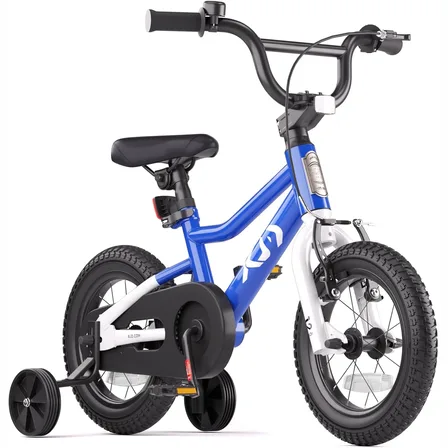
XJD Boys & Girls BMX Bike with Training Wheels, 12/14/16" – Blue
The XJD Boys & Girls BMX Bike in Blue is a first pedal bike for kids roughly age…$99.99
$119.99