

How big a bike for a 12 year old
For a 12-year-old, start by comparing a 20-inch and 24-inch bike: choose by measured height and fit, not age. A 20-inch bike starts at 48–60 in (122–152 cm), while a 24-inch bike starts at 54–64 in (137–163 cm). Riders over 60 in (153 cm) may also fit a 26-inch bike, but every choice needs an individual fit check.
Which wheel size should you check first?
Measure your child before shopping. Because the height ranges overlap, age 12 does not identify one automatic wheel size. Use these XBikes figures only as starting points:
| Wheel size | Age starting point | Rider height | Likely relevance at age 12 |
|---|---|---|---|
| 20 Inch | 7–12 | 48–60 in / 122–152 cm | Check for a shorter rider within the height range |
| 24 Inch | 10–14 | 54–64 in / 137–163 cm | Often the first comparison for this age |
| 26 Inch | Youth and adults | Over 60 in / 153 cm | Consider for a taller rider, subject to fit |
If your child is 58 in tall, for example, both the 20-inch and 24-inch height ranges include that measurement. The correct decision then depends on stand-over clearance, reach, brake control and confidence—not a rule that the larger wheel is automatically better.
Measure height and inseam
Measure height without shoes, with the child standing straight against a wall. Then measure inseam from the floor to the crotch while the child stands naturally. Record both measurements rather than estimating from clothing size or comparing the child with classmates.
Wheel-size tables use overall height, but inseam helps you assess the actual bicycle. With the child standing over the top tube, there should be usable clearance rather than contact. Frame shapes differ, so an inseam measurement cannot establish fit without trying the specific bike.
Do a hands-on fit check
Have the child try the bicycle. The American Academy of Pediatrics advises against buying an oversized bike merely for future growth. During the trial, check whether the rider can:
- stand over the frame without being pressed against the top tube;
- mount, start, steer and stop while remaining in control;
- reach the handlebars without excessive stretching or a cramped posture;
- operate the brakes comfortably and reliably with their hands;
- place their feet as intended for the bike while maintaining balance.
A child who looks stretched, cannot reach the brake controls, or struggles to steer should not move up simply because a larger size may last longer. Conversely, a bike that is visibly cramped or restricts steering is not made suitable by lowering the seat.
How the supplied 20-inch options relate
The supplied catalog contains two training-wheel bikes with 20-inch variants: Girls' Training Wheel Bike by XJD, 12–20 Inch Wheels – Blue and XJD Girls' Bike with Training Wheels, 12/14/16/20 Inch – Purple. They help parents compare a 20-inch option when the rider falls within the 48–60 in range and still needs that type of bike. Neither product has a 24-inch or 26-inch variant, so these are comparison points—not substitutes when the fit check indicates a larger wheel.
 Girls' Training Wheel Bike by XJD, 12–20 Inch Wheels – Blue
A 20-inch variant is relevant for a 12-year-old measuring 48–60 inches if an individual fit check and current confidence also support a training-wheel bike.
 XJD Girls' Bike with Training Wheels, 12/14/16/20 Inch – Purple
This training-wheel bike includes a 20-inch variant for comparison when the rider is 48–60 inches tall; its 12-, 14- and 16-inch variants are smaller starting points.
Both catalog listings offer 12 Inch, 14 Inch, 16 Inch and 20 Inch SKU labels and are categorized as training-wheel bikes. Those are the only supported comparison facts here. The smaller variants fall below the normal XBikes age and height starting points for a 12-year-old, and they should not be treated as equivalent to the 20-inch version.
Training wheels may be relevant when they match the child's present confidence and the exact product is suitable after a fit check. Do not infer brake type, load limit, adjustability or compatibility from the titles. Check the exact product manual, and use a qualified bicycle mechanic for assembly or adjustments when needed.
Check control before committing
Ask the child to ride in a traffic-free area under close adult supervision. Watch the first start, several turns and repeated controlled stops. Hesitation alone does not prove the bike is too large, but inability to reach the controls, steer predictably or stop reliably means the fit is not acceptable.
Also fit a bicycle helmet for every ride. U.S. Consumer Product Safety Commission guidance says it should fit properly, sit level and have its straps used according to the helmet manufacturer's instructions.
Make the size decision
- Measure height and inseam.
- Use 20, 24 or—above 60 in—26 inches as comparison starting points.
- Try the actual bicycle and verify stand-over clearance, reach and brake operation.
- Choose the size the child can control now; do not size up solely for growth.
For this 12-year-old, choose a supplied 20-inch model only if the rider is within its height range, can control it comfortably and training wheels suit current confidence. If a 24-inch or 26-inch bike fits better, continue the search in that exact size rather than treating either supplied product as an equal alternative.
Bikes for your next adventure
-

26-Inch XJD Beach Cruiser Bike for Girls – Purple, V-Brake
This XJD 26-inch purple beach cruiser is sized for big kids and teens — suggeste…$218.49
$229.99 -

Light Pink XJD Girls' Bicycle with Basket & Training Wheels
The Light Pink XJD Girls' Bicycle with Basket & Training Wheels is a retro-style…$109.99
$129.99 -
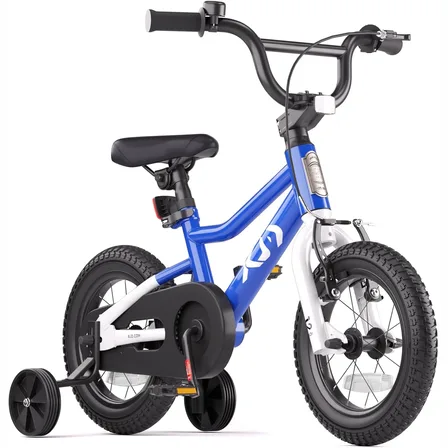
XJD Boys & Girls BMX Bike with Training Wheels, 12/14/16" – Blue
The XJD Boys & Girls BMX Bike in Blue is a first pedal bike for kids roughly age…$99.99
$119.99