

How early can a child ride a bike
Most children can start riding around age 3 on a 12-inch bike, but height, inseam, control and confidence—not birthday alone—decide readiness.
How early is realistic?
Using XBikes starting points, a 12-inch bicycle is the earliest listed size: ages 3–4 and rider height 34–40 inches (86–102 cm). Treat those numbers as a screening range, not permission to ride. A child should still be able to mount, stand over, steer, stop and reach the controls without stretching or becoming frightened.
A younger child who is below the height range or cannot control the bicycle should wait, even if eager. A three- or four-year-old within the range may also need more time. Starting later is preferable to putting a child on an oversized bicycle.
Measure before choosing a wheel size
First measure the child barefoot against a wall for current height. Then measure inseam from the floor to the crotch while the child stands naturally. Compare height with the table, but use the inseam during an actual fit check: the child needs comfortable clearance when standing over the bicycle.
| Wheel size | Age starting point | Rider height |
|---|---|---|
| 12 Inch | 3–4 | 34–40 in / 86–102 cm |
| 14 Inch | 3–6 | 37–45 in / 94–114 cm |
| 16 Inch | 4–7 | 40–48 in / 102–122 cm |
| 18 Inch | 5–9 | 43–52 in / 109–132 cm |
| 20 Inch | 7–12 | 48–60 in / 122–152 cm |
| 24 Inch | 10–14 | 54–64 in / 137–163 cm |
| 26 Inch | Youth and adults | Over 60 in / 153 cm |
Where ranges overlap, do not automatically choose the larger wheel. Compare both in person and favor the bicycle the child can control now. The American Academy of Pediatrics advises having the child try the bicycle rather than buying an oversized model for future growth.
Use a hands-on readiness check
A child is ready for the selected bicycle only when the complete fit works. During a supervised tryout, check that the rider can:
- Stand over the bicycle comfortably and remain balanced.
- Get on and off without being lifted or catching clothing.
- Reach the handlebars without locking the arms or leaning excessively.
- Turn the bars while maintaining a stable seated position.
- Reach and operate the bicycle’s braking controls reliably.
- Follow simple directions and stay attentive in the riding area.
If the child cannot complete one of these checks, compare a smaller size or postpone riding. Training wheels may support early practice, but their presence does not correct poor stand-over clearance, excessive reach or weak brake control.
Where the supplied bikes fit
The two supplied catalog options are relevant because both are training-wheel bikes with available 12-, 14- and 16-inch SKU labels, covering XBikes starting ranges from age 3 upward. They let parents compare nearby sizes while still requiring a hands-on fit check.
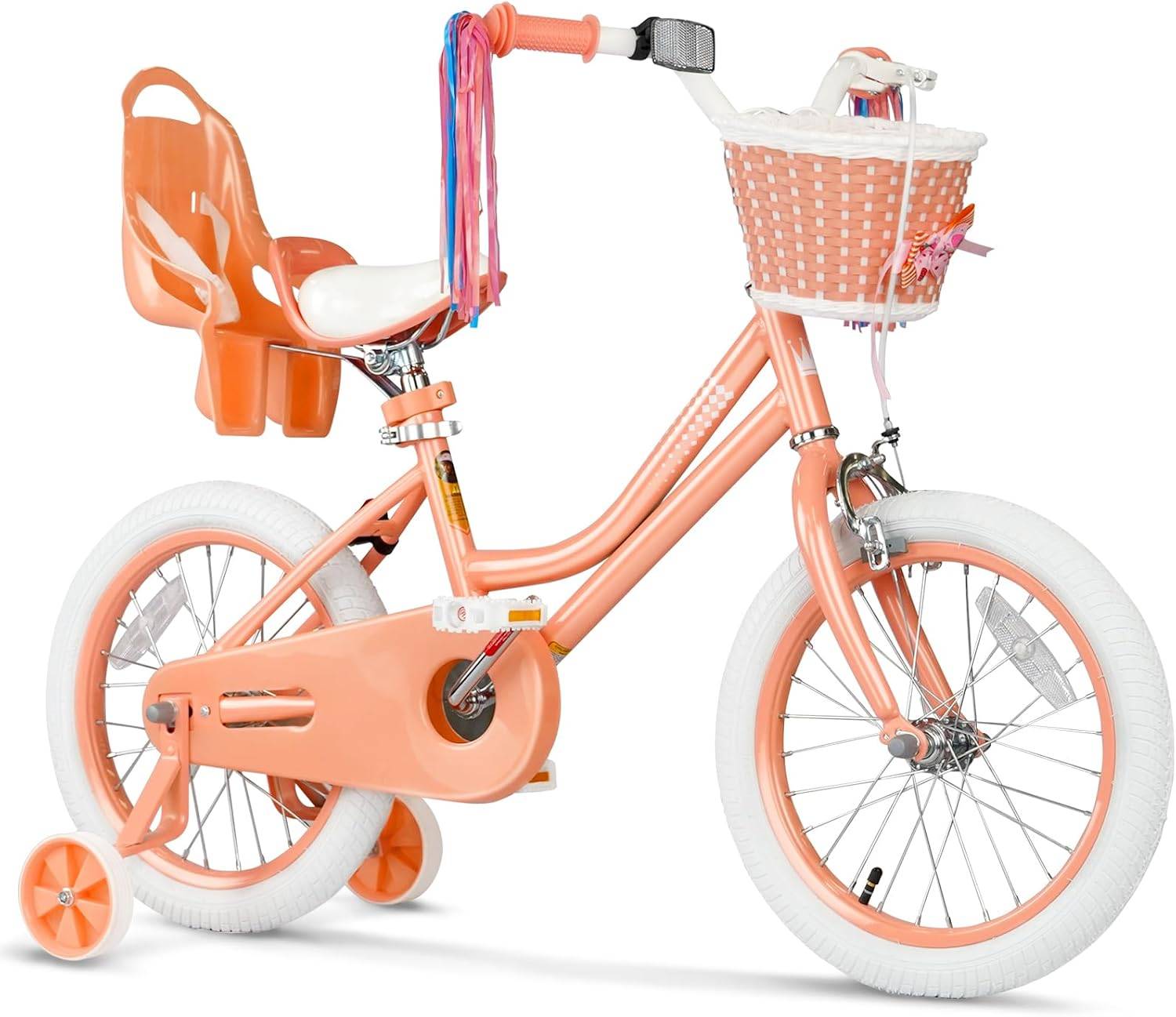 Girls 12/14/16 Inch Kids Bike by XJD with Training Wheels – Peach
A training-wheel bike with supplied 12-, 14- and 16-inch options. Its 12-inch label aligns with the earliest XBikes starting range, but the child still needs an individual height, inseam, reach and control check.
 XJD Light Purple Girls Bike with Basket, Training Wheels, 12/14/16/20 Inch
A training-wheel bike with supplied available labels of 12, 14 and 16 inches. Although 20 Inch appears in the exact title, it is not included in the supplied available SKU labels.
Girls 12/14/16 Inch Kids Bike by XJD with Training Wheels – Peach is listed in Training Wheel Bikes and has supplied available labels of 12 Inch, 14 Inch and 16 Inch. The 12-inch option is the earliest match in the XBikes chart; compare 14 or 16 inches only when the child’s measurements and control support them.
XJD Light Purple Girls Bike with Basket, Training Wheels, 12/14/16/20 Inch is also listed in Training Wheel Bikes. Although 20 Inch appears in its exact catalog title, the supplied available SKU labels are only 12 Inch, 14 Inch and 16 Inch. Do not assume a 20-inch option is currently selectable from the provided information.
Choose between these products only after identifying the right wheel-size range. Their supplied facts do not specify materials, weight, brake type, load limits, assembly details or compatibility. Consult the exact product manual or a qualified bicycle mechanic for those points.
Prepare the first rides
Use a level, open area away from traffic, driveways, slopes and obstacles. Keep initial sessions short enough that fatigue does not undermine steering or stopping. Stay close enough to intervene, and stop if the child repeatedly loses control or becomes anxious.
A properly fitted bicycle helmet is required for every ride. Following U.S. Consumer Product Safety Commission guidance, check that it fits properly, sits level and has straps adjusted according to the helmet manufacturer’s instructions. Clothing should not hang near moving parts, and closed-toe footwear helps protect the feet.
Make the decision now
If the child measures 34–40 inches (86–102 cm), begin by trying a 12-inch bike; do not purchase from age alone. Compare measured height, inseam clearance, reach, braking ability and confidence. If all five checks work, begin supervised practice. If they do not, choose a better-fitting size or wait rather than sizing up for growth.
Bikes for your next adventure
-

Kids Bike Helmet by XJD for Boys & Girls – Black, Blue, Green, Pink, Purple
The XJD Kids Bike Helmet covers a wide 2-to-8-year age range thanks to two head-…$59.99
-

Kids Bike Helmet by XJD for Girls – Pink
The XJD Kids Bike Helmet in Pink is a lightweight multi-sport helmet for girls r…$59.99
$99 -

XJD Kids Bike for Girls – Pink, 12/14/16/20 Inch with Training Wheels
The XJD Kids Bike for Girls in Pink is a training-wheel bike built to carry your…$139
$159