

How long is an infant bike seat good for
An infant bike seat is good only until the earliest of these points: its manual’s stated service life, the child outgrowing its limits, or damage, missing parts, a recall, or an unsafe fit making it unusable.
There is no single universal number of years
The usable life of a child-carrying bicycle seat depends on its exact manufacturer and model. Find the model label and manufacturing date, then read that seat’s current manual. Follow any stated expiration, maximum child size, maintenance schedule, bicycle compatibility rules and replacement requirements. If the label or manual cannot be identified, ask the manufacturer; do not guess from appearance alone.
Stop using the seat when any one limit is reached, even if the other limits have not been reached. A seat that remains within its calendar life may still be unsuitable because the child no longer fits, the mounting system no longer matches the bicycle, or a component is damaged.
What to measure and compare now
Measure the child as directed by the seat manual and compare the result with every stated limit. Depending on the model, the manual may specify body weight, height, developmental readiness, harness fit or other conditions. Do not invent a limit or transfer one from a different seat.
- Child fit: Confirm that the harness, foot supports and protective areas fit exactly as the manual describes. The child must not exceed any stated limit.
- Seat identity: Record the brand, model, manufacturing date and serial or batch information from its label.
- Bicycle compatibility: Compare the bicycle, rack or frame with the approved mounting requirements in the exact manual.
- Helmet fit: Use a properly fitting bicycle helmet that sits level, with straps adjusted according to its manufacturer’s instructions.
A child’s age by itself cannot establish whether the seat remains suitable. Physical fit, the seat’s stated limits and the child’s readiness all matter.
Inspect before the next ride
Do not continue using a seat with cracks, deformation, corrosion, loose or missing hardware, damaged straps or buckles, illegible safety labels, or a mount that shifts. Also stop if it has been involved in a crash or another event for which the manual requires inspection or replacement.
Check the manufacturer’s recall information for the exact model. Use only approved replacement parts. For assembly, fastener torque, rack capacity, maintenance or compatibility details that are not available on the label, follow the exact product manual or have a qualified bicycle mechanic examine the complete bicycle-and-seat setup.
When to retire or replace it
Retire the infant bike seat immediately if it has passed a stated service-life limit, the child exceeds any listed limit, the child cannot be secured as instructed, the mounting bicycle is incompatible, or the seat has damage that the manufacturer does not permit to be repaired. Missing documentation is a reason to pause use until the model and requirements can be verified.
A secondhand seat needs the same checks plus a known history. Confirm that all original required parts are present and that no unapproved modification has been made. If its age, crash history or identity cannot be established, replacement is the prudent next step.
Why the listed XBikes products are different
The supplied catalog products are children’s bicycles in the Training Wheel Bikes category, not verified infant-carrying bike seats. Their doll seats are accessories for dolls and must never be treated as child-passenger seats. They are relevant only when an older child is moving from being carried to riding a correctly fitted bicycle.
Purple XJD Girls' Bike with Doll Seat & Basket and Pink Girls' 12/14/16" Bike by XJD – Basket & Doll Seat both offer 12 Inch, 14 Inch and 16 Inch SKU labels. These are comparison options for an independently riding child, not substitutes for the infant bike seat named in the title.
 Purple XJD Girls' Bike with Doll Seat & Basket
A Training Wheel Bikes option offered in 12 Inch, 14 Inch and 16 Inch labels. Its doll seat is not an infant passenger seat; consider it only for a child ready to ride after an individual fit check.
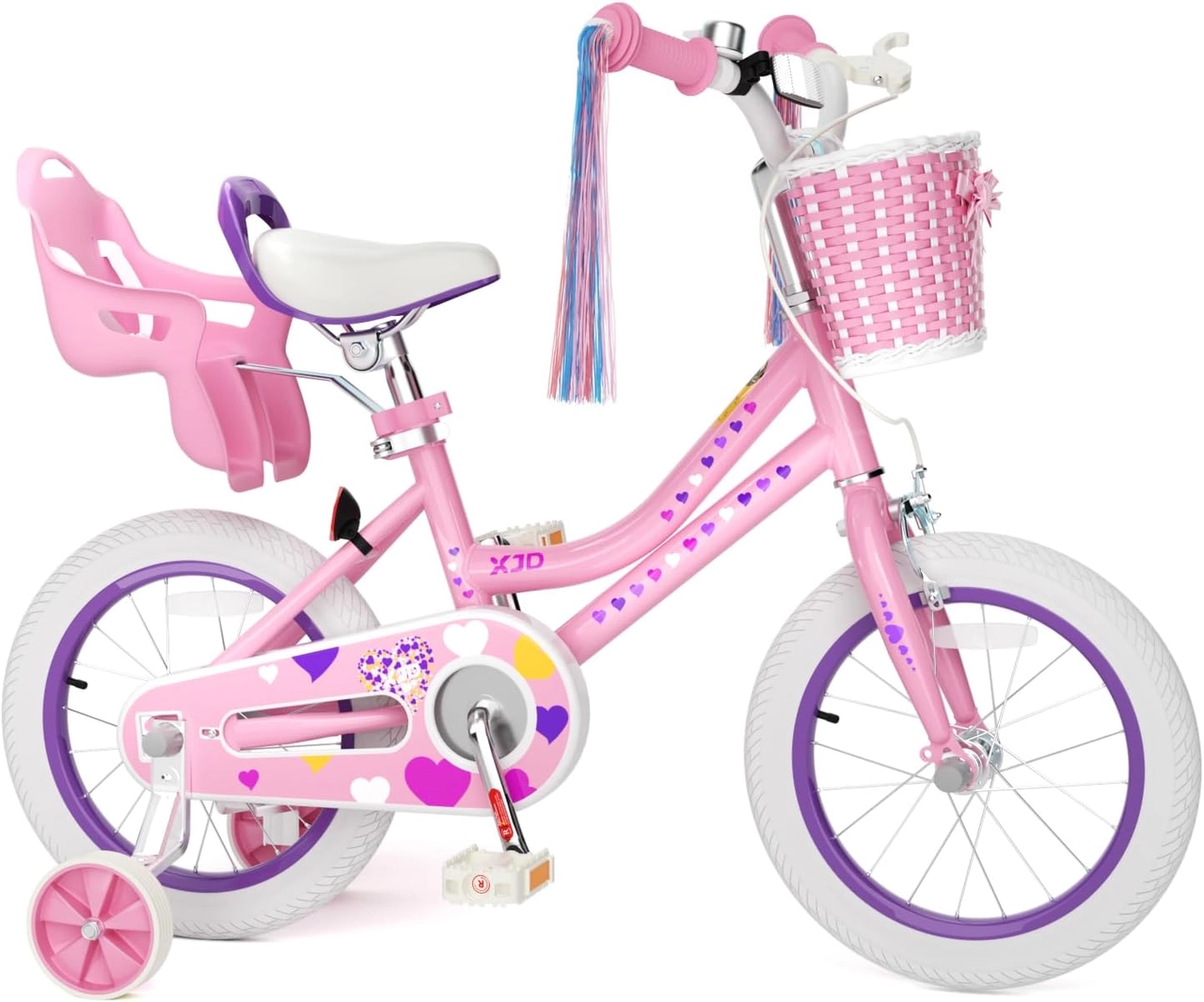 Pink Girls' 12/14/16" Bike by XJD – Basket & Doll Seat
Available with 12 Inch, 14 Inch and 16 Inch SKU labels in the Training Wheel Bikes category. Its doll seat must not carry an infant; the bicycle is relevant only to a correctly fitted independent rider.
If the child is ready for a bicycle instead
Start with measured height, then have the child try the bicycle. XBikes lists 12 Inch for 34–40 in (86–102 cm), usually ages 3–4; 14 Inch for 37–45 in (94–114 cm), usually ages 3–6; and 16 Inch for 40–48 in (102–122 cm), usually ages 4–7. These ranges are starting points, not proof of fit.
Check stand-over clearance, reach, brake control and present confidence. Do not buy an oversized bicycle merely to allow room for growth. Where height ranges overlap, the child’s actual control and fit should decide; one wheel size is not equivalent to another.
For the immediate decision, locate the infant seat’s label and manual, measure the child, inspect the entire setup and check recalls. Use it again only if every service-life, child-fit, condition and compatibility requirement is satisfied; otherwise retire it before the next ride.
Bikes for your next adventure
-

Kids Bike Helmet by XJD for Boys & Girls – Black, Blue, Green, Pink, Purple
The XJD Kids Bike Helmet covers a wide 2-to-8-year age range thanks to two head-…$59.99
-

Kids Bike Helmet by XJD for Girls – Pink
The XJD Kids Bike Helmet in Pink is a lightweight multi-sport helmet for girls r…$59.99
$99 -

XJD Kids Bike for Girls – Pink, 12/14/16/20 Inch with Training Wheels
The XJD Kids Bike for Girls in Pink is a training-wheel bike built to carry your…$139
$159