

How many inch bike for 11 year old
For most 11-year-olds, start by comparing 20-inch and 24-inch bikes. Measure the child first: 20-inch fits the 48–60 in range, while 24-inch starts at 54 in.
Choose by height, not age alone
At age 11, a rider can fall into either of two XBikes starting ranges. A 20-inch bike corresponds to ages 7–12 and rider heights of 48–60 in (122–152 cm). A 24-inch bike corresponds to ages 10–14 and heights of 54–64 in (137–163 cm).
The overlap from 54 to 60 in means height alone may leave two reasonable candidates. In that case, compare actual stand-over clearance, reach, brake control and confidence on each bike. Do not automatically move up to 24 inches because it should last longer; an oversized bicycle can be harder for a child to start, stop and steer.
| Measured rider height | Wheel-size starting point | What to do |
|---|---|---|
| 48–53 in (122–136 cm) | 20 Inch | Try a 20-inch bike and complete the control checks. |
| 54–60 in (137–152 cm) | 20 Inch or 24 Inch | Try both; choose by control and confidence, not growth room. |
| 61–64 in (155–163 cm) | 24 Inch | Start with 24 inches and verify the individual fit. |
| Over 60 in (153 cm) | 26 Inch may also enter the comparison | Compare carefully because height ranges overlap; wheel size does not establish fit by itself. |
These are starting points, not guarantees. Frame shape and adjustment can make two bicycles with the same wheel size feel different.
Measure the rider before shopping
Measure height without shoes, standing upright against a wall. Then measure inseam from the floor to the crotch while the child stands naturally. The XBikes numerical standard maps wheel size to height, but it does not provide a numerical inseam rule, so use inseam during an in-person stand-over check rather than inventing a cutoff.
Write down both measurements and bring the shoes the child normally wears while riding. If the rider is near a boundary, plan to try the sizes on both sides of it. Current skill matters too: a hesitant rider may control a smaller suitable bicycle more comfortably than a larger candidate.
Check the bicycle with the child on it
Have the child try the actual bicycle. The American Academy of Pediatrics guidance emphasizes individual fit and advises against buying an oversized bike merely for growth. During the trial, check that the child can:
- Stand over the bicycle without the frame preventing a stable stance.
- Reach the handlebar without stretching, locking the elbows or losing a centered posture.
- Turn the handlebar while remaining balanced and in control.
- Reach and operate the brakes confidently with the hands in a normal riding position.
- Start, stop and place a foot down without panic or a dramatic lean.
If either 20 or 24 inches fails these checks, it is not the right choice even when the age or height chart appears to match.
When the supplied XBikes option is relevant
The catalog option that directly helps with this comparison is the Pink XJD Beach Cruiser Bike, 24"/26", U-Brake. Its available labels are 24 Inch and 26 Inch, so its 24-inch version is relevant for an 11-year-old measuring 54–64 in (137–163 cm), subject to the fit checks above. The 26-inch version is only a comparison candidate for a rider over 60 in (153 cm), and it is not equivalent to the 24-inch version.
These catalog choices help answer the title because they let a taller 11-year-old compare the relevant 24-inch starting point with a 26-inch option when the measured height exceeds 60 in. They do not provide a 20-inch substitute for a shorter rider.

If the child measures below 54 in (137 cm), this supplied product is not the size starting point indicated by the XBikes chart; begin with a 20-inch bicycle instead. Do not choose its larger wheel labels solely because the rider is 11.
Complete the setup and safety check
After selecting a size, confirm adjustments on the exact bicycle rather than assuming the display setup is correct. For assembly, maintenance, compatibility, load limits and torque, follow the exact product manual or ask a qualified bicycle mechanic; those details are not provided here.
Add a bicycle helmet that fits properly, sits level and has straps adjusted according to its manufacturer’s instructions, consistent with U.S. Consumer Product Safety Commission guidance. Recheck brake reach and control after any fit adjustment.
The decision for an 11-year-old
Measure height now. Choose 20 inches as the starting point at 48–53 in, compare 20 and 24 inches at 54–60 in, and start with 24 inches at 61–64 in. If the rider is over 60 in, a 26-inch bike can enter the trial, but only choose it if stand-over, reach, braking and confident control all work on the actual bicycle.
Bikes for your next adventure
-
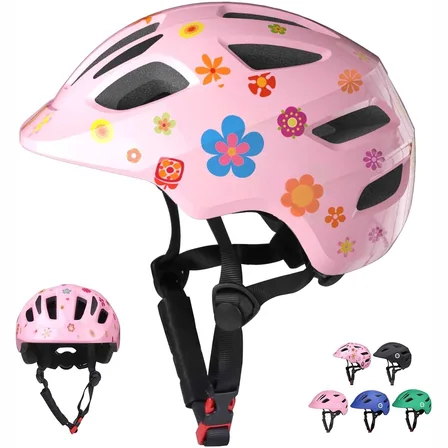
XJD Kids Bike Helmet for Girls, Pink Flowers, Adjustable (XS–S)
The XJD Kids Bike Helmet in Pink Flowers is an adjustable toddler-and-kids helme…$21.24
$24.99 -

Kids Bike Helmet by XJD for Boys & Girls – Black, Blue, Green, Pink, Purple
The XJD Kids Bike Helmet covers a wide 2-to-8-year age range thanks to two head-…$59.99
-

Kids Bike Helmet by XJD for Girls – Pink
The XJD Kids Bike Helmet in Pink is a lightweight multi-sport helmet for girls r…$59.99
$99