

How many inches bike for 9 year old
For most 9-year-olds, start with a 20-inch bike, then confirm the fit using the child’s height, inseam, reach, brake control and confidence. A shorter rider may still fit an 18-inch bike; do not move to 24 inches unless measurements and a hands-on fit check support it.
Choose by height before age
Age gives you a starting point, not a final size. Under the XBikes wheel-size guide, both 18-inch and 20-inch bikes can include age nine, but their rider-height ranges differ. Measure the child rather than choosing the larger option for future growth.
| Wheel size | Starting age | Rider height | Meaning for a 9-year-old |
|---|---|---|---|
| 18 Inch | Ages 5–9 | 43–52 in / 109–132 cm | Consider for a shorter rider whose fit and controls check out. |
| 20 Inch | Ages 7–12 | 48–60 in / 122–152 cm | The usual first size to assess at age nine. |
| 24 Inch | Ages 10–14 | 54–64 in / 137–163 cm | Consider only for a sufficiently tall rider who can control it confidently. |
The height ranges overlap because wheel diameter alone cannot describe frame shape, seat adjustment or reach. If the child is 48–52 inches tall, both 18-inch and 20-inch starting ranges apply, making an actual comparison especially important.
Measure height and inseam
- Height: Have the child stand straight without shoes against a wall. Mark the top of the head and measure from the floor.
- Inseam: With feet slightly apart, measure from the floor to the crotch. Use a firm, level book against the crotch to make the endpoint easier to identify.
- Record both: Compare standing height with the XBikes ranges above, then use inseam during the physical stand-over and starting-position checks.
Do not convert an age into a wheel size without these measurements. Two children who are both nine can need different bikes because their height, leg length, arm reach and riding experience differ.
Perform the hands-on fit check
Have the child try the exact bicycle. When standing over it, the child should not be forced against the frame. When seated in a practical starting position, the child should be able to get ready, push off and stop without the bicycle feeling too tall or unwieldy.
Next, check reach. The child should hold the handlebar without an uncomfortable stretch or a cramped posture. Ask them to operate the available brake controls: they need to reach and use them deliberately while keeping control of the handlebar. Also watch a start, a gentle turn and a controlled stop in a suitable supervised area.
If the child cannot stand over, steer, start or brake confidently, reject that fit even when the age or height chart appears to match. The American Academy of Pediatrics advises having the child try the bicycle and not buying an oversized bike merely for growth.
How the supplied products help
The catalog options below provide concrete 20-inch and 24-inch comparison points for this question. They help you assess the likely 20-inch starting choice against a larger size, but their SKU labels do not prove individual fit.
 XJD Pink Beach Cruiser for Girls – Rear Rack & V-Brake
Offers 20 Inch for the usual starting assessment, plus 24 Inch and 26 Inch comparison options that require the rider’s measurements and an individual control check.
 Girls' Training Wheel Bike by XJD with Basket – Purple
Offers 20 Inch as the relevant starting comparison for many nine-year-olds; 14 Inch and 16 Inch SKU labels are also supplied but do not establish fit.
Girls' Training Wheel Bike by XJD with Basket – Purple has 14 Inch, 16 Inch and 20 Inch SKU labels. For a typical nine-year-old assessment, only its 20 Inch option falls within the XBikes age starting point of 7–12 and height range of 48–60 inches. The smaller labels should not be selected solely because they appear on the same product.
XJD Pink Beach Cruiser for Girls – Rear Rack & V-Brake has 20 Inch, 24 Inch and 26 Inch SKU labels. Its 20 Inch option is relevant to the usual starting assessment. Its 24 Inch option is a larger comparison for riders measuring within 54–64 inches, but the XBikes starting age is 10–14, so a nine-year-old needs particularly careful individual verification. The 26 Inch label is for youth and adults over 60 inches / 153 cm and is not automatically appropriate because it is available.
No supplied product offers an 18 Inch SKU label. If measurements point toward 18 inches, these products are comparison points, not equal substitutes for that size.
Check controls, setup and helmet fit
Recheck reach and braking with the bicycle adjusted according to its exact product manual. For assembly, adjustments, compatibility, maintenance or torque instructions not stated in the catalog facts, follow that manual or use a qualified bicycle mechanic rather than guessing.
A bicycle helmet must fit properly, sit level and have its straps used according to the helmet manufacturer’s instructions, consistent with U.S. Consumer Product Safety Commission guidance. A helmet does not correct a bicycle that is too large or difficult to control.
Make the 9-year-old size decision
Measure first. If the child is 48–60 inches tall, try a 20-inch bike and approve it only after stand-over, reach, starting, steering and braking checks. If the child is 43–52 inches tall and struggles with 20 inches, compare an 18-inch bike elsewhere. Consider 24 inches only when the child is at least 54 inches tall and demonstrates comfortable, confident control—never simply to leave room for growth.
Bikes for your next adventure
-
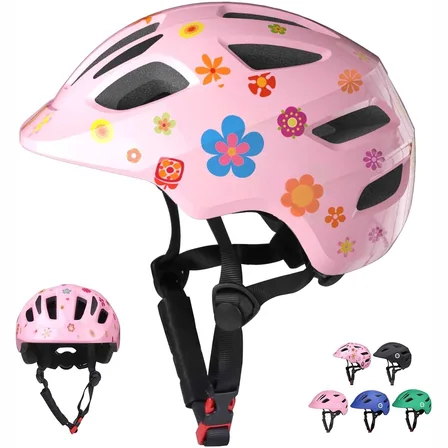
XJD Kids Bike Helmet for Girls, Pink Flowers, Adjustable (XS–S)
The XJD Kids Bike Helmet in Pink Flowers is an adjustable toddler-and-kids helme…$21.24
$24.99 -

Kids Bike Helmet by XJD for Boys & Girls – Black, Blue, Green, Pink, Purple
The XJD Kids Bike Helmet covers a wide 2-to-8-year age range thanks to two head-…$59.99
-

Kids Bike Helmet by XJD for Girls – Pink
The XJD Kids Bike Helmet in Pink is a lightweight multi-sport helmet for girls r…$59.99
$99