

How many inches for a 7 year old bike
For most 7-year-olds, start by comparing 18-inch and 20-inch bikes. Use measured height—not age alone: 18-inch suits 43–52 in (109–132 cm), while 20-inch suits 48–60 in (122–152 cm). A smaller rider may still fit a 16-inch bike.
Choose the starting size by height
Measure your child without shoes, standing straight against a wall. Compare that height with the XBikes starting points below. Where ranges overlap, either wheel size may be worth trying; the correct choice depends on stand-over clearance, reach, brake control and confidence.
| Wheel size | XBikes age starting point | Rider height | Relevance at age 7 |
|---|---|---|---|
| 16 Inch | Ages 4–7 | 40–48 in / 102–122 cm | Check for a shorter 7-year-old |
| 18 Inch | Ages 5–9 | 43–52 in / 109–132 cm | Common size to compare |
| 20 Inch | Ages 7–12 | 48–60 in / 122–152 cm | Common starting point from age 7 |
If the child is 48–52 inches tall, both the 18-inch and 20-inch ranges include that height. Do not automatically choose 20 inches for extra growing room. A bike that is too large can make starting, stopping and steering harder.
Measure inseam as well as total height
Height narrows the search, but inseam helps reveal whether the frame can be straddled comfortably. Have the child stand in socks with feet slightly apart. Place a rigid book upright between the legs, gently raise it to simulate a saddle, then measure from the floor to the top edge.
Compare that measurement with the bicycle manufacturer’s stand-over information or have the child try the exact bike. Frame shapes vary, so wheel diameter alone cannot establish clearance. When standing over the frame, the child should not be forced onto tiptoes or pressed against the top tube.
Perform the fit check on the actual bike
A practical fit check matters more than the number printed on the wheel. With an adult stabilizing the bicycle, ask the child to sit naturally and hold the grips.
- Stand-over: The child can straddle the frame with stable footing and comfortable clearance.
- Reach: The grips are reachable without locking the elbows, leaning excessively or stretching the torso.
- Brake control: If the bike has hand controls, the child can reach and operate them confidently while maintaining the grip.
- Starting and stopping: The child can mount, begin moving, steer and stop without the bike’s size overwhelming them.
- Confidence: The rider appears composed rather than fearful or dependent on an adult to control the bike.
If either candidate feels awkward, try the neighboring size instead of assuming the child will quickly grow into the larger one. The American Academy of Pediatrics’ guidance supports trying the bike, checking control and brake reach, and avoiding an oversized purchase made only for growth.
How the supplied 12-, 14- and 16-inch options compare
The catalog includes the XJD Girls Bike for Kids Ages 3-8, 12/14/16 Inch with Training Wheels – Purple in 12 Inch, 14 Inch and 16 Inch SKU labels. These options help answer the question by showing the smaller end of the comparison, particularly the 16-inch possibility for a shorter 7-year-old.
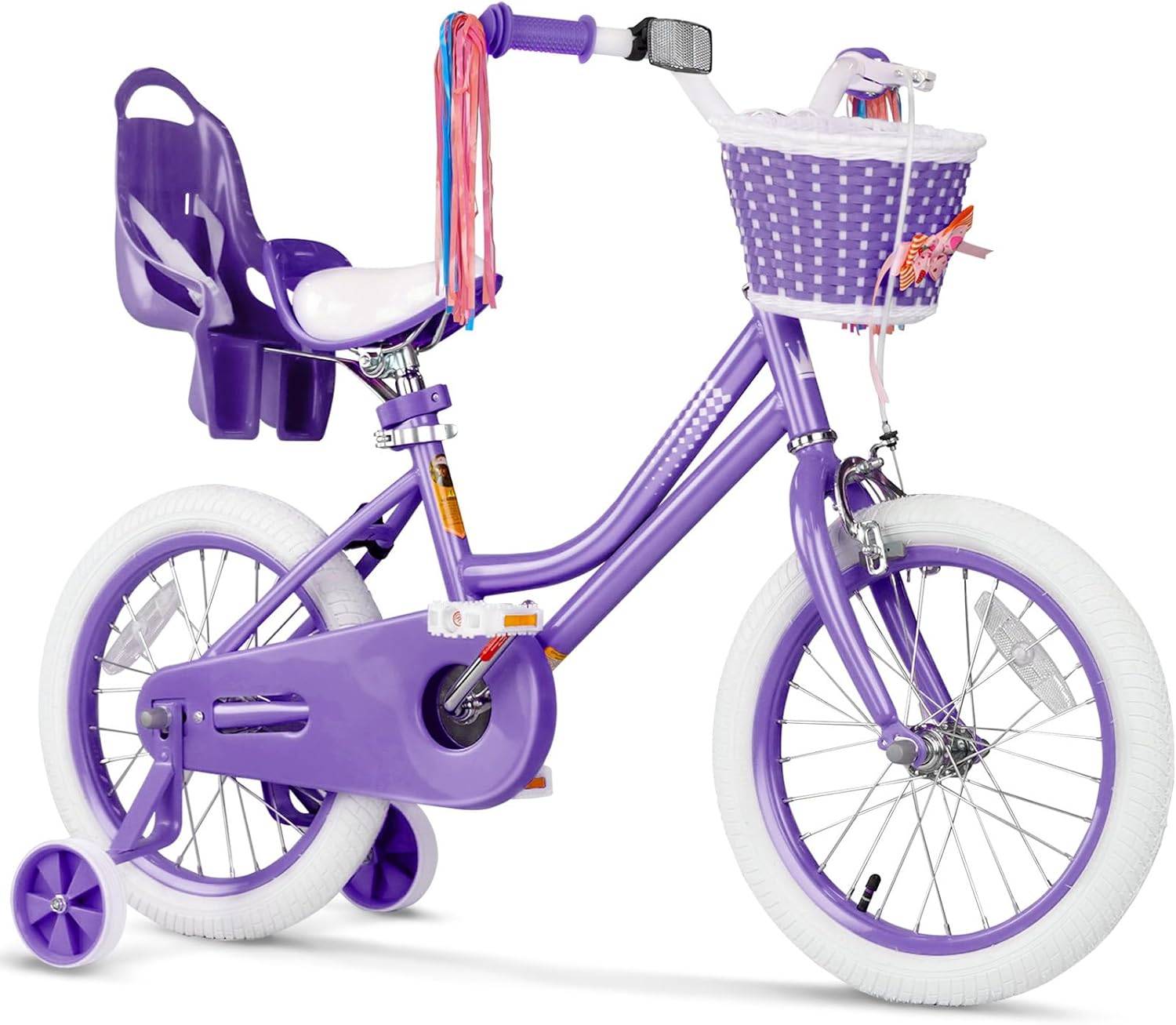
The age wording in that exact product title is a catalog label, not proof that every 7-year-old will fit. Under the XBikes standard, 16 Inch starts at ages 4–7 and heights of 40–48 inches (102–122 cm). It may therefore be relevant when the rider’s measured height and actual fit support it.
The 12 Inch range is ages 3–4 and 34–40 inches (86–102 cm); the 14 Inch range is ages 3–6 and 37–45 inches (94–114 cm). Those two options generally fall below the age-seven starting points, though measurements still govern. None of the supplied products offers an 18-inch or 20-inch SKU, so these catalog options are smaller-size comparison points, not substitutes for an 18-inch or 20-inch bike.
Check control, setup and helmet fit
Before riding, follow the exact bicycle manual for assembly, adjustment, maintenance, compatibility, load limits and torque. If any instruction is missing or the setup is uncertain, use a qualified bicycle mechanic rather than improvising a procedure.
A bicycle helmet also needs an individual fit. It should sit level and use its straps according to the helmet manufacturer’s instructions, consistent with U.S. Consumer Product Safety Commission guidance.
Make the decision
Measure height and inseam first. Compare 18 inches and 20 inches for most 7-year-olds, adding 16 inches when the child is within its 40–48-inch height range. Then choose only after the child demonstrates comfortable stand-over clearance, natural reach, reliable brake control and confident starts and stops on the exact bicycle.
Bikes for your next adventure
-
XJD Kids Bike Helmet for Girls, Pink Flowers, Adjustable (XS–S)
The XJD Kids Bike Helmet in Pink Flowers is an adjustable toddler-and-kids helme…$21.24
$24.99 -

Kids Bike Helmet by XJD for Boys & Girls – Black, Blue, Green, Pink, Purple
The XJD Kids Bike Helmet covers a wide 2-to-8-year age range thanks to two head-…$59.99
-

Kids Bike Helmet by XJD for Girls – Pink
The XJD Kids Bike Helmet in Pink is a lightweight multi-sport helmet for girls r…$59.99
$99