

How many inches is a kids bike
Kids’ bikes commonly range from 12 to 26 inches, measured by wheel diameter—not frame height. Measure your child’s height and inseam, then check fit and control in person.
What the inch number means
A 12-inch, 16-inch or 20-inch kids’ bike is named for the approximate diameter of its wheels. The number does not tell you the seat height, stand-over clearance or reach, and two bikes with the same wheel size may fit differently.
Use wheel size to narrow the search, then have the child try the actual bicycle. Do not choose an oversized bike merely to leave growing room. A bike that is too large can make starting, stopping, steering and reaching the brakes harder.
Kids’ bike inches by height and age
Start with measured rider height. Age is only a secondary clue because children of the same age can differ considerably in size, reach and confidence.
| Wheel size | Starting age | Rider height |
|---|---|---|
| 12 Inch | 3–4 | 34–40 in / 86–102 cm |
| 14 Inch | 3–6 | 37–45 in / 94–114 cm |
| 16 Inch | 4–7 | 40–48 in / 102–122 cm |
| 18 Inch | 5–9 | 43–52 in / 109–132 cm |
| 20 Inch | 7–12 | 48–60 in / 122–152 cm |
| 24 Inch | 10–14 | 54–64 in / 137–163 cm |
| 26 Inch | Youth and adults | Over 60 in / 153 cm |
Overlapping ranges are intentional. If your child falls into two rows, compare both sizes in person rather than choosing automatically by age.
Measure before comparing bikes
- Height: Have the child stand without shoes against a wall, looking straight ahead. Measure from the floor to the top of the head.
- Inseam: With feet slightly apart, place a firm, thin book between the legs and raise it gently to simulate a saddle. Measure from the floor to the book’s top edge.
- Compare: Use height to identify one or two starting wheel sizes in the table. Use inseam during the physical stand-over and saddle check; do not convert it into a wheel size with an invented formula.
Recheck measurements if the child is near a range boundary or has grown recently. Use the bike’s exact manual for adjustment limits, assembly and maintenance instructions, or ask a qualified bicycle mechanic.
What a proper fit should let the child do
Ask the child to straddle the bicycle and confirm there is usable clearance rather than uncomfortable contact. Seated, the child should be able to reach the handlebar without stretching or crowding. They should steer smoothly, keep control at low speed, and reach and operate the brakes confidently.
Also observe how the child starts, stops and gets on and off. Current confidence matters: a hesitant beginner may handle a different fit better than an experienced rider of identical height. If reach, stand-over or braking is doubtful, try another size or model.
How the supplied bikes help with comparison
The catalog options provide concrete 12-, 14-, 16- and 20-inch training-wheel bike choices to compare after measuring. They are relevant when those wheel sizes match the child’s starting range and the individual fit check succeeds.
 XJD Kids' Training Wheel Bike for Boys & Girls, 12/14/16 Inch – White
Offers supplied 12 Inch, 14 Inch and 16 Inch labels, making it relevant for comparing three adjacent training-wheel sizes after measuring rider height and confirming individual fit.
 Girls' Training Wheel Bike by XJD, 12–20 Inch Wheels – Blue
Offers supplied 12 Inch, 14 Inch, 16 Inch and 20 Inch labels, extending the training-wheel comparison through the 20-inch starting range; each option still requires an individual fit check.
XJD Kids' Training Wheel Bike for Boys & Girls, 12/14/16 Inch – White has supplied size labels of 12 Inch, 14 Inch and 16 Inch. It lets you compare three adjacent starting sizes for riders whose measured height falls within the corresponding table ranges.
Girls' Training Wheel Bike by XJD, 12–20 Inch Wheels – Blue has supplied labels of 12 Inch, 14 Inch, 16 Inch and 20 Inch. Its 20-inch option extends the comparison to the 48–60 in / 122–152 cm starting range.
Neither supplied product lists an 18-, 24- or 26-inch option. If your measurements point to one of those sizes, these products are comparison points only, not equal-size substitutes. Availability labels also do not prove fit, so the child must still try the exact bike.
Make the final size decision
Choose the wheel size indicated by measured height only after the child demonstrates comfortable stand-over clearance, natural reach, reliable steering and confident brake operation. Reject a larger size if it compromises control, even when it promises more growing room.
Before riding, provide a bicycle helmet that fits properly, sits level and has straps adjusted according to its manufacturer’s instructions. Your next step is simple: measure height and inseam, shortlist the matching inch sizes, and arrange an individual fit check before selecting the bike.
Bikes for your next adventure
-
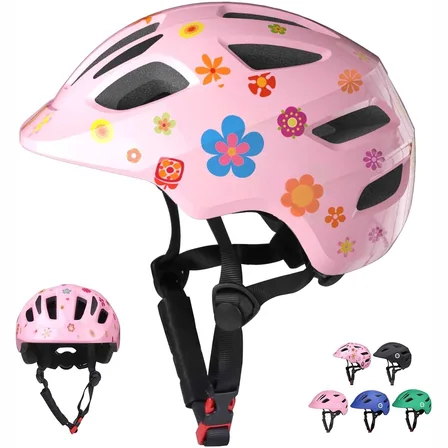
XJD Kids Bike Helmet for Girls, Pink Flowers, Adjustable (XS–S)
The XJD Kids Bike Helmet in Pink Flowers is an adjustable toddler-and-kids helme…$21.24
$24.99 -

Kids Bike Helmet by XJD for Boys & Girls – Black, Blue, Green, Pink, Purple
The XJD Kids Bike Helmet covers a wide 2-to-8-year age range thanks to two head-…$59.99
-

Kids Bike Helmet by XJD for Girls – Pink
The XJD Kids Bike Helmet in Pink is a lightweight multi-sport helmet for girls r…$59.99
$99