

How many inches of bicycle needed for 6 year old
Most 6-year-olds need a 16-inch or 18-inch bicycle, but height and fit decide: measure your child, then check stand-over, reach and brake control.
Start with height, not age
At age 6, the XBikes starting points overlap. A 14-inch bicycle covers rider heights of 37–45 inches (94–114 cm), a 16-inch covers 40–48 inches (102–122 cm), and an 18-inch covers 43–52 inches (109–132 cm). That means age alone cannot identify the correct wheel size.
Measure your child standing upright without shoes, with their back against a wall. Record the floor-to-top-of-head height. Then measure inseam from the floor to the crotch while the child stands with feet slightly apart. Use measured height to narrow the wheel-size range and inseam to judge clearance over the actual frame.
Compare the measurement with XBikes starting points
| Wheel size | XBikes age starting point | Rider height | Meaning for a 6-year-old |
|---|---|---|---|
| 14 Inch | Ages 3–6 | 37–45 in / 94–114 cm | Consider only when the child is within the height range and fits the bicycle comfortably. |
| 16 Inch | Ages 4–7 | 40–48 in / 102–122 cm | A common starting comparison at age 6, subject to an individual fit check. |
| 18 Inch | Ages 5–9 | 43–52 in / 109–132 cm | Compare when the child is tall enough and can fully control the bicycle. |
| 20 Inch | Ages 7–12 | 48–60 in / 122–152 cm | Relevant only for a child already within this height range who passes every control check. |
The ranges overlap because wheel diameter is only a starting point. Frame shape, saddle position and handlebar reach can make two bicycles with the same wheel label fit differently.
Have the child try the actual bicycle
Do not buy an oversized bicycle simply to leave room for growth. With the child wearing normal riding shoes, use the following checks on the exact bicycle:
- Stand-over: Ask the child to straddle the frame with both feet flat on the ground. There should be usable clearance rather than contact or a forced tiptoe stance.
- Saddle position: Confirm that the available adjustment permits a stable starting and stopping position while still allowing comfortable pedaling.
- Reach: The child should reach the handlebars without stretching, locking the elbows or leaning so far forward that steering becomes awkward.
- Brake control: The child must be able to reach and operate the bicycle's braking controls reliably. Do not assume a control will fit small hands.
- Confidence: Watch a supervised start, straight ride, turn and stop. If the bicycle feels intimidating or difficult to control, choose a better-fitting option even when the chart includes the child's height.
How the supplied 12-, 14- and 16-inch options help
The three supplied catalog bicycles each offer 12 Inch, 14 Inch and 16 Inch SKU labels, so they can help you compare the smaller overlapping sizes for a 6-year-old. They do not provide an 18-inch or 20-inch choice and should not be treated as substitutes when the fit check points to either of those sizes.
 Purple XJD Girls' Bike with Doll Seat & Basket
Available in 12 Inch, 14 Inch and 16 Inch labels. This Training Wheel Bikes option is relevant if the child's measured height and hands-on fit point to one of those sizes.
 Black XJD Kids' BMX Bicycle with Training Wheels
This Kids' BMX Bikes model is offered in 12 Inch, 14 Inch and 16 Inch labels. Use it as a comparison only after checking the child's height, stand-over, reach and brake control.
 Pink Girls' 12/14/16" Bike by XJD – Basket & Doll Seat
Listed under Training Wheel Bikes with 12 Inch, 14 Inch and 16 Inch labels. It can be compared when measurements indicate one of those sizes, but it does not supply an 18-inch option.
Purple XJD Girls' Bike with Doll Seat & Basket is listed under Training Wheel Bikes and is available in 12 Inch, 14 Inch and 16 Inch labels. Pink Girls' 12/14/16" Bike by XJD – Basket & Doll Seat has the same supplied size labels and category, making both relevant when measurements lead you to compare those three sizes.
Black XJD Kids' BMX Bicycle with Training Wheels is listed under Kids' BMX Bikes and also comes in 12 Inch, 14 Inch and 16 Inch labels. The supplied facts establish its category and available labels, but not its dimensions beyond wheel size. Compare the child's stand-over, reach and brake control on the exact selected version.
For many 6-year-olds, the 12-inch starting range of ages 3–4 and heights 34–40 inches (86–102 cm) will be too small. Still, use the child's actual height rather than rejecting or selecting it from age alone.
Complete the fit and safety decision
Once a likely size is identified, repeat the fit checks after any permitted saddle or handlebar adjustment. Follow the exact product manual for assembly, maintenance, compatibility, load limits and torque. If instructions are missing or the setup is uncertain, use a qualified bicycle mechanic rather than inventing an adjustment procedure.
Add a properly fitting bicycle helmet. It should sit level and its straps should be adjusted according to the helmet manufacturer's instructions. A helmet does not correct a bicycle that is too large, too small or difficult for the child to control.
What to do next for your 6-year-old
Measure height and inseam today. Begin with 16 Inch if the child is 40–48 inches tall, compare 18 Inch if they are 43–52 inches tall, and consider another listed size only when its height range applies. Then choose the bicycle on which your child can straddle, reach, steer and brake confidently—never the larger one merely for future growth.
Bikes for your next adventure
-
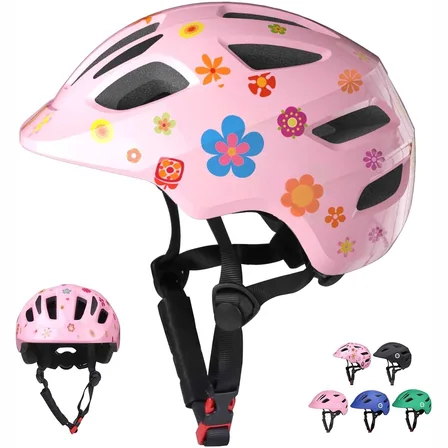
XJD Kids Bike Helmet for Girls, Pink Flowers, Adjustable (XS–S)
The XJD Kids Bike Helmet in Pink Flowers is an adjustable toddler-and-kids helme…$21.24
$24.99 -

Kids Bike Helmet by XJD for Boys & Girls – Black, Blue, Green, Pink, Purple
The XJD Kids Bike Helmet covers a wide 2-to-8-year age range thanks to two head-…$59.99
-

Kids Bike Helmet by XJD for Girls – Pink
The XJD Kids Bike Helmet in Pink is a lightweight multi-sport helmet for girls r…$59.99
$99