

How old can kids learn to ride a bike
Children can begin learning to ride at about age 3, but age alone does not determine readiness. Measure height, check fit and confirm confident control.
When is a child ready to learn?
The XBikes starting point for a 12-inch bike is ages 3–4 and a rider height of 34–40 inches (86–102 cm). That means many children can start learning around age 3. Some will be ready later, and that is entirely normal.
Readiness is practical rather than birthday-based. A child should be willing to practise, able to follow simple directions and comfortable sitting on the bicycle. Before choosing a size, measure the child’s height without shoes and assess inseam, reach, brake control and current confidence.
If the child appears stretched, cannot control the brakes or feels frightened by the bicycle’s height, do not move ahead merely because the age range appears suitable.
Compare height with these starting points
| Wheel size | Age starting point | Rider height |
|---|---|---|
| 12 Inch | 3–4 | 34–40 in / 86–102 cm |
| 14 Inch | 3–6 | 37–45 in / 94–114 cm |
| 16 Inch | 4–7 | 40–48 in / 102–122 cm |
| 18 Inch | 5–9 | 43–52 in / 109–132 cm |
| 20 Inch | 7–12 | 48–60 in / 122–152 cm |
| 24 Inch | 10–14 | 54–64 in / 137–163 cm |
| 26 Inch | Youth and adults | Over 60 in / 153 cm |
These ranges are comparison points, not a remote fitting method. When age and measured height suggest different sizes, prioritize measured height and an individual fit check. Overlapping ranges are useful because two children of the same age may need different sizes.
Check the bicycle in person
Have the child try the bicycle rather than buying from an age label alone. Check four things before deciding:
- Stand-over: the child needs appropriate clearance and should not feel trapped by the frame.
- Reach: the child should hold the controls without an awkward stretch or strained posture.
- Brakes: confirm the child can reach and operate the brakes with control.
- Confidence: ask the child to show that starting, steering, stopping and getting off feel manageable.
Do not buy an oversized bicycle solely to allow room for growth. A size that may last longer is not useful if the child cannot control it now. Follow the exact product manual for assembly, adjustments, compatibility, maintenance and load limits, or ask a qualified bicycle mechanic.
Where the supplied bike fits the decision
The Black XJD Kids Bike for Boys – 12, 14 & 16 Inch Sizes is a training-wheel bike offered in three supplied size labels: 12 Inch, 14 Inch and 16 Inch. Those options provide relevant comparison points for children within the corresponding XBikes height ranges. The title’s wording is a catalog name, not independent fit evidence; select only after checking the individual child.

Start by comparing the measured height with the three available labels: 12 Inch for 34–40 inches (86–102 cm), 14 Inch for 37–45 inches (94–114 cm), or 16 Inch for 40–48 inches (102–122 cm). Age can narrow the search, but it cannot confirm fit. If the child needs an 18-inch or larger starting point, this supplied product does not offer that stated wheel size and should not be treated as an equivalent substitute.
Make the first practice sessions manageable
- Choose a level practice area away from traffic and other hazards.
- Fit a bicycle helmet before riding. It should fit properly, sit level and have its straps used according to the helmet manufacturer’s instructions.
- Begin with brief practice focused on controlled starts, straight steering and deliberate stops.
- Stay close enough to help while allowing the child to build control without pressure.
Training wheels describe the supplied product category, but they do not replace a correct size, working controls or active supervision. Progress should be based on demonstrated balance and control rather than a deadline.
What to do next
Measure the child’s height, compare it with the wheel-size table, and arrange an individual fit check on the likely size. Proceed only when stand-over, reach, brake operation and confidence all work for that child. In short, learning may begin around age 3, but the right time is when the child fits and controls the bicycle—not simply when a birthday says so.
Bikes for your next adventure
-

Black XJD Kids Bike for Boys – 12, 14 & 16 Inch Sizes
For a son between roughly 3 and 8 years old, the XJD Kids Bike in Black covers t…$169
$199 -

Blue XJD Girls Bike with Training Wheels – 12/14/16 Inch
If you're shopping for a first pedal bike for a daughter roughly 3 to 8 years ol…$149
$169 -
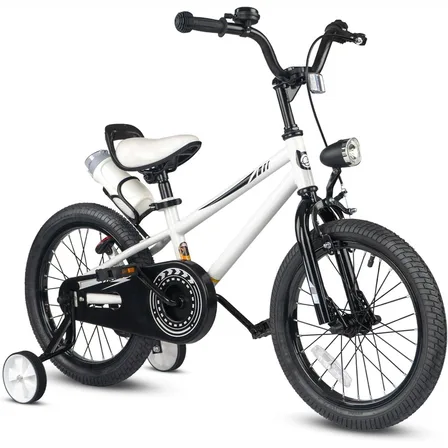
XJD Kids' Training Wheel Bike for Boys & Girls, 12/14/16 Inch – White
The XJD kids' training wheel bike in White is made for riders ages 3–8 (roughly …$169
$199