

How old does baby have to be for bike trailer
A baby should usually be at least 12 months old before riding in a bike trailer, and age alone is not enough: confirm the trailer manual’s minimums, stable unsupported sitting, strong head and neck control, and proper helmet fit.
Use readiness and the trailer manual together
There is no single birthday that makes every baby ready for every trailer. Begin with the exact trailer and bicycle manuals. Check their passenger age, weight, seating, harness and compatibility requirements. If the child does not meet every stated condition, wait.
The child must be able to sit upright without support and keep the head stable while wearing a helmet. A helmet adds weight and changes head movement, so head control without one is not the whole test. Premature birth, low muscle tone, developmental differences or medical concerns warrant a conversation with the child’s pediatrician before riding.
Do not use an infant insert, car seat or improvised padding unless the trailer manufacturer expressly permits that exact setup for cycling. An accessory intended for strolling does not automatically make it suitable while the trailer is attached to a bicycle.
What to measure and compare
- Child’s age and weight: Compare both with the trailer manual’s stated minimum and maximum limits; do not estimate.
- Seated fit: Check that the child fits within the trailer’s harness and seating system exactly as its instructions describe.
- Headroom with a helmet: Make sure the helmet does not press against the trailer or force the head forward.
- Helmet fit: It should fit properly, sit level and have its straps adjusted according to the helmet manufacturer’s instructions.
- Towing compatibility: Confirm that the trailer hitch is approved for the towing bicycle. Follow both manuals for assembly, maintenance, load limits and attachment procedures, or ask a qualified bicycle mechanic.
A simple go, wait or ask decision
Go only when the baby is at least about 12 months old, meets every manual requirement, sits independently, controls the helmeted head consistently and fits the restraint correctly. Start with a short ride in a low-traffic setting and observe whether the child remains comfortably upright.
Wait if the child slumps, cannot maintain head position, is below any manual minimum, lacks adequate helmet clearance or does not fit the harness as directed. Do not compensate by loosening the restraint or changing the seating arrangement.
Ask the trailer manufacturer when the wording in the manual is unclear, a component is missing, or bicycle compatibility is uncertain. Use a qualified bicycle mechanic for an attachment or mechanical concern and the child’s pediatrician for developmental readiness.
How the supplied bikes relate to this question
The supplied XBikes products are bicycles rather than baby trailers, so none establishes when an infant can ride as a trailer passenger. They become relevant later as wheel-size comparison points for a child progressing toward an independently fitted bicycle; they are not substitutes for a trailer or for its manual.
 Pink 12/14/16/20" XJD Girls Bike with Training Wheels & Basket
A 12 Inch option is the nearest supplied independent-bike starting point, with an XBikes range of ages 3–4 and 34–40 in / 86–102 cm; it is not a baby trailer.
 26-Inch XJD Beach Cruiser Bike for Girls – Purple, V-Brake
Its supplied 20, 24 and 26 Inch variants are comparison points for later independent riding, not evidence of infant readiness or substitutes for a bike trailer.
 XJD 24-Inch Green Beach Cruiser Bike with U-Brake
The supplied 24 and 26 Inch variants suit comparison with larger-rider starting points only; this bicycle does not determine when a baby can ride in a trailer.
The Pink 12/14/16/20" XJD Girls Bike with Training Wheels & Basket offers 12, 14, 16 and 20 Inch catalog options. The 12 Inch size is the nearest listed starting point for a young independent rider, but the XBikes starting range is ages 3–4 and 34–40 in / 86–102 cm—far beyond trailer-age infancy.
The 26-Inch XJD Beach Cruiser Bike for Girls – Purple, V-Brake has supplied 20, 24 and 26 Inch variants across its listed colors. The XJD 24-Inch Green Beach Cruiser Bike with U-Brake is supplied in 24 and 26 Inch variants. Those sizes are comparison points for substantially taller riders, not baby-transport equipment.
When choosing an independent bike later
| Wheel size | XBikes age starting point | Rider height starting point |
|---|---|---|
| 12 Inch | 3–4 | 34–40 in / 86–102 cm |
| 14 Inch | 3–6 | 37–45 in / 94–114 cm |
| 16 Inch | 4–7 | 40–48 in / 102–122 cm |
| 20 Inch | 7–12 | 48–60 in / 122–152 cm |
| 24 Inch | 10–14 | 54–64 in / 137–163 cm |
| 26 Inch | Youth and adults | Over 60 in / 153 cm |
These are starting points, not automatic fit decisions. Measure the child’s height and inseam, then have the child try the bicycle. Check stand-over clearance, reach, brake control and current confidence. Do not buy an oversized bicycle merely for growth.
What to do next
Find the trailer’s exact model manual, record the baby’s age and weight, and test unsupported sitting and helmeted head control off the bicycle. Ride only when every requirement agrees; if even one does not, postpone the trailer ride.
Bikes for your next adventure
-

Kids Bike Helmet by XJD for Girls – Pink
The XJD Kids Bike Helmet in Pink is a lightweight multi-sport helmet for girls r…$59.99
$99 -

Blue XJD Kids Bike Helmet for Boys & Girls
The Blue XJD Kids Bike Helmet is a lightweight, adjustable multi-sport helmet fo…$59.99
$99 -
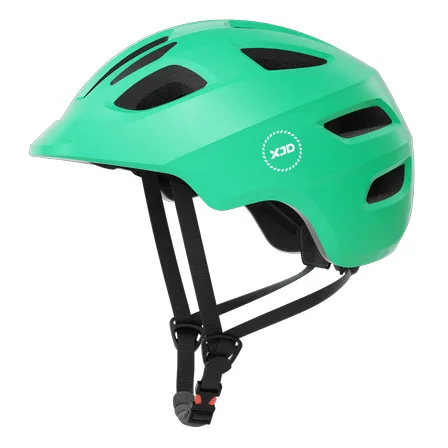
Green XJD Kids Bike Helmet for Boys & Girls
The Green XJD Kids Bike Helmet is a lightweight multi-sport helmet for toddlers …$59.99
$99