

How old does baby need to be for bike trailer
There is no single age when every baby is ready for a bike trailer. Use the trailer manual’s minimum age and fit rules, then confirm that your baby can maintain stable head and neck control while properly restrained.
Start with the trailer, not a birthday
Age alone cannot answer this safely. Find the exact make and model of the trailer and read its manual before riding. The manufacturer’s minimum age, passenger fit requirements, harness instructions and permitted seating configuration are the first checks. If the manual is missing, obtain the correct one from the manufacturer rather than relying on instructions for a similar trailer.
Do not use the trailer if your child is below its stated minimum, cannot fit its restraint system correctly or needs an unsupported seating arrangement that the manual does not permit. A stroller mode, infant insert or other accessory does not automatically mean that the same setup is approved for bicycle towing.
Check your baby’s physical readiness
Compare the manual’s requirements with the child in front of you. Your baby should be able to remain in the required riding position with stable head and neck control, including when wearing the required head protection. The harness must lie in the intended locations and secure the child without improvisation.
- Can the baby hold the head steady in the required seated position?
- Does the harness adjust correctly around the child?
- Is the child within every passenger limit stated in the manual?
- Does any required helmet fit without forcing the head into an unstable position?
- Does the trailer permit the exact seat, insert and towing configuration you plan to use?
If your baby’s developmental readiness is uncertain, pause and ask the child’s health professional. Passing an age threshold does not override poor head control or an unsuitable fit.
Inspect the complete towing setup
Confirm that the trailer is compatible with the towing bicycle and that its hitch, restraints and other parts are assembled exactly as directed. Follow the exact product manuals for assembly, maintenance, passenger or cargo limits and compatibility. When the documentation is unclear, have a qualified bicycle mechanic inspect the setup.
Before carrying a child, check the towing bicycle’s steering and brakes and practice with the empty trailer in a traffic-free area. A trailer changes the bicycle’s overall length, turning path and stopping behavior. Begin any child-carrying ride conservatively and avoid conditions that exceed the instructions for either product.
Fit the helmet correctly
Follow the helmet manufacturer’s instructions and any applicable trailer requirements. U.S. Consumer Product Safety Commission guidance says a bicycle helmet must fit properly, sit level and use its straps as directed by the manufacturer. A loose, tilted or incorrectly strapped helmet does not become suitable merely because it is the labeled size.
Check the fit on the child rather than purchasing for future growth. If the helmet or trailer seating makes it difficult for the baby to maintain the required position, do not ride until the fit problem is resolved.
Why the supplied bicycle is only a later-stage comparison
The supplied XBikes catalog does not include a baby trailer. The 26-Inch XJD Beach Cruiser Bike for Girls – Purple, V-Brake is therefore not a solution for carrying a baby and provides no evidence about trailer compatibility. Its listed 20-, 24- and 26-inch options are useful only as comparison points for the much later decision of fitting a child to a bicycle.
These catalog options help separate two easily confused questions: trailer readiness depends on the trailer manual and the baby’s individual development, while independent bicycle fit depends on the rider’s measurements, reach, brake control and confidence.

When those wheel sizes become relevant
| Wheel size | XBikes starting point | Fit reminder |
|---|---|---|
| 20 Inch | Ages 7–12; 48–60 in / 122–152 cm | Measure and test control |
| 24 Inch | Ages 10–14; 54–64 in / 137–163 cm | Check stand-over and reach |
| 26 Inch | Youth and adults over 60 in / 153 cm | Confirm brake control and confidence |
These are starting points, not guarantees. Have the rider try the bicycle, and do not choose an oversized bike simply to allow room for growth. Check measured height, inseam, stand-over clearance, reach, brake access and present confidence. The cruiser’s sizes must never be treated as evidence that a baby is ready for a trailer.
Make the decision now
- Locate the exact trailer manual and identify every passenger requirement.
- Compare those requirements with your baby’s current head control, seating stability and harness fit.
- Verify the towing bicycle, hitch and load compatibility from both manuals or with a qualified bicycle mechanic.
- Fit the required helmet according to its manufacturer’s directions.
If any requirement is unmet or uncertain, wait. Your baby is ready only when the manual permits the setup, the restraint and helmet fit correctly, and the child can maintain the required stable position—not simply because a particular birthday has arrived.
Bikes for your next adventure
-

Kids Bike Helmet by XJD for Girls – Pink
The XJD Kids Bike Helmet in Pink is a lightweight multi-sport helmet for girls r…$59.99
$99 -

Blue XJD Kids Bike Helmet for Boys & Girls
The Blue XJD Kids Bike Helmet is a lightweight, adjustable multi-sport helmet fo…$59.99
$99 -
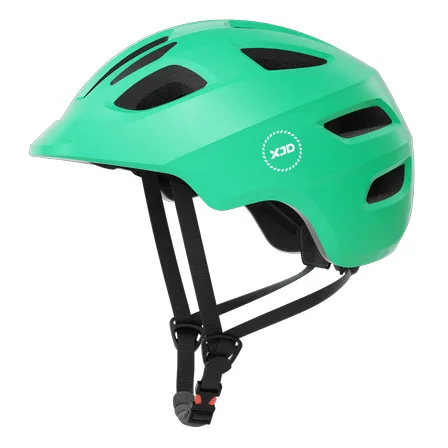
Green XJD Kids Bike Helmet for Boys & Girls
The Green XJD Kids Bike Helmet is a lightweight multi-sport helmet for toddlers …$59.99
$99