

How old for 18 inch bike
An 18-inch bike is a starting point for many children ages 5–9 who are 43–52 inches (109–132 cm) tall, but measured fit and control matter more than age.
Is an 18-inch bike the right size?
Use the age range only as an initial clue. First measure your child’s standing height without shoes and compare it with the 18-inch starting range: 43–52 inches (109–132 cm). Then have the child try the actual bicycle. Frame shapes, saddle adjustment and riding position can differ even when two bikes share the same wheel size.
Do not choose an oversized bicycle simply to leave room for growth. A bike that is too large can make starting, stopping, steering and reaching the brakes harder. If your child falls outside the height range, or cannot control the bike comfortably, compare another wheel size rather than relying on age.
What to measure before shopping
- Standing height: Measure from the floor to the top of the head while the child stands straight against a wall without shoes.
- Inseam: Measure from the floor to the crotch. Use it when checking whether the child can stand over the bicycle without the frame pressing into the body.
- Reach: With the child seated, check that the handlebars can be held without stretching, locking the elbows or leaning excessively.
- Brake control: Confirm that the child can reach and operate the bicycle’s brakes as designed while keeping control of the handlebars.
The inseam measurement does not select a wheel size by itself because no universal stand-over clearance applies to every frame. Compare it with the exact bicycle in person and follow that model’s manual for permitted adjustments.
How 18 inches compares with nearby sizes
| Wheel size | Starting age | Rider height |
|---|---|---|
| 16 Inch | 4–7 | 40–48 in / 102–122 cm |
| 18 Inch | 5–9 | 43–52 in / 109–132 cm |
| 20 Inch | 7–12 | 48–60 in / 122–152 cm |
The ranges overlap because children of the same age can have different proportions and confidence levels. A shorter or less confident rider near a boundary may control the smaller option more comfortably; a taller rider may be ready to try the larger option. Neither conclusion should be made from the chart alone.
What the child should do during a fit check
Have the child wear ordinary riding shoes and try the fully assembled bicycle in a clear, supervised area. Check that the child can stand over it, sit in a balanced position, hold the bars naturally and turn them without the knees or body interfering.
Next, ask the child to start, ride a short straight line, steer, stop and put a foot down without panic or a sudden loss of balance. Brake levers, if present on the bicycle being considered, must be within comfortable reach and usable with control. Current confidence matters: fitting within the height range does not prove readiness for a particular bike.
Assembly, adjustments, component compatibility and torque requirements must follow the exact product manual. If anything is unclear or the controls cannot be positioned correctly within the permitted adjustments, use a qualified bicycle mechanic.
How the supplied bikes help with the comparison
Neither supplied catalog product has an 18-inch option, so these bikes are nearest-size comparison points, not substitutes for an 18-inch bicycle. They help you compare the adjacent 16-inch and 20-inch starting ranges after measuring and conducting an individual fit check.
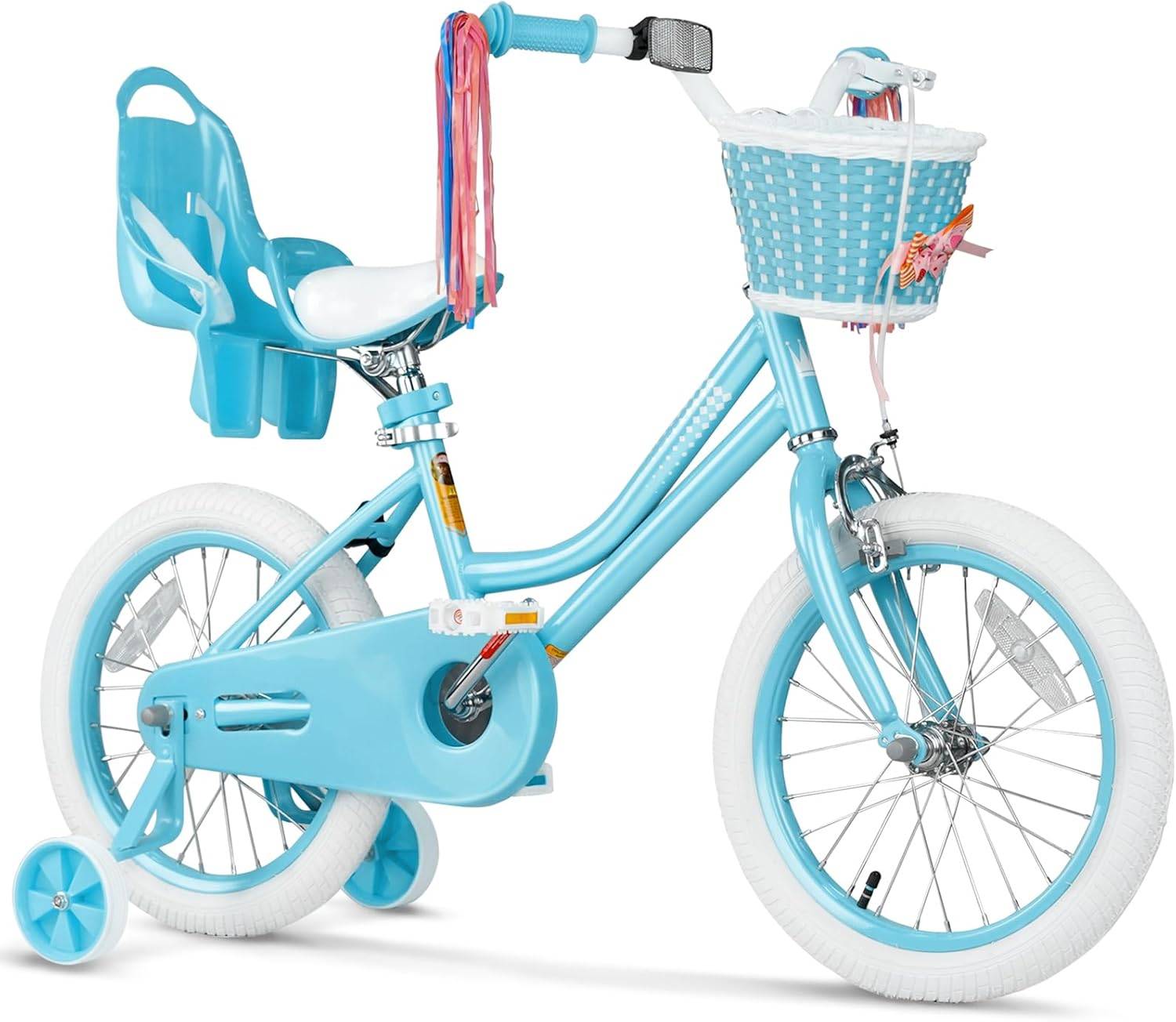 Blue XJD Girls Bike with Training Wheels – 12/14/16 Inch
A Training Wheel Bikes model offered in 12-inch, 14-inch and 16-inch labels. The 16-inch option is a nearest-smaller comparison point, not an 18-inch substitute, and still requires an individual fit check.
 Girls' Training Wheel Bike by XJD with Basket – Purple
A Training Wheel Bikes model offered in 14-inch, 16-inch and 20-inch labels. Its adjacent 16-inch and 20-inch options can help compare fit boundaries, but neither is equivalent to the requested 18-inch size.
Blue XJD Girls Bike with Training Wheels – 12/14/16 Inch is listed in the Training Wheel Bikes category with 12-inch, 14-inch and 16-inch SKU labels. Its 16-inch option provides the nearest smaller comparison for a child who is near the lower end of the 18-inch range or cannot yet control an 18-inch bike comfortably.
Girls' Training Wheel Bike by XJD with Basket – Purple is also listed in the Training Wheel Bikes category and has 14-inch, 16-inch and 20-inch SKU labels. Its 16-inch and 20-inch choices let a parent compare both adjacent wheel sizes, but neither should be treated as equivalent to 18 inches.
Use the relevant XBikes starting points for those comparisons: 16 inches corresponds to ages 4–7 and heights of 40–48 inches (102–122 cm), while 20 inches corresponds to ages 7–12 and heights of 48–60 inches (122–152 cm). Product titles and SKU labels do not establish an individual child’s fit.
Make the final 18-inch decision
Choose an 18-inch bike only when your child is broadly within the 43–52-inch height range and the actual bicycle passes the stand-over, reach, brake-control and riding-confidence checks. If it does not, compare the appropriate adjacent size instead of buying for future growth.
Before riding, provide a properly fitting bicycle helmet. It should sit level and its straps should be adjusted according to the helmet manufacturer’s instructions. Your next step is simple: record height and inseam, arrange an actual fit check, and accept 18 inches only if your child can start, steer and stop with calm control.
Bikes for your next adventure
-

Kids Bike Helmet by XJD for Boys & Girls – Black, Blue, Green, Pink, Purple
The XJD Kids Bike Helmet covers a wide 2-to-8-year age range thanks to two head-…$59.99
-

Kids Bike Helmet by XJD for Girls – Pink
The XJD Kids Bike Helmet in Pink is a lightweight multi-sport helmet for girls r…$59.99
$99 -

XJD Kids Bike for Girls – Pink, 12/14/16/20 Inch with Training Wheels
The XJD Kids Bike for Girls in Pink is a training-wheel bike built to carry your…$139
$159