

How old is a 16 inch bike for
A 16-inch bike is generally for children ages 4–7 who are 40–48 inches (102–122 cm) tall, but the child’s measurements and control matter more than age.
Is a 16-inch bike the right age?
The XBikes starting range for a 16-inch bike is ages 4–7. That range answers the age question, but it cannot confirm fit by itself. Children of the same age may differ substantially in height, leg length, reach and riding confidence.
Measure the child rather than choosing from a birthday alone. A rider outside the 40–48-inch (102–122 cm) height range should be compared with the neighboring wheel-size ranges, then fitted on the actual bicycle. Do not buy an oversized bicycle simply to allow room for growth.
What to measure before choosing
- Standing height: Measure the child without shoes, with their back straight against a wall. Compare the result with the 40–48-inch (102–122 cm) starting range.
- Inseam: Measure from the floor to the crotch while the child stands naturally. Compare that measurement with the bicycle’s stand-over clearance and adjustment information in its exact product manual.
- Reach: On the actual bike, check that the child can hold the handlebar without stretching, locking the elbows or leaning excessively forward.
- Brake control: If the bicycle has hand-operated controls, the child must be able to reach and operate them confidently. Consult the manual or a qualified bicycle mechanic for adjustments.
Wheel diameter does not reveal the frame shape, stand-over height or control position. Those details can vary, so measurements are a screening step rather than a substitute for trying the bicycle.
Compare the neighboring wheel sizes
| Wheel size | Starting age | Rider height |
|---|---|---|
| 14 Inch | 3–6 | 37–45 in / 94–114 cm |
| 16 Inch | 4–7 | 40–48 in / 102–122 cm |
| 18 Inch | 5–9 | 43–52 in / 109–132 cm |
| 20 Inch | 7–12 | 48–60 in / 122–152 cm |
The ranges overlap because age and height are only starting points. If a child falls in an overlap, favor the bicycle on which they can stand over the frame, reach the controls and ride with better balance and confidence. An 18-inch or 20-inch bicycle is not automatically the next choice merely because the child is near the top of an age band.
How to perform the fit check
Have the child try the fully assembled bicycle in a controlled area. First, confirm that they can stand over it without the frame preventing a stable stance. Next, seat them and assess whether they can start, stop, steer and put a foot down without struggling.
Watch the upper body as well as the legs. The rider should not need to lunge toward the handlebar, twist to reach a control or surrender steering control while braking. Current confidence matters: a cautious beginner may handle a correctly fitted smaller option more effectively than a larger bike chosen for future growth.
If the child cannot achieve a stable position or operate the controls reliably, that particular bicycle does not fit—even when their age and height appear in the 16-inch range. Follow the exact product manual for assembly and adjustments; use a qualified bicycle mechanic when the fit or setup remains uncertain.
How the supplied bicycles relate
Both supplied catalog options include a 16 Inch SKU, so they are directly relevant size options rather than nearest-size substitutes. The Light Pink XJD Girls' Bicycle with Basket & Training Wheels is listed in 12, 14, 16 and 20 Inch sizes. The Blue XJD Girls Bike with Training Wheels – 12/14/16 Inch is listed in 12, 14 and 16 Inch sizes. Both are categorized as Training Wheel Bikes. These facts help identify comparable 16-inch listings, but they do not establish an individual fit.
 Light Pink XJD Girls' Bicycle with Basket & Training Wheels
Available with a 16 Inch SKU and categorized as a Training Wheel Bike; its 12, 14 and 20 Inch options also provide catalog size comparisons, but individual fit still requires measurement and a trial.
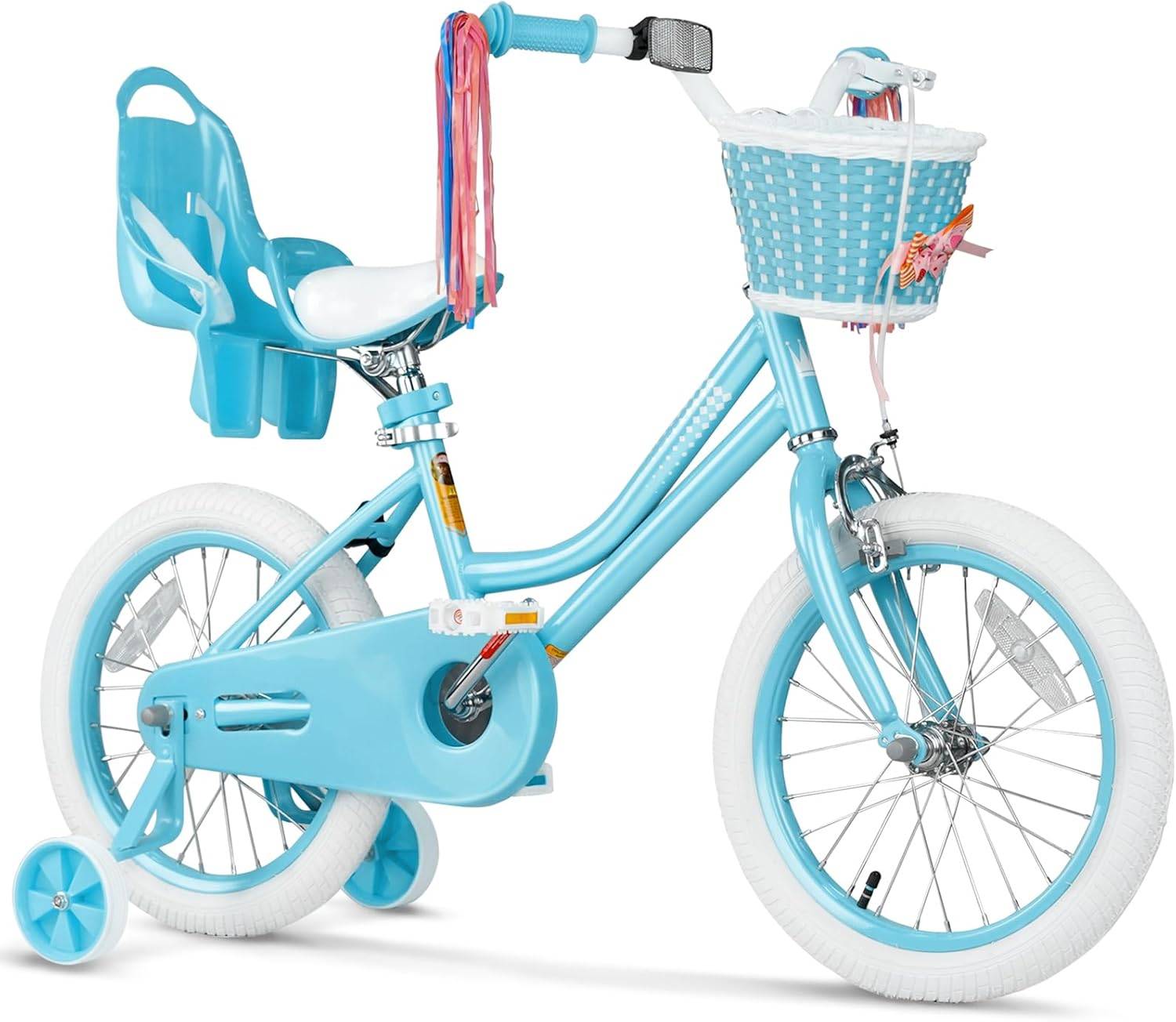 Blue XJD Girls Bike with Training Wheels – 12/14/16 Inch
Available in 12, 14 and 16 Inch SKUs and categorized as a Training Wheel Bike. The 16 Inch option is relevant to the question, subject to height, stand-over, reach, control and confidence checks.
Choose the 16 Inch label only after confirming the exact selected SKU and having the child complete the same height, stand-over, reach, brake-control and confidence checks. The catalog titles and available size labels do not provide frame dimensions, component specifications or permission to skip a trial fit.
Helmet and final decision
A properly fitting bicycle helmet should sit level and be secured using its straps according to the helmet manufacturer’s instructions. A helmet cannot correct an oversized or poorly controlled bicycle, so assess the bike and helmet separately.
The practical answer is: consider a 16-inch bike for a 4–7-year-old who measures 40–48 inches (102–122 cm), then approve the specific bicycle only if the child can stand over it, reach and operate its controls, and ride with present-day confidence.
Bikes for your next adventure
-

Kids Bike Helmet by XJD for Boys & Girls – Black, Blue, Green, Pink, Purple
The XJD Kids Bike Helmet covers a wide 2-to-8-year age range thanks to two head-…$59.99
-

Kids Bike Helmet by XJD for Girls – Pink
The XJD Kids Bike Helmet in Pink is a lightweight multi-sport helmet for girls r…$59.99
$99 -

XJD Kids Bike for Girls – Pink, 12/14/16/20 Inch with Training Wheels
The XJD Kids Bike for Girls in Pink is a training-wheel bike built to carry your…$139
$159