

How tall 16 inch bike
A 16-inch bike is a starting match for a child 40–48 inches (102–122 cm) tall, usually age 4–7, but the child must try it for fit.
What “16 inch” tells you
The 16-inch label refers to the bicycle’s wheel size, not the bike’s overall height and not the child’s inseam. Bikes with the same wheel size can still differ in frame shape, seat adjustment and reach. That is why rider height is useful for narrowing the choice, while an individual fit check decides whether a particular bicycle works.
Using the XBikes starting points, compare a measured rider height with the 40–48 inch (102–122 cm) range. Age 4–7 is only a secondary guide. A taller or shorter child of that age may need another wheel size, and confidence or control can also change the decision.
Measure the child before comparing bikes
Measure the child in ordinary riding clothes and flat shoes. Record these details:
- Standing height: Have the child stand straight against a wall, then measure from the floor to the top of the head.
- Inseam: Measure from the floor to the crotch with the feet slightly apart. This helps assess clearance and whether the child can get on and off confidently.
- Reach and hand control: These cannot be settled from a body measurement alone. They must be checked on the actual bicycle.
If the measured height is below 40 inches (102 cm) or above 48 inches (122 cm), do not assume a 16-inch bike will fit. Compare the child with the adjacent XBikes starting points: 14-inch bikes cover 37–45 inches (94–114 cm), while 18-inch bikes cover 43–52 inches (109–132 cm). Overlapping ranges mean a hands-on check matters; they do not make the sizes interchangeable.
Perform the fit check
Have the child try the exact bicycle rather than buying an oversized model for future growth. Check that the child can stand over it with practical clearance, mount and dismount without struggling, and remain balanced while seated. Follow the exact product manual when adjusting the seat or other components.
Next, watch the child hold the handlebar. The child should reach it without an exaggerated stretch or cramped posture, steer smoothly in both directions, and operate the fitted brakes comfortably. Brake reach and control must be assessed on the actual model; wheel size alone cannot confirm them.
Finally, consider current confidence. A child who falls within the height range but cannot start, stop, steer or dismount with control is not yet well matched to that setup. Ask a qualified bicycle mechanic for help if fit, adjustment, assembly or compatibility remains uncertain.
How the supplied 16-inch options compare
The supplied catalog choices are relevant because each offers a labeled 16 Inch SKU alongside smaller 12 Inch and 14 Inch versions, allowing parents to select the requested wheel-size option only after measuring and checking fit.
 Blue XJD Girls Bike with Training Wheels – 12/14/16 Inch
Offers a labeled 16 Inch SKU relevant to this size question, plus 12 Inch and 14 Inch choices. Confirm the child’s measurements and hands-on fit before selecting.
 XJD Boys 12/14/16" Training Wheel Bike – Blue
This Training Wheel Bikes listing includes 12 Inch, 14 Inch and 16 Inch SKU labels. Its 16 Inch option requires an individual stand-over, reach, brake-control and confidence check.
 Black XJD Kids Bike for Boys – 12, 14 & 16 Inch Sizes
Available with 12 Inch, 14 Inch and 16 Inch size labels in Training Wheel Bikes. Use the 16 Inch option only after measuring the rider and checking the actual bicycle.
Blue XJD Girls Bike with Training Wheels – 12/14/16 Inch is listed under Training Wheel Bikes and has 12 Inch, 14 Inch and 16 Inch SKU labels. Select the 16 Inch label when evaluating it for this question; the title itself does not establish fit.
XJD Boys 12/14/16" Training Wheel Bike – Blue is also a Training Wheel Bikes option with 12 Inch, 14 Inch and 16 Inch SKU labels. Its 16 Inch version is relevant to a measured child in the starting height range, subject to the same stand-over, reach, brake-control and confidence checks.
Black XJD Kids Bike for Boys – 12, 14 & 16 Inch Sizes likewise appears in Training Wheel Bikes and offers those three size labels. Nothing in the supplied facts establishes dimensions beyond wheel-size labels, so consult its exact manual for assembly, adjustments, load limits, maintenance and compatibility.
Do not size up merely for growth
An oversized bicycle can make mounting, stopping and steering harder. If a child is near a range boundary, compare the actual candidate sizes instead of automatically choosing the larger wheel. The correct choice is the bicycle on which the child can achieve suitable clearance, reach the controls, use the brakes and ride with present-day confidence.
A properly fitted bicycle helmet is also essential. It should sit level, fit properly and have its straps used according to the helmet manufacturer’s instructions. A helmet does not correct a poorly fitting bicycle.
Your 16-inch decision
Measure height and inseam now. If height is 40–48 inches (102–122 cm), try the specific 16-inch bike, verify stand-over clearance, reach, brake operation and confident control, then follow its manual for setup. If any check fails, compare an adjacent size rather than forcing the 16-inch choice or buying room to grow.
Bikes for your next adventure
-
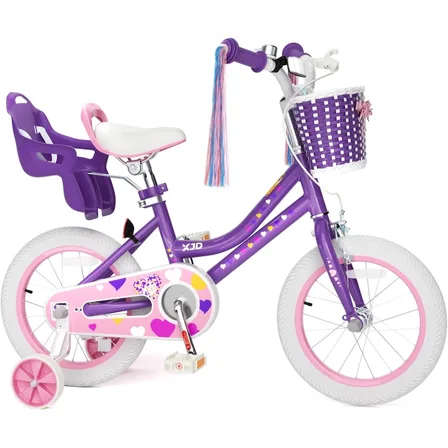
Purple XJD Girls' Bike with Doll Seat & Basket
For girls 71–122 cm tall (about ages 3–7), this XJD girls' bike in Purple pairs …$75.99
$99.99 -

Blue XJD Girls Bike with Training Wheels – 12/14/16 Inch
If you're shopping for a first pedal bike for a daughter roughly 3 to 8 years ol…$149
$169 -
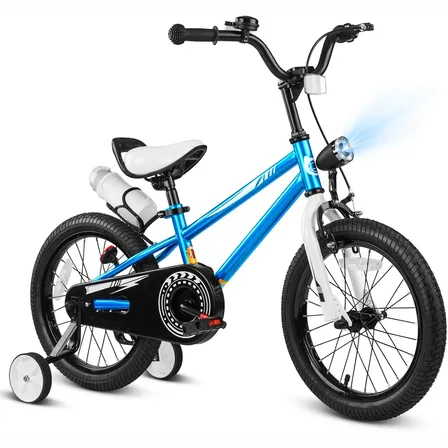
XJD Boys 12/14/16" Training Wheel Bike – Blue
The XJD Boys Bike in Blue is a training wheel bike for riders 71–122 cm tall—rou…$169
$199