

How old kids learn to ride bike
Children can learn to ride at different ages; readiness depends more on bike fit, balance, control and confidence than on a birthday. Measure first, choose the matching wheel-size range, check the child on the bike, then teach one skill at a time.
Start with measurements, not age
Measure the child’s standing height and inseam while they wear the shoes they will use for riding. Height narrows the wheel-size choices; inseam helps you judge whether the child can stand over and manage the bicycle comfortably. Age is only a starting point.
| Wheel size | Starting age | Rider height |
|---|---|---|
| 12 Inch | 3–4 | 34–40 in / 86–102 cm |
| 14 Inch | 3–6 | 37–45 in / 94–114 cm |
| 16 Inch | 4–7 | 40–48 in / 102–122 cm |
| 18 Inch | 5–9 | 43–52 in / 109–132 cm |
| 20 Inch | 7–12 | 48–60 in / 122–152 cm |
| 24 Inch | 10–14 | 54–64 in / 137–163 cm |
| 26 Inch | Youth and adults | Over 60 in / 153 cm |
If the child falls within overlapping ranges, compare both sizes in person. Do not automatically choose the larger bicycle for growth. A child who cannot control the larger option will have a harder time learning.
Check readiness on the actual bike
The child should try the bicycle before you decide. Following American Academy of Pediatrics guidance, check stand-over clearance, overall control and brake reach rather than relying on the size label alone.
- Standing: The child can stand over the bicycle without being trapped or forced onto tiptoes.
- Starting and stopping: They can get on, begin moving and put a foot down deliberately.
- Reach: They can hold the handlebars without stretching, twisting or locking their arms.
- Braking: They can reach and operate the bicycle’s braking controls reliably.
- Confidence: They remain attentive and willing to practise rather than freezing or panicking.
If any check fails, compare another size or setup. Wheel diameter alone does not prove that a bicycle fits.
How children learn the riding sequence
Use a flat, open area away from traffic and obstacles. Keep sessions short enough that fatigue does not replace useful practice.
- Learn stopping first. Before building speed, have the child practise using the available braking controls and putting a foot down.
- Develop balance. Let the child practise looking ahead, keeping the handlebars steady and moving without abrupt turns.
- Add propulsion. Once balance is improving, practise smooth starts and steady pedalling.
- Practise steering. Use wide, predictable turns before tighter changes of direction.
- Combine the skills. Repeat starting, riding a short line, turning and stopping under control.
Training wheels can support early pedalling confidence, but they do not replace the later task of balancing on two wheels. Reduce physical assistance only when the child can stop, steer and stay composed.
Where the supplied bike is relevant
The XJD Girls' Bike with Training Wheels, 12/14/16/20 Inch – Purple is relevant when a family wants to compare training-wheel bikes across four catalogued wheel labels: 12 Inch, 14 Inch, 16 Inch and 20 Inch. Those options cover several XBikes height starting points, but each still requires the individual stand-over, reach, brake-control and confidence checks above.

This product is not an 18 Inch, 24 Inch or 26 Inch option. If the child’s measurements point to one of those sizes, treat the listed versions only as comparison points, not equal substitutes. The words in the product title identify the catalog item; they do not independently establish fit.
Protect the learning session
Use a bicycle helmet that fits properly. U.S. Consumer Product Safety Commission guidance says it should sit level and its straps should be used according to the helmet manufacturer’s instructions. Recheck the fit whenever the child wears different headwear or the adjustment has shifted.
Before riding, confirm that the bicycle is assembled and functioning as its exact product manual requires. For maintenance, assembly, load limits, compatibility or torque details not supplied here, follow that manual or ask a qualified bicycle mechanic rather than guessing.
Make the age-and-fit decision
Use age to find a row, measured height to narrow the choice, and an in-person fit check to make the decision. If the child can stand over the bike, reach and use the controls, stop deliberately and practise without fear, begin with stopping and balance. If not, change the size or setup before teaching them to ride.
Bikes for your next adventure
-

Black XJD Kids Bike for Boys – 12, 14 & 16 Inch Sizes
For a son between roughly 3 and 8 years old, the XJD Kids Bike in Black covers t…$169
$199 -

Blue XJD Girls Bike with Training Wheels – 12/14/16 Inch
If you're shopping for a first pedal bike for a daughter roughly 3 to 8 years ol…$149
$169 -
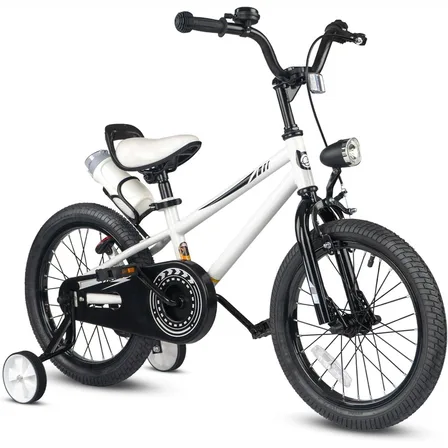
XJD Kids' Training Wheel Bike for Boys & Girls, 12/14/16 Inch – White
The XJD kids' training wheel bike in White is made for riders ages 3–8 (roughly …$169
$199