

How old should baby be in bike trailer
A baby should be at least 12 months old before riding in a bike trailer—and must also sit unsupported and support a properly fitted lightweight helmet.
Age is only the first requirement
The American Academy of Pediatrics advises that infants younger than 12 months should not be carried on a bicycle. After the first birthday, readiness depends on development rather than the calendar alone. A child should sit well without support and have enough neck strength to hold their head steady while wearing a lightweight bicycle helmet.
If your baby is 12 months or older but slumps, cannot remain upright, or struggles with the helmet's weight, wait. Prematurity, low muscle tone, developmental differences, or medical conditions can also change the decision. Ask your child's pediatrician when readiness is uncertain.
What to measure and compare
Before putting a child in the trailer, check the child and the exact trailer rather than relying on an age label.
- Unsupported sitting: Confirm that the child can stay upright without pillows, hands, or another person providing support.
- Head and neck control: With the helmet on, the child should hold their head steadily rather than tipping forward or sideways.
- Helmet fit: The helmet should match the child's current head size, sit level, and use its straps exactly as its manufacturer directs. Follow U.S. Consumer Product Safety Commission fitting guidance.
- Harness fit: Use the trailer's built-in restraint exactly as its manual specifies. It should secure the child without improvised cushions or unapproved inserts.
- Trailer limits: Compare the child's age and measurements with the precise minimum age, seating requirements, load limits, and helmet-clearance instructions in that trailer's manual.
If the child's helmet contacts the trailer or forces the head forward, the setup is not suitable. Do not remove the helmet to make the child fit.
Check the equipment before the first ride
Confirm that the trailer is intended for bicycle towing and compatible with the towing bicycle. Inspect the frame, wheels, tires, hitch, secondary retention device, harness, enclosure, and any safety flag specified by the manufacturer. Follow the exact manuals for assembly, attachment, tire pressure, maintenance, compatibility, and load limits; use a qualified bicycle mechanic if anything is unclear.
Seat and secure the child while the bicycle is stationary and supported by an adult. Check that clothing, fingers, feet, straps, and toys cannot reach wheels or moving parts. An adult should tow the trailer; never leave a child unattended in it.
Make the first outing a controlled test
- Practice towing the empty trailer in a traffic-free area so you can feel its width, turning path, braking distance, and handling.
- Place the helmeted child in the correct seating position and fasten the supplied harness according to the manual.
- Start with a short ride on a smooth, quiet route in suitable weather, using cautious speeds and wide, gradual turns.
- Stop promptly to check posture, comfort, temperature, helmet position, harness fit, and attachment points.
Do not ride if the child is slumping, distressed, unusually sleepy, overheated, or unable to keep their head stable. Avoid busy roads, rough surfaces, abrupt maneuvers, and conditions prohibited by the trailer manual. Remember that precautions reduce risk but cannot eliminate it.
How the supplied bicycle relates to this decision
The XJD Girls' Bike with Training Wheels, 12/14/16/20 Inch – Purple is a child-ridden training-wheel bicycle, not a baby bike trailer. Its available 12, 14, 16, and 20 Inch options do not replace a trailer or establish that a baby is ready to ride as a passenger. These catalog options are relevant only as later-stage comparison points, once a child is ready to operate a bicycle and can complete an individual fit check.

For that later transition, XBikes lists the 12 Inch size as a starting point for ages 3–4 and heights 34–40 in (86–102 cm); 14 Inch for ages 3–6 and 37–45 in (94–114 cm); 16 Inch for ages 4–7 and 40–48 in (102–122 cm); and 20 Inch for ages 7–12 and 48–60 in (122–152 cm). Overlapping ranges are not proof that sizes are interchangeable.
Measure the child's current height and inseam, then have them try the bicycle. Check stand-over clearance, reach, brake control, and confidence. Do not buy an oversized bicycle for growth. Because no trailer is supplied here, the featured bicycle is not a substitute for the equipment needed to carry a baby.
Your go-or-wait decision
Proceed only when the child is at least 12 months old, sits unsupported, holds their helmeted head steady, fits both helmet and harness correctly, and meets every requirement in the exact trailer manual. If any one check fails—or the manufacturer sets a stricter minimum—wait and reassess later.
Bikes for your next adventure
-

Kids Bike Helmet by XJD for Girls – Pink
The XJD Kids Bike Helmet in Pink is a lightweight multi-sport helmet for girls r…$59.99
$99 -

Blue XJD Kids Bike Helmet for Boys & Girls
The Blue XJD Kids Bike Helmet is a lightweight, adjustable multi-sport helmet fo…$59.99
$99 -
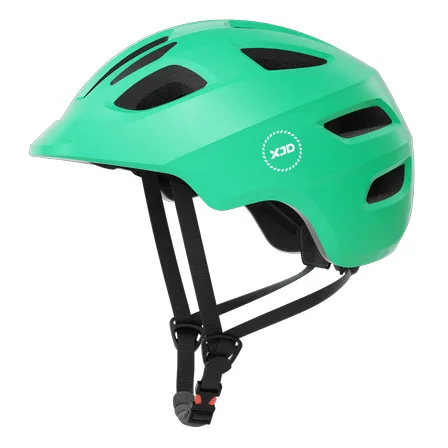
Green XJD Kids Bike Helmet for Boys & Girls
The Green XJD Kids Bike Helmet is a lightweight multi-sport helmet for toddlers …$59.99
$99