

How old should baby be to ride in bike trailer
There is no single age that makes every baby ready for a bike trailer. Wait until your child meets the trailer maker’s minimum age and developmental requirements, fits its harness correctly, and can maintain the head and seated posture required by the manual.
Read the trailer manual before using age as a shortcut
The correct threshold comes from the exact trailer and any infant-support accessory approved for it. Check the manufacturer’s instructions for minimum age, required physical development, permitted seating configuration, passenger limits, and whether cycling use has different rules from strolling use. An accessory must not be assumed to make a younger baby suitable for riding behind a bicycle.
If the manual is missing, unclear, or does not expressly allow your child’s current stage, do not ride yet. Obtain the instructions from the manufacturer or have the setup checked by a qualified bicycle mechanic. Do not guess at load limits, attachment compatibility, assembly steps or fastener torque.
What to assess and measure
Compare your child and the complete setup with the manual rather than relying on a birthday alone. Check these points before the first ride:
- Development: confirm that the baby has the head, neck and trunk control specified by the trailer manufacturer and can remain stable in the required seated position.
- Passenger measurements: measure current weight and height, then compare them with the exact model’s stated passenger limits. Leave age-based assumptions out of this comparison.
- Seated fit: check harness placement, shoulder position and headroom in the normal riding position. Include any helmet or approved insert exactly as the instructions require.
- Bike compatibility: verify that the hitch and trailer are approved for the towing bicycle and installed precisely as directed.
- Adult control: the rider must be comfortable starting, steering, braking and stopping with the trailer attached.
A bicycle helmet must fit properly, sit level and have its straps adjusted according to its manufacturer’s instructions. Follow the trailer manual on helmet use inside that specific enclosure; never use poor headroom or an awkward neck position just to make a helmet fit.
A practical first-ride check
- Assemble and attach the trailer according to its manual, including every required retention or backup connection.
- Place the child in the specified seating position and adjust the harness as instructed.
- Confirm that the child remains upright and comfortable, with adequate clearance and no forced head position.
- Inspect tires, wheels, hitch and bicycle brakes using the applicable manuals; ask a mechanic about anything uncertain.
- Practise towing the empty trailer in a traffic-free area, then make the first occupied ride short, smooth and away from traffic.
Stop if the child slumps, cannot maintain the required posture, appears distressed, or the trailer affects control beyond the rider’s confidence. Recheck fit as the child grows and whenever clothing, helmet, seating accessories or towing bicycle changes.
When the answer is “not yet”
Delay cycling if your baby falls below any manual requirement, lacks the specified postural control, cannot be secured correctly, or does not have enough seated clearance. Also wait when the towing setup has uncertain compatibility, damage, missing parts or unresolved assembly questions. A calendar milestone does not override any of these conditions.
If developmental readiness is uncertain, ask the child’s pediatric clinician about the child rather than treating a general age found online as approval. The trailer manufacturer remains the source for model-specific operating requirements.
How the supplied kids’ bikes relate
The catalog products below do not establish when a baby can ride in a trailer. They are relevant only as later, child-ridden bicycle comparison points: both are training-wheel bikes with labeled wheel-size choices, so parents can see that independent riding requires a separate height-based fit decision.
 XJD Kids Bike for Girls – Pink, 12/14/16/20 Inch with Training Wheels
A later independent-riding comparison with 12, 14, 16 and 20 Inch labeled options and training wheels; it does not determine baby bike-trailer readiness.
 XJD Pink Girls' Bike – Kids 12/14/16 Inch Training Wheel Bicycle
A training-wheel bicycle offered in 12, 14 and 16 Inch labels for later fit comparison, not a trailer or evidence that a baby is ready to ride in one.
XJD Kids Bike for Girls – Pink, 12/14/16/20 Inch with Training Wheels is offered in 12, 14, 16 and 20 Inch labels. XJD Pink Girls' Bike – Kids 12/14/16 Inch Training Wheel Bicycle is offered in 12, 14 and 16 Inch labels. Neither is a bike trailer, trailer accessory or substitute for checking a trailer manual.
For later bicycle selection, XBikes uses these starting points: 12 Inch for 34–40 in / 86–102 cm, 14 Inch for 37–45 in / 94–114 cm, 16 Inch for 40–48 in / 102–122 cm, and 20 Inch for 48–60 in / 122–152 cm. The corresponding age starting points are 3–4, 3–6, 4–7 and 7–12, but measured height comes first.
Have the child try the bicycle. Check stand-over clearance, reach, brake control and current confidence, and do not buy an oversized bicycle merely for growth. Wording in a product title is a catalog label, not proof of fit.
Your decision today
Measure your baby’s current height and weight, assess seated head and body control, and compare all three with the exact trailer manual. Ride only when every stated requirement is met and the harness, clearance, hitch and towing bicycle check out; otherwise, wait and resolve the specific failed check first.
Bikes for your next adventure
-

Kids Bike Helmet by XJD for Girls – Pink
The XJD Kids Bike Helmet in Pink is a lightweight multi-sport helmet for girls r…$59.99
$99 -

Blue XJD Kids Bike Helmet for Boys & Girls
The Blue XJD Kids Bike Helmet is a lightweight, adjustable multi-sport helmet fo…$59.99
$99 -
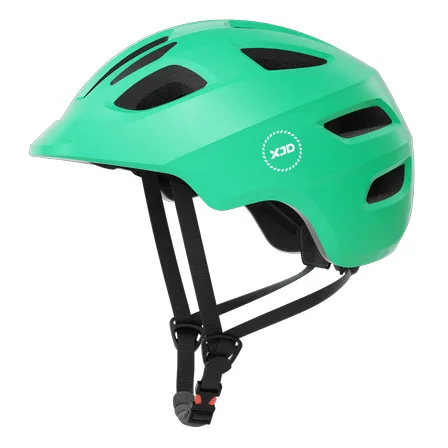
Green XJD Kids Bike Helmet for Boys & Girls
The Green XJD Kids Bike Helmet is a lightweight multi-sport helmet for toddlers …$59.99
$99