

How old to ride in baby bike seat
There is no universal age that makes a child ready for a baby bike seat. Use the seat manual’s minimum requirements, your child’s development and a precise fit check.
What determines whether a child is ready?
Do not decide from a birthday alone. Before riding, confirm that the child meets every minimum and maximum requirement in the exact child-seat manual. The child must also be able to maintain the posture and head control required by that manufacturer while wearing a properly fitted bicycle helmet.
If the child slumps, cannot keep their head stable, does not fit the harness correctly or cannot wear the required helmet properly, they are not ready for that seat. Delay the ride and ask the child’s pediatrician about developmental readiness if you are uncertain.
What to measure and compare
Write down the child’s current weight and height, then compare both with the limits printed in the seat manual. Do not estimate, rely on clothing size or assume that a seat marketed with broad age wording will fit an individual child.
- Child weight and height: Both must fall within the manufacturer’s stated range.
- Harness fit: Check that the restraint adjusts securely in the positions specified by the manual.
- Helmet fit: The helmet should sit level and its straps must be adjusted according to the helmet manufacturer’s instructions.
- Head and posture control: Confirm that the child can remain properly positioned for the ride, including while wearing the helmet.
- Bicycle and seat compatibility: Verify the required mounting points, bicycle type and any carrier requirements in the manuals.
- Total load: Include the child, seat and anything else carried; use only the limits supplied by the relevant manufacturers.
If a specification, mounting procedure or torque value is missing, do not improvise. Contact the manufacturer or have a qualified bicycle mechanic inspect the bicycle and seat together.
Check the adult’s bicycle, not just the seat
A correctly sized child seat can still be unsuitable for a particular bicycle. Confirm that the seat is explicitly compatible with the bicycle and that no cable, brake component, wheel or moving part interferes with the installation. Follow the exact manuals for assembly, maintenance, fastener torque and load limits.
The adult rider should be comfortable starting, stopping, steering and braking with the added load. Practice mounting, dismounting and controlling the loaded bicycle in a traffic-free area before carrying the child. If balance or control feels uncertain, do not take the passenger.
How the supplied XBikes products relate
The supplied products are complete beach cruiser bicycles, not baby bike seats. The XJD 24-Inch Green Beach Cruiser Bike with U-Brake is offered in Green / 24 Inch, Pink / 24 Inch and Pink / 26 Inch labels. The Pink XJD Beach Cruiser Bike, 24"/26", U-Brake is offered in 24 Inch and 26 Inch labels. Those facts do not establish child-seat compatibility, mounting hardware or load capacity.
These particular catalog options help answer the title only as comparison points: their 24- and 26-inch wheel labels concern the person riding the bicycle, while baby-seat readiness concerns the passenger and the exact seat instructions. They are not substitutes for a child seat, and neither should be selected for carrying a child without manual-confirmed compatibility.
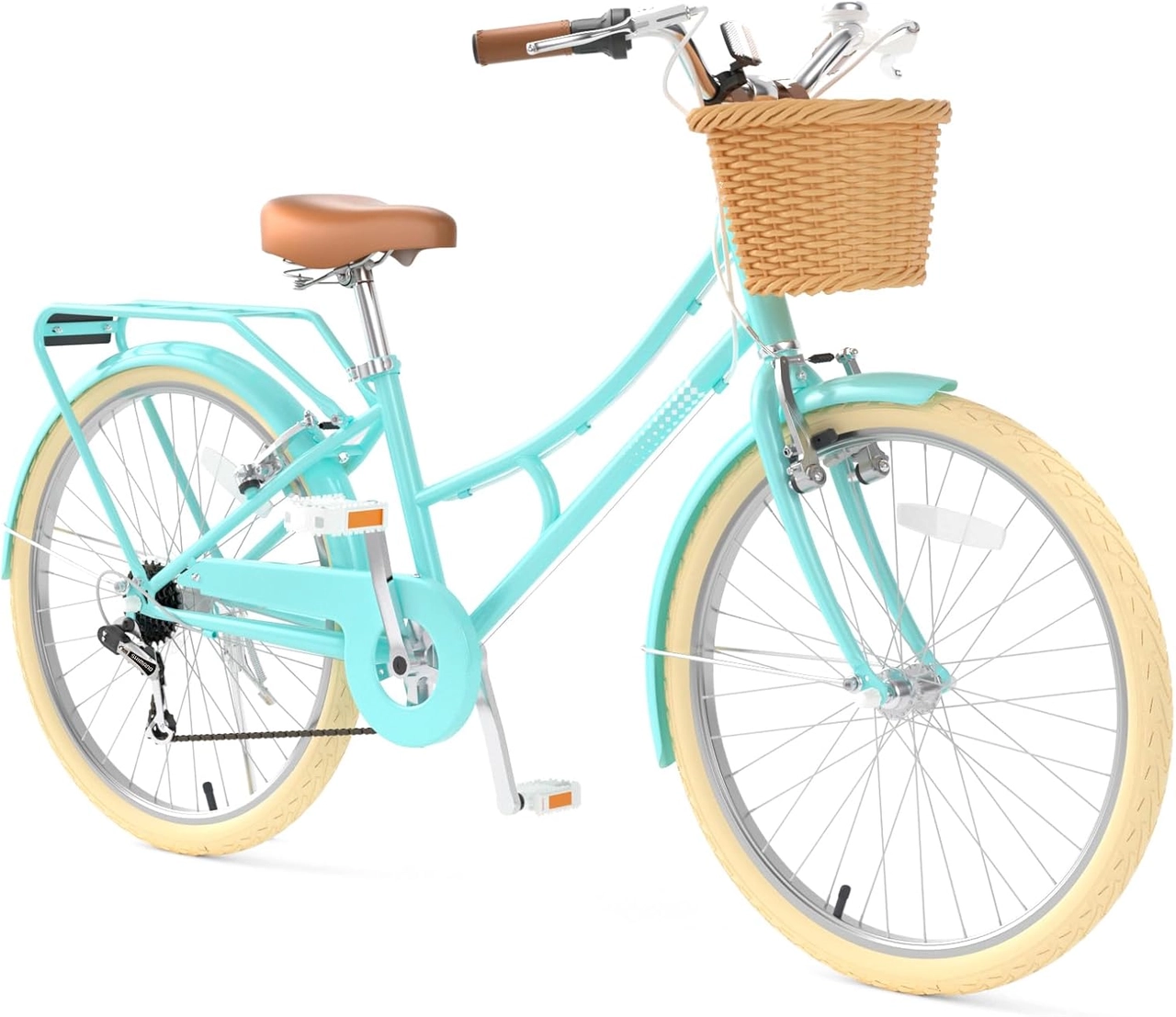 XJD 24-Inch Green Beach Cruiser Bike with U-Brake
A 24- or 26-inch beach cruiser comparison point for the adult or independent rider; the supplied facts do not establish baby-seat compatibility, mounting requirements or load capacity.
 Pink XJD Beach Cruiser Bike, 24"/26", U-Brake
Available with 24 Inch and 26 Inch labels and a U-Brake, but it is a complete beach cruiser bicycle rather than a baby seat. Check the exact bicycle and seat manuals for compatibility.
Wheel size applies to an independent rider
If an older child is moving from passenger to independent rider, XBikes lists 24 Inch as a starting point for ages 10–14 and heights of 54–64 in / 137–163 cm. A 26 Inch bicycle is a starting point for youth and adults over 60 in / 153 cm. These ranges do not determine when a baby can ride in a child seat.
For either supplied bicycle, prioritize measured height, inseam, reach, brake control and current confidence over age. Have the rider try the bicycle, check stand-over clearance and confirm that the controls and brakes are comfortably reachable. Do not buy an oversized bicycle merely to allow room for growth.
Your decision before the first ride
- Identify the exact baby-seat model and read its complete manual.
- Measure the child’s weight and height; compare both with the stated limits.
- Check developmental readiness, stable positioning, harness adjustment and helmet fit.
- Confirm bicycle compatibility, mounting requirements and total permitted load from the manuals.
- Have a qualified bicycle mechanic resolve any missing specification or uncertain installation.
- Test the adult rider’s control away from traffic before carrying the child.
Your child is old enough for a baby bike seat only when every manufacturer requirement and individual readiness check is satisfied now. If even one check fails or cannot be verified, wait rather than using age as permission.
Bikes for your next adventure
-

Kids Bike Helmet by XJD for Boys & Girls – Black, Blue, Green, Pink, Purple
The XJD Kids Bike Helmet covers a wide 2-to-8-year age range thanks to two head-…$59.99
-

Kids Bike Helmet by XJD for Girls – Pink
The XJD Kids Bike Helmet in Pink is a lightweight multi-sport helmet for girls r…$59.99
$99 -

XJD Kids Bike for Girls – Pink, 12/14/16/20 Inch with Training Wheels
The XJD Kids Bike for Girls in Pink is a training-wheel bike built to carry your…$139
$159