

How old to teach a kid to ride a bike
Most children can start learning to ride a bike around age 3, but there is no single correct age. Start when your child fits the bike, can follow simple directions and feels willing to practise; use measured height, inseam, reach, brake control and confidence rather than birthday alone.
Look for readiness, not a deadline
A child is ready to learn when they can walk and run steadily, get on and off with little help, hold the handlebar, look ahead and understand instructions such as “stop” and “slow down.” Interest matters too. A hesitant child may benefit from more time, while an eager child may progress sooner.
Do not treat age three as a requirement. Some children begin later and learn comfortably. Pause if your child cannot control the bike, repeatedly panics or cannot reach the controls. Short, calm sessions are more useful than pushing through fear or fatigue.
Measure before choosing a wheel size
Measure your child’s height without shoes. Then measure inseam from the floor to the crotch while the child stands upright. Use the XBikes ranges below only as starting points:
| Wheel size | Starting age | Rider height |
|---|---|---|
| 12 Inch | 3–4 | 34–40 in / 86–102 cm |
| 14 Inch | 3–6 | 37–45 in / 94–114 cm |
| 16 Inch | 4–7 | 40–48 in / 102–122 cm |
| 18 Inch | 5–9 | 43–52 in / 109–132 cm |
| 20 Inch | 7–12 | 48–60 in / 122–152 cm |
| 24 Inch | 10–14 | 54–64 in / 137–163 cm |
| 26 Inch | Youth and adults | Over 60 in / 153 cm |
Overlapping ranges are normal. If two sizes appear possible, do not choose from the chart alone or buy the larger bicycle merely for future growth. The American Academy of Pediatrics advises having the child try the bicycle and checking stand-over clearance, control and brake reach.
Perform an individual fit check
Have your child wear the shoes they will ride in and try the exact bicycle. Check these points before teaching:
- Stand-over: The child can straddle the bike without being forced onto tiptoes or pressed against the frame.
- Starting and stopping: They can mount, put a foot down and stop without the bicycle overwhelming them.
- Reach: They can steer while remaining balanced, without stretching excessively or locking their arms.
- Brake control: They can reach and operate the bicycle’s controls confidently.
- Confidence: The size feels manageable during turns, starts and stops.
If any of these checks fail, compare another size or setup. Follow the exact product manual for assembly, adjustment, maintenance, compatibility and limits; ask a qualified bicycle mechanic when the instructions or fit are unclear.
How the supplied training-wheel bikes are relevant
The two catalog options are relevant when a beginning rider fits a 12-, 14- or 16-inch bicycle and training wheels suit the family’s teaching approach. The Girls 12/14/16 Inch Kids Bike by XJD with Training Wheels – Peach is categorized as a training-wheel bike with supplied 12-, 14- and 16-inch options. The XJD Light Purple Girls Bike with Basket, Training Wheels, 12/14/16/20 Inch is also categorized as a training-wheel bike; the supplied available SKU labels are 12, 14 and 16 Inch. Its title includes 20 Inch, but a 20-inch available SKU was not supplied here, so verify the exact selectable option rather than relying on the title.
These particular choices provide direct comparison points across the earliest XBikes starting ranges: 12 Inch for 34–40 in, 14 Inch for 37–45 in and 16 Inch for 40–48 in. They are not automatically appropriate just because a child falls within an age band; the individual fit check still decides.
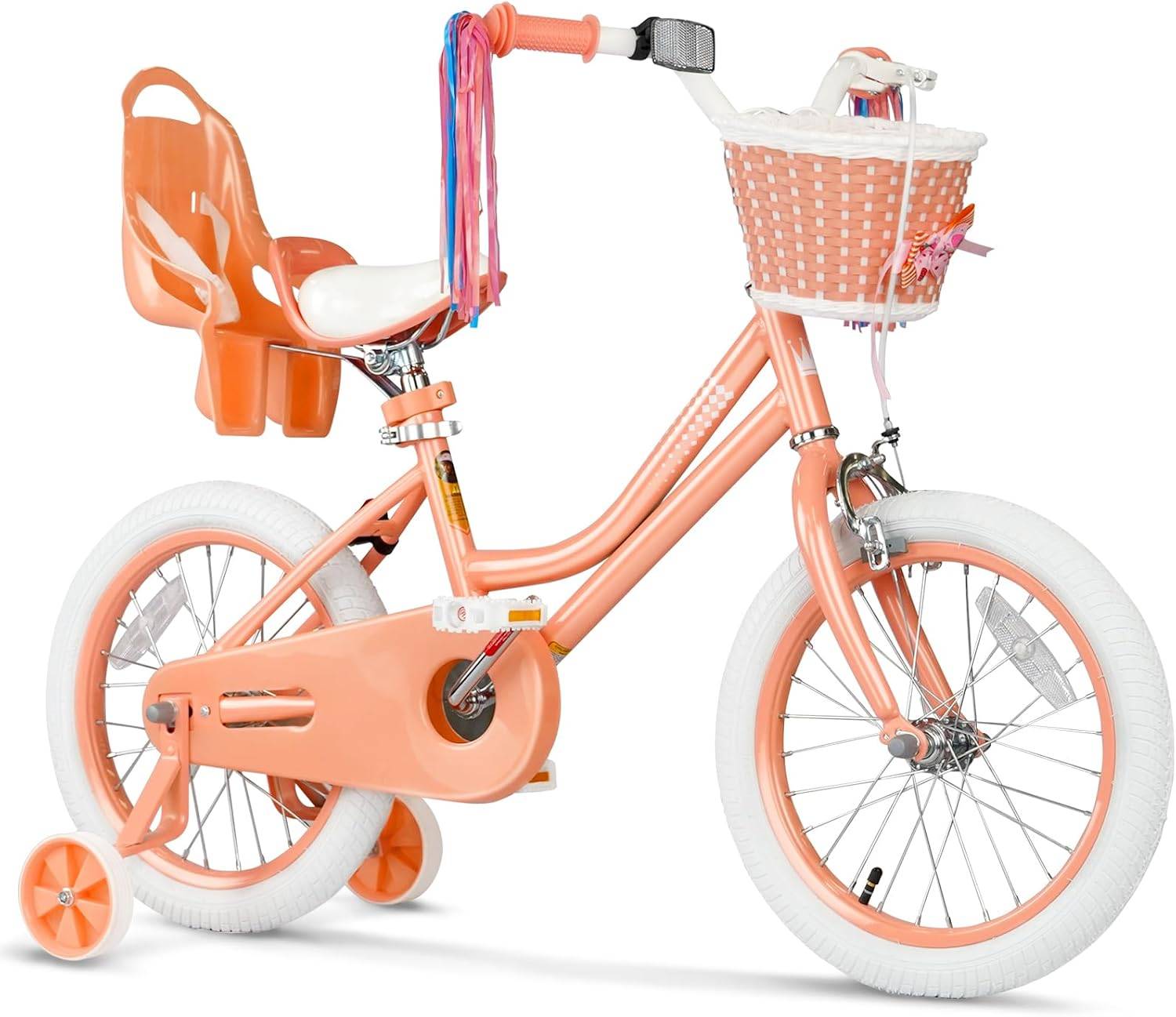 Girls 12/14/16 Inch Kids Bike by XJD with Training Wheels – Peach
A training-wheel bike offered in supplied 12-, 14- and 16-inch options, making it relevant for comparing a measured beginner against those XBikes starting ranges. Individual fit and control still determine suitability.
 XJD Light Purple Girls Bike with Basket, Training Wheels, 12/14/16/20 Inch
A training-wheel bike whose supplied available SKU labels are 12, 14 and 16 Inch. Although its exact catalog title includes 20 Inch, that size was not supplied as an available SKU here; verify the selectable option.
Teach in a controlled sequence
- Choose a flat, open area away from traffic, slopes and obstacles.
- First practise mounting, looking ahead and stopping while you stay close.
- Let the child make short, controlled runs rather than holding a long session.
- Practise starting, straight riding, gentle turns and stopping separately before combining them.
- Increase distance only when the child remains in control and wants to continue.
Training wheels can support an early stage, but they do not replace correct sizing, steering practice or braking control. Use or adjust them only as directed by the exact bicycle manual.
Helmet and final go-or-wait decision
Use a bicycle helmet every ride. The U.S. Consumer Product Safety Commission says it should fit properly, sit level and have its straps used according to the manufacturer’s instructions. Riding should also be supervised in an appropriate traffic-free practice area.
Teach now if your child is willing, fits the exact bike, can reach and use its controls, and can practise basic stops calmly. If one of those conditions is missing, measure again, try another size or wait—readiness and control give a better answer than age alone.
Bikes for your next adventure
-

Kids Bike Helmet by XJD for Boys & Girls – Black, Blue, Green, Pink, Purple
The XJD Kids Bike Helmet covers a wide 2-to-8-year age range thanks to two head-…$59.99
-

Kids Bike Helmet by XJD for Girls – Pink
The XJD Kids Bike Helmet in Pink is a lightweight multi-sport helmet for girls r…$59.99
$99 -

XJD Kids Bike for Girls – Pink, 12/14/16/20 Inch with Training Wheels
The XJD Kids Bike for Girls in Pink is a training-wheel bike built to carry your…$139
$159