

How old to teach child to ride bike
Most children can begin learning to ride between ages 3 and 6, but there is no single correct age. Start when your child is willing and can fit, control and stop the bicycle.
Readiness matters more than a birthday
Age gives you a starting point, not permission to skip a fit check. A child is ready for instruction when they can follow simple directions, stay engaged for a short practice session and approach the bicycle without being forced. Confidence may develop gradually, so reluctance is a reason to pause rather than move to a larger bike or intensify the lesson.
Before teaching, have the child try the bicycle. Check that they can stand over it comfortably, reach the handlebar without stretching, steer while looking ahead and operate the brakes with control. Do not buy an oversized bicycle for future growth; extra size can make starting, turning and stopping harder.
Measure before choosing a wheel size
Measure the child's standing height without shoes. Also measure inseam from the floor to the crotch, then compare that measurement with the actual bicycle's stand-over clearance and lowest usable saddle position. Wheel size alone does not establish fit because bicycle geometry can differ.
| Wheel size | XBikes age starting point | Rider-height starting point |
|---|---|---|
| 12 Inch | Ages 3–4 | 34–40 in / 86–102 cm |
| 14 Inch | Ages 3–6 | 37–45 in / 94–114 cm |
| 16 Inch | Ages 4–7 | 40–48 in / 102–122 cm |
| 18 Inch | Ages 5–9 | 43–52 in / 109–132 cm |
| 20 Inch | Ages 7–12 | 48–60 in / 122–152 cm |
| 24 Inch | Ages 10–14 | 54–64 in / 137–163 cm |
| 26 Inch | Youth and adults | Over 60 in / 153 cm |
Use overlapping ranges as prompts to compare two sizes in person. Choose according to measured height, inseam, reach, brake control and current confidence—not the upper end of an age bracket.
A quick fit and control check
- Stand-over: Ask the child to straddle the bicycle with feet on the ground. They should not be trapped against the frame.
- Starting position: Confirm they can settle onto the saddle and establish a stable starting position without struggling against the bicycle's size.
- Reach and steering: Their hands should reach the handlebar naturally, with enough control to steer rather than merely hang on.
- Braking: Have them demonstrate that they can reach and operate the bicycle's brakes reliably before riding independently.
- Confidence: If they become tense or lose control during basic starts, stops or turns, reconsider the setup, size or timing.
How to run the first lessons
Choose a flat, open area away from traffic and obstacles. Keep sessions brief. Begin with mounting, looking ahead, steering and stopping; add pedaling only when the child can remain composed and control direction. Stay close enough to assist, but avoid pulling the handlebar because that prevents the child from learning balance and steering corrections.
Use one instruction at a time: look ahead, start, steer, then stop. End while the child is still reasonably comfortable. A few calm sessions are more useful than pushing through fear or fatigue.
A properly fitted bicycle helmet is essential for every practice. It should sit level and be secured with its straps according to the helmet manufacturer's instructions. Inspect the bicycle before use, and follow the exact product manual or consult a qualified bicycle mechanic for assembly, adjustments, compatibility, maintenance or torque guidance.
How the supplied bicycles relate to learning age
These catalog options provide useful wheel-size comparison points across early learning and later youth riding. Their listed sizes should narrow what to try, but the child's measurements and hands-on control check must decide the fit.
 XJD Light Purple Girls Bike with Basket, Training Wheels, 12/14/16/20 Inch
A Training Wheel Bikes option with available 12, 14 and 16 Inch labels, relevant for comparing early-learning sizes after measuring the child's height and checking individual fit.
 XJD Kids Beach Cruiser Bicycle, Rear Rack & V-Brakes, Mint Green
A Beach Cruiser Bikes option with available 20, 24 and 26 Inch labels, relevant mainly when the rider's measured height supports a larger youth size and control is confirmed.
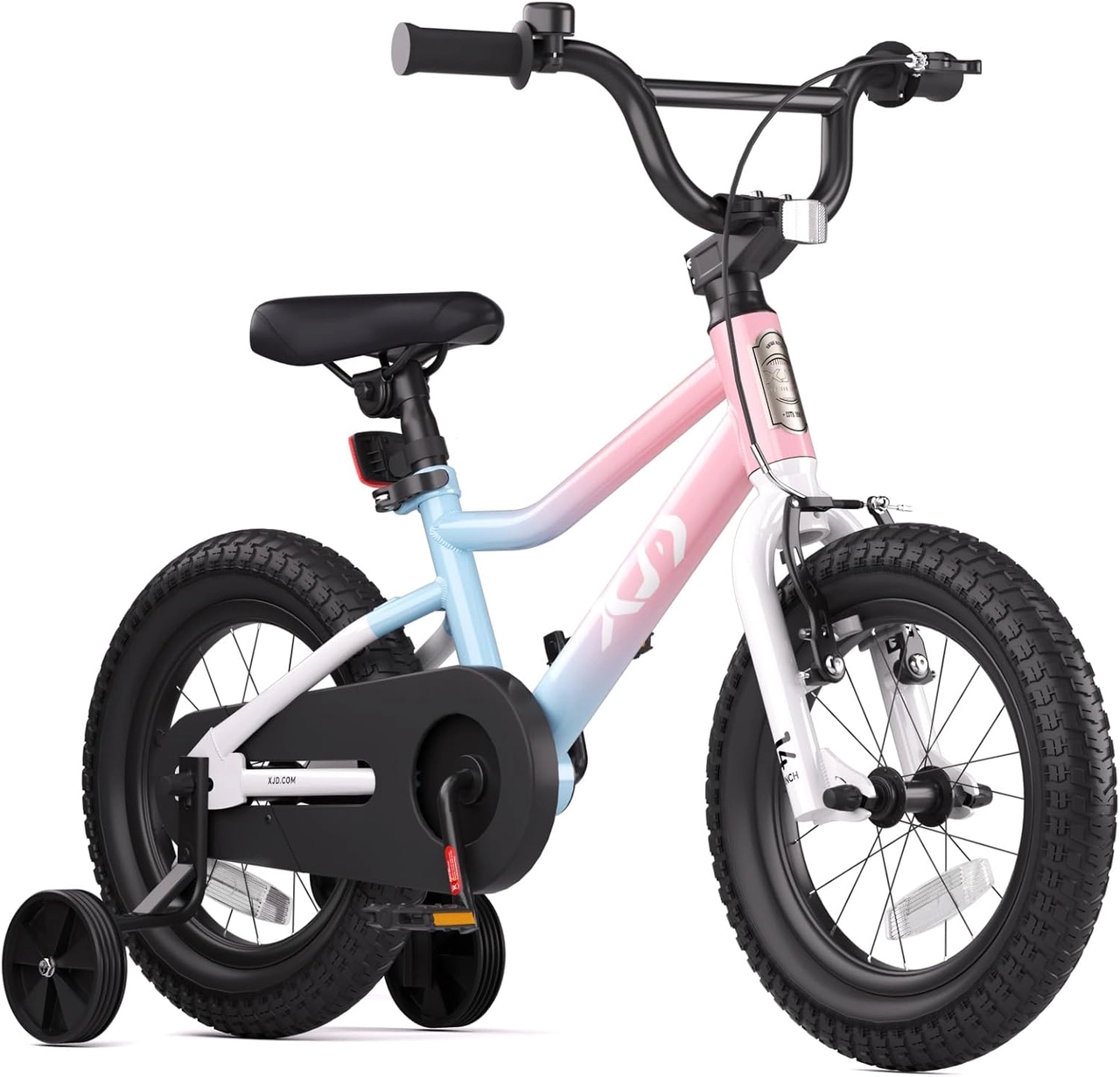 XJD Girls BMX Bike 12/14/16 Inch with Training Wheels – Pink Blue
A Kids' BMX Bikes option with available 12, 14 and 16 Inch labels, useful as an early-size comparison point while stand-over, reach, braking and confidence determine actual fit.
The XJD Light Purple Girls Bike with Basket, Training Wheels, 12/14/16/20 Inch is listed in Training Wheel Bikes, with available 12, 14 and 16 Inch SKU labels. Those sizes overlap the XBikes starting ranges from ages 3 through 7, depending on size, height and individual fit.
The XJD Girls BMX Bike 12/14/16 Inch with Training Wheels – Pink Blue is listed in Kids' BMX Bikes and likewise has available 12, 14 and 16 Inch labels. Compare it only at the size matching the child's measured range, then verify stand-over, reach and control.
The XJD Kids Beach Cruiser Bicycle, Rear Rack & V-Brakes, Mint Green is listed in Beach Cruiser Bikes with 20, 24 and 26 Inch labels. These are starting points for taller or generally older riders: 20 Inch begins at 48 inches of rider height, 24 Inch at 54 inches, and 26 Inch above 60 inches. It is not a substitute when a smaller learning size fits.
Decide whether to start now
Start teaching now if your child is interested, falls within a relevant height starting point and can pass the stand-over, reach, steering and braking checks on the actual bicycle. Wait, adjust the setup or compare another size if any check fails. The right age is the age at which this particular child can control this particular bike with calm, repeatable starts and stops.
Bikes for your next adventure
-

Kids Bike Helmet by XJD for Boys & Girls – Black, Blue, Green, Pink, Purple
The XJD Kids Bike Helmet covers a wide 2-to-8-year age range thanks to two head-…$59.99
-

Kids Bike Helmet by XJD for Girls – Pink
The XJD Kids Bike Helmet in Pink is a lightweight multi-sport helmet for girls r…$59.99
$99 -

XJD Kids Bike for Girls – Pink, 12/14/16/20 Inch with Training Wheels
The XJD Kids Bike for Girls in Pink is a training-wheel bike built to carry your…$139
$159