

How tall child for 16 inch bike
A child is usually in the starting range for a 16-inch bike at 40–48 inches (102–122 cm) tall. Measure the child, then confirm the individual fit before choosing.
Measure height first
Have the child stand without shoes, with their back straight against a wall and their feet flat on the floor. Place a flat book level on top of the head, mark the wall, and measure from the floor to the mark. Compare that result with the XBikes starting range of 40–48 inches (102–122 cm) for a 16-inch bicycle.
The age starting point is 4–7 years, but age should not decide the size by itself. Children of the same age can differ substantially in height, leg length, reach and riding confidence.
Check inseam, stand-over and reach
Measure inseam with the child standing upright in shoes, feet slightly apart. Hold a book firmly between the legs to represent the saddle area, then measure from the floor to the top edge of the book. Compare this measurement with the bicycle manufacturer’s fit information rather than assuming that wheel size determines stand-over clearance.
Next, have the child try the actual bicycle. They should be able to stand over it comfortably, get on and off without struggling, and reach the handlebar without stretching or locking their arms. Seated posture should allow stable steering rather than forcing the child to lean excessively forward.
Ask the child to operate every brake control fitted to the bicycle. They need to reach and use the controls reliably with their normal hand position. If their fingers cannot reach, their hands slip, or using a control disrupts steering, the bike does not fit safely enough to choose yet.
Compare the nearby wheel-size ranges
| Wheel size | XBikes rider-height starting point | Age starting point |
|---|---|---|
| 14 Inch | 37–45 in / 94–114 cm | 3–6 years |
| 16 Inch | 40–48 in / 102–122 cm | 4–7 years |
| 20 Inch | 48–60 in / 122–152 cm | 7–12 years |
Overlap between ranges is a reason to test fit, not proof that either size will work. A child near 40 inches may need a comparison with a 14-inch model, while one near 48 inches may be approaching a 20-inch model. In either case, measured height, inseam, reach, brake control and confidence take priority.
Do not buy extra size for growth
An oversized bicycle can make starting, stopping, steering and dismounting harder. Choose the size the child can control now rather than a larger frame intended to last longer. A child within the stated height range can still need another size if the individual bicycle’s geometry prevents comfortable stand-over, reach or control.
Confidence matters as well. A hesitant beginner may need a setup that makes mounting and stopping feel especially manageable. A confident rider still must pass the same physical checks; experience does not compensate for poor reach or inadequate control.
How the supplied 16-inch options are relevant
All three supplied XJD catalog options include a 16 Inch SKU label and are categorized as Training Wheel Bikes, so they provide direct 16-inch product options to compare after the child falls within the starting height range. Their other labeled sizes can also help when the child is close to a range boundary, but a label alone does not confirm fit.
 Pink 12/14/16/20" XJD Girls Bike with Training Wheels & Basket
Includes a 16 Inch SKU label for direct comparison, plus 12 Inch, 14 Inch and 20 Inch labels. It is categorized as a Training Wheel Bike and includes training wheels and a basket in its catalog title.
 Light Pink XJD Girls' Bicycle with Basket & Training Wheels
A Training Wheel Bike with supplied 12 Inch, 14 Inch, 16 Inch and 20 Inch SKU labels. Its 16 Inch option is relevant once the child’s measurements and hands-on control checks support that size.
 Blue XJD Girls Bike with Training Wheels – 12/14/16 Inch
Offers supplied 12 Inch, 14 Inch and 16 Inch SKU labels in the Training Wheel Bikes category. The 16 Inch option is relevant to the target range, while the 14 Inch label permits a nearby size comparison.
Pink 12/14/16/20" XJD Girls Bike with Training Wheels & Basket offers labeled 12 Inch, 14 Inch, 16 Inch and 20 Inch choices. Light Pink XJD Girls' Bicycle with Basket & Training Wheels has the same four supplied size labels. Blue XJD Girls Bike with Training Wheels – 12/14/16 Inch offers labeled 12 Inch, 14 Inch and 16 Inch choices.
These facts support comparing size labels and catalog category only. They do not establish frame dimensions, brake type, weight, stock status or suitability for a particular child. Select the 16 Inch variant only after checking the exact product fit. Follow its manual for assembly, maintenance, compatibility and limits, or ask a qualified bicycle mechanic when the manual does not resolve a concern.
Run a final control check
- Confirm that measured height is within, or meaningfully close to, 40–48 inches (102–122 cm).
- Compare the measured inseam with the exact bicycle’s fit information.
- Have the child mount, stand over, sit on and dismount from the bicycle.
- Check comfortable handlebar reach, steering control and access to every brake control.
- Observe a careful start, turn and stop in a controlled area before accepting the fit.
Use a properly fitting bicycle helmet that sits level, with its straps adjusted according to the helmet manufacturer’s instructions. A helmet does not correct a bicycle that is too large or difficult to control.
Make the 16-inch decision
Choose a 16-inch bike when the child’s measured height aligns with the 40–48-inch starting range and the actual bicycle passes the inseam, stand-over, reach, braking and confidence checks. If any check fails, compare the adjacent size range and another actual bike instead of waiting for the child to grow into an oversized purchase.
Bikes for your next adventure
-
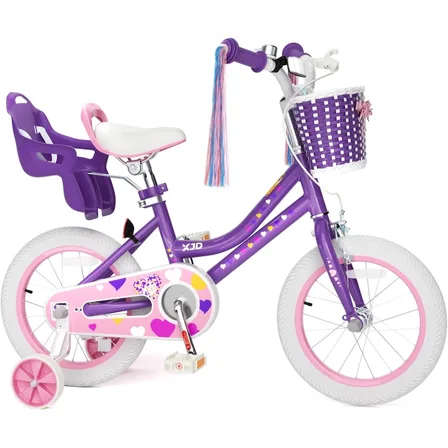
Purple XJD Girls' Bike with Doll Seat & Basket
For girls 71–122 cm tall (about ages 3–7), this XJD girls' bike in Purple pairs …$75.99
$99.99 -

Blue XJD Girls Bike with Training Wheels – 12/14/16 Inch
If you're shopping for a first pedal bike for a daughter roughly 3 to 8 years ol…$149
$169 -

XJD Boys 12/14/16" Training Wheel Bike – Blue
The XJD Boys Bike in Blue is a training wheel bike for riders 71–122 cm tall—rou…$169
$199