

How tall for 16 inch bike
A 16-inch bike usually suits a child who is 40–48 inches (102–122 cm) tall, typically ages 4–7, but only an individual fit check confirms it.
Measure height and inseam first
Measure the child without shoes, standing straight against a wall. Record total height from the floor to the top of the head. For inseam, have the child stand with feet slightly apart and measure from the floor to the crotch. Use height to identify the likely wheel-size range, then use inseam and an actual try-on to judge clearance.
For a 16-inch bike, the XBikes starting range is 40–48 inches (102–122 cm). Age 4–7 is only a secondary guide: children of the same age can have different proportions, reach and confidence.
Check the child on the bicycle
Wheel size does not reveal the frame shape or seat adjustment range, so two 16-inch bicycles may fit differently. Have the child try the exact bicycle rather than relying on its wheel label alone.
- Stand-over: Ask the child to straddle the bike with both feet firmly on the ground. There should be comfortable clearance, without the frame pressing into the child.
- Seated position: Confirm that the child can get on and off without struggling and can place their feet as required for a confident start and stop.
- Reach: The child should hold the handlebar without stretching, locking the elbows or leaning excessively forward.
- Brake control: If the bicycle has hand-operated brake controls, the child must be able to reach and operate them reliably while maintaining steering control.
- Confidence: Watch for controlled starting, steering, stopping and dismounting. A technically possible fit is not a useful fit if the bicycle feels intimidating.
How 16 inches compares with nearby sizes
| Wheel size | Starting height range | Starting age range |
|---|---|---|
| 14 Inch | 37–45 in / 94–114 cm | 3–6 |
| 16 Inch | 40–48 in / 102–122 cm | 4–7 |
| 18 Inch | 43–52 in / 109–132 cm | 5–9 |
| 20 Inch | 48–60 in / 122–152 cm | 7–12 |
The overlapping ranges are starting points, not proof that multiple sizes fit equally well. If the child falls near a boundary, compare the relevant bicycles in person. Choose according to stand-over clearance, usable reach, brake control and present riding confidence.
Do not size up just for growth
An oversized bicycle can make mounting, steering and stopping harder. Do not choose an 18-inch or 20-inch bike merely because the child may grow into it. Likewise, do not keep a child on a cramped 16-inch bicycle after reach, posture or control indicates that it no longer fits.
If the child is below 40 inches (102 cm), begin comparison with the smaller ranges rather than assuming a 16-inch model will work. If the child is over 48 inches (122 cm), examine the next applicable range, but still perform the same physical checks. At exactly 48 inches, both 16-inch and 20-inch starting ranges meet; that overlap calls for comparison, not an automatic jump in size.
Relevant 16-inch catalog options
These particular catalog options help because every supplied model includes a 16 Inch SKU label, while their other labeled sizes provide nearby comparison choices. The labels identify available wheel-size variants; they do not replace measuring the rider or trying the exact bicycle.
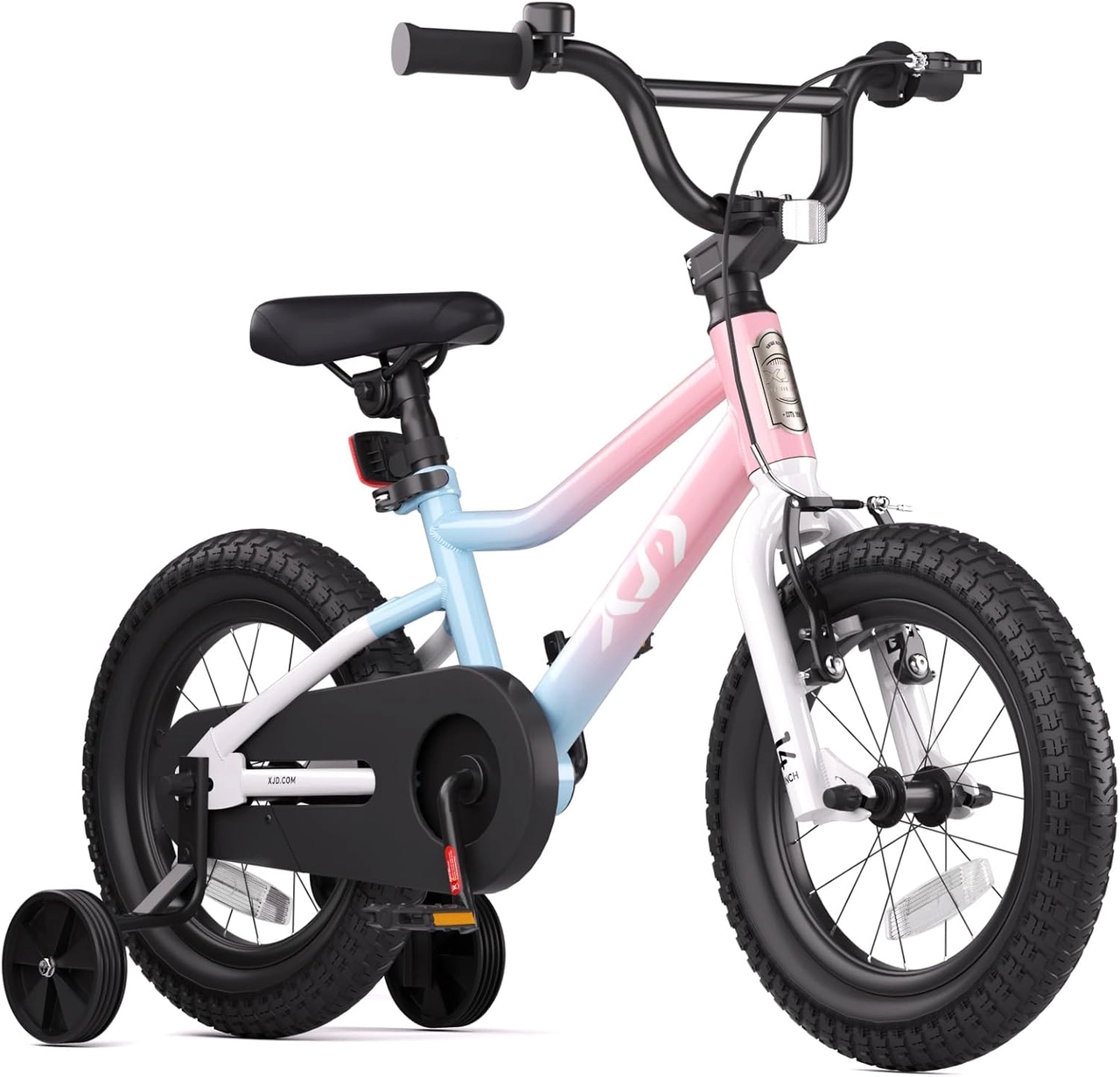 XJD Girls BMX Bike 12/14/16 Inch with Training Wheels – Pink Blue
Available in 12 Inch, 14 Inch and 16 Inch labels, this Kids' BMX Bikes model provides a relevant 16-inch option plus smaller variants for fit comparison.
 XJD Boys & Girls BMX Bike with Training Wheels, 12/14/16" – Blue
This Kids' BMX Bikes product includes 12 Inch, 14 Inch and 16 Inch SKU labels. Its 16 Inch variant is relevant only after checking the child's measurements and control.
 Girls' Training Wheel Bike by XJD with Basket – Purple
This Training Wheel Bikes model offers 14 Inch, 16 Inch and 20 Inch labels, making it relevant for comparison around the requested size without treating the variants as equivalent.
XJD Girls BMX Bike 12/14/16 Inch with Training Wheels – Pink Blue is a Kids' BMX Bikes option with 12 Inch, 14 Inch and 16 Inch labels. It is relevant when comparing a requested 16-inch variant with smaller labeled variants.
XJD Boys & Girls BMX Bike with Training Wheels, 12/14/16" – Blue is also categorized as Kids' BMX Bikes and offers 12 Inch, 14 Inch and 16 Inch labels. Its 16 Inch variant matches the requested wheel-size label, subject to an individual fit check.
Girls' Training Wheel Bike by XJD with Basket – Purple is categorized as a Training Wheel Bikes option and has 14 Inch, 16 Inch and 20 Inch labels. That spread can support comparison around the 16-inch range, but a 20-inch variant is not equivalent to a 16-inch bike.
For assembly, adjustment, maintenance, load limits, compatibility and torque, follow the manual for the exact product or ask a qualified bicycle mechanic. Details not stated in the supplied catalog information should not be assumed from a title or wheel-size label.
Make the final 16-inch decision
Use a properly fitting bicycle helmet that sits level and is secured with its straps according to the helmet manufacturer's instructions. Then make the bike decision: if the child measures 40–48 inches (102–122 cm) and can comfortably straddle, reach, steer and operate the brakes on the exact 16-inch bicycle, it is a reasonable size to consider. If any of those checks fail, compare the adjacent size that matches the child's measured height instead of forcing the 16-inch choice.
Bikes for your next adventure
-
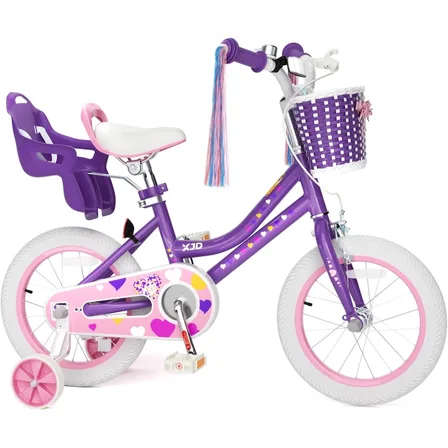
Purple XJD Girls' Bike with Doll Seat & Basket
For girls 71–122 cm tall (about ages 3–7), this XJD girls' bike in Purple pairs …$75.99
$99.99 -

Blue XJD Girls Bike with Training Wheels – 12/14/16 Inch
If you're shopping for a first pedal bike for a daughter roughly 3 to 8 years ol…$149
$169 -

XJD Boys 12/14/16" Training Wheel Bike – Blue
The XJD Boys Bike in Blue is a training wheel bike for riders 71–122 cm tall—rou…$169
$199