

How tall should you be for a 16inch bike
A 16-inch bike usually suits a child who is 40–48 inches (102–122 cm) tall, typically around ages 4–7. Measure height and inseam, then check stand-over clearance, reach, brake control and confidence on the actual bike before deciding.
Start with measured height, not age
The XBikes starting range for a 16-inch wheel bike is 40–48 inches (102–122 cm) in rider height. The age range of 4–7 is only a starting point because children of the same age can differ considerably in height, proportions and coordination.
If the child is shorter than 40 inches (102 cm), compare a 14-inch bike rather than assuming the larger wheel will soon fit. If the child is taller than 48 inches (122 cm), include a 20-inch bike in the fit comparison. Children near either boundary should try both neighboring sizes.
| Wheel size | Rider-height starting point | Age starting point |
|---|---|---|
| 14 Inch | 37–45 in / 94–114 cm | 3–6 |
| 16 Inch | 40–48 in / 102–122 cm | 4–7 |
| 18 Inch | 43–52 in / 109–132 cm | 5–9 |
| 20 Inch | 48–60 in / 122–152 cm | 7–12 |
Measure the child before comparing bikes
- Height: Have the child stand barefoot against a wall, looking straight ahead. Mark the top of the head and measure from the floor.
- Inseam: With feet slightly apart, place a firm book upright between the legs to represent the saddle area. Measure from the floor to the top edge of the book.
- Record both measurements: Use height to select likely wheel sizes, then use inseam and an actual try-on to judge whether the frame can be comfortably straddled.
Wheel diameter does not determine every frame dimension. Two 16-inch bikes can have different frame shapes, saddle adjustment ranges and handlebar positions, so height alone cannot confirm fit.
Check the fit on the actual 16-inch bike
Following the American Academy of Pediatrics guidance, have the child try the bicycle instead of buying an oversized bike for future growth. Ask the child to straddle it and confirm there is comfortable clearance rather than pressure from the frame.
Next, observe the riding position. The child should reach the handlebars without an exaggerated stretch, turn them without losing balance and operate the brakes confidently. Hands must be able to reach and control the brake levers; merely touching them is not enough.
Watch a start, controlled stop and turn in a safe, traffic-free area. A child who freezes, cannot steer smoothly or struggles to put a foot down may need a smaller or differently proportioned bike, even when measured height falls within the 16-inch range.
How the supplied XBikes options are relevant
Each supplied catalog option includes 12 Inch, 14 Inch and 16 Inch SKU labels. That makes these particular models relevant when comparing the requested 16-inch size with smaller choices, although their catalog labels do not replace an individual fit check.
 XJD Boys 12/14/16" Training Wheel Bike – Blue
A Training Wheel Bike offered with 12 Inch, 14 Inch and 16 Inch SKU labels, allowing the requested 16-inch option to be compared with two smaller listed sizes.
 Black XJD Kids Bike for Boys – 12, 14 & 16 Inch Sizes
This Training Wheel Bike includes 12 Inch, 14 Inch and 16 Inch selections. Its 16-inch choice is relevant only after checking the individual rider's measurements, reach and control.
 XJD Kids' Training Wheel Bike for Boys & Girls, 12/14/16 Inch – White
Listed as a Training Wheel Bike with 12 Inch, 14 Inch and 16 Inch options, this model provides a relevant 16-inch candidate and smaller-size comparison points.
XJD Boys 12/14/16" Training Wheel Bike – Blue is listed in Training Wheel Bikes and offers 12 Inch, 14 Inch and 16 Inch selections. Black XJD Kids Bike for Boys – 12, 14 & 16 Inch Sizes has the same listed category and size choices.
XJD Kids' Training Wheel Bike for Boys & Girls, 12/14/16 Inch – White is also a Training Wheel Bike with 12 Inch, 14 Inch and 16 Inch labels. These facts establish available size comparisons only; they do not establish frame geometry, brake type, weight, load limit or suitability for a particular child.
Do not size up solely for growth
A too-large bicycle can make mounting, stopping and steering harder. If a child cannot straddle, reach or brake with control, the 16-inch option is not appropriate yet, regardless of age or anticipated growth. Conversely, a confident child within the height range still needs the same checks because body proportions affect fit.
For assembly, adjustments, maintenance, torque values and compatibility, follow the exact product manual or use a qualified bicycle mechanic. Do not improvise specifications that are not provided for the model.
Make the final 16-inch decision
- Choose 16 inches as a candidate when measured height is 40–48 inches (102–122 cm).
- Compare 14 inches near the lower boundary and 18 or 20 inches near the upper boundary, using their stated height ranges.
- Approve the bike only after comfortable stand-over, natural reach, reliable brake operation and controlled riding are demonstrated.
- Use a properly fitting bicycle helmet that sits level, with straps secured according to its manufacturer's instructions, as advised by the U.S. Consumer Product Safety Commission.
If the child passes every hands-on check, a 16-inch bike is a reasonable fit; if any check fails, compare the adjacent size or another frame rather than waiting for the child to adapt to an oversized bicycle.
Bikes for your next adventure
-
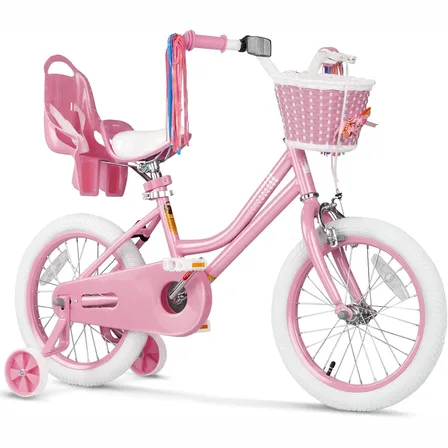
XJD Pink Girls' Bike – Kids 12/14/16 Inch Training Wheel Bicycle
The XJD Pink Girls' Bike is a training-wheel bicycle for girls ages 3 to 8 (ride…$149
$169 -

Blue XJD Girls Bike with Training Wheels – 12/14/16 Inch
If you're shopping for a first pedal bike for a daughter roughly 3 to 8 years ol…$149
$169 -

XJD Boys 12/14/16" Training Wheel Bike – Blue
The XJD Boys Bike in Blue is a training wheel bike for riders 71–122 cm tall—rou…$169
$199