

How tall of a bike for a 6 year old
For most 6-year-olds, start by comparing a 16-inch and 18-inch bike. Choose by measured height and fit: 16-inch suits 40–48 in (102–122 cm), while 18-inch suits 43–52 in (109–132 cm).
Measure your child before choosing
Age narrows the search, but it does not determine the correct bike. Measure your child’s height without shoes, standing straight against a wall. Also measure inseam from the floor to the crotch while the child stands with feet slightly apart.
Compare height with the XBikes starting points first. Then use inseam to assess stand-over clearance when the child tries the actual bicycle. Frame shapes and seat-height ranges can differ even when two bikes have the same wheel size, so wheel diameter alone cannot confirm fit.
Compare the likely wheel sizes
| Wheel size | XBikes age starting point | Rider height | Relevance at age 6 |
|---|---|---|---|
| 14 Inch | Ages 3–6 | 37–45 in / 94–114 cm | Consider only for a shorter rider who fits and controls it comfortably. |
| 16 Inch | Ages 4–7 | 40–48 in / 102–122 cm | A common starting comparison for this age. |
| 18 Inch | Ages 5–9 | 43–52 in / 109–132 cm | Compare for a taller child, provided reach and control are suitable. |
| 20 Inch | Ages 7–12 | 48–60 in / 122–152 cm | Consider only if the rider is already at least 48 in / 122 cm and passes every fit check. |
The overlapping ranges are intentional starting points, not proof that either size will fit. For example, a child who is 44 inches tall falls within the 14-, 16- and 18-inch height ranges. Trying the bikes resolves that overlap more reliably than age or height alone.
Use a hands-on fit check
Have the child wear ordinary riding shoes and try the bicycle. Do not buy an oversized bike merely to allow room for growth. A bike that is too tall or long can make starting, stopping and steering harder.
- Check stand-over: with the child straddling the frame and both feet on the ground, confirm there is comfortable clearance rather than contact with the frame.
- Check seated position: make sure the child can sit securely and place a foot down confidently when stopping.
- Check reach: the child should hold the handlebar without stretching, locking the elbows or leaning excessively forward.
- Check brake control: if the bicycle has hand brakes, the child must be able to reach and operate them while maintaining control. Follow the exact product manual for any adjustment.
- Check movement: ask the child to start, steer, turn and stop in a controlled area. Hesitation caused by size is a reason to compare a smaller option.
When the supplied XBikes options are relevant
The Blue XJD Girls Bike with Training Wheels – 12/14/16 Inch and XJD Boys 12/14/16" Training Wheel Bike – Blue are both cataloged as training-wheel bikes with 12-, 14- and 16-inch SKU labels. They help families compare the smaller sizes, especially 16-inch for a rider within the 40–48 in (102–122 cm) starting range or 14-inch for a shorter rider within 37–45 in (94–114 cm).
 Blue XJD Girls Bike with Training Wheels – 12/14/16 Inch
A training-wheel bike offered with 12-, 14- and 16-inch SKU labels; its 16-inch option is relevant to compare for riders measuring 40–48 inches, subject to an individual fit check.
 XJD Boys 12/14/16" Training Wheel Bike – Blue
This training-wheel bike has 12-, 14- and 16-inch SKU labels. The 16-inch version may suit the title’s age group when rider height, stand-over, reach, brake control and confidence all support the fit.
These products are relevant only if the child needs a 12-, 14- or 16-inch option and the individual fit check succeeds. Neither supplied product has an 18-inch or 20-inch SKU label. If measurements point to one of those sizes, the listed bikes are nearest-size comparison points, not equal replacements or substitutes.
Training wheels may be useful for a child whose current confidence calls for that format, but their presence does not make an incorrectly sized frame suitable. Confirm balance, steering, reach and stopping control on the assembled bicycle.
Finish the setup safely
Choose a bicycle helmet that fits properly, sits level on the head and has straps positioned according to the helmet manufacturer’s instructions. Recheck the fit whenever the helmet is adjusted or worn over a different hairstyle or head covering.
For assembly, maintenance, component adjustment, compatibility, load limits and torque settings, follow the exact bicycle manual. If instructions are missing or the setup is uncertain, use a qualified bicycle mechanic rather than guessing.
Make the decision
Measure height and inseam today, compare 16-inch and 18-inch bikes first, and include 14-inch or 20-inch only when the measured height supports them. Select the smallest suitable option on which your 6-year-old has comfortable stand-over clearance, natural reach, reliable brake control and confident starts and stops.
Bikes for your next adventure
-
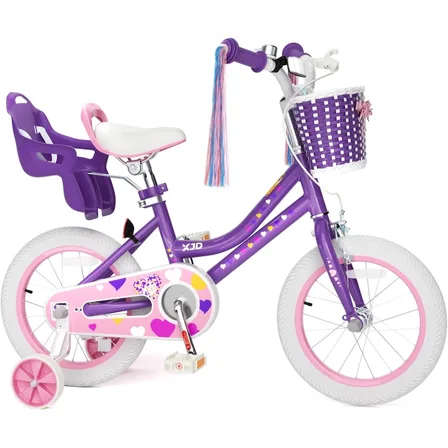
Purple XJD Girls' Bike with Doll Seat & Basket
For girls 71–122 cm tall (about ages 3–7), this XJD girls' bike in Purple pairs …$75.99
$99.99 -

Blue XJD Girls Bike with Training Wheels – 12/14/16 Inch
If you're shopping for a first pedal bike for a daughter roughly 3 to 8 years ol…$149
$169 -

XJD Boys 12/14/16" Training Wheel Bike – Blue
The XJD Boys Bike in Blue is a training wheel bike for riders 71–122 cm tall—rou…$169
$199