

How tall for a 14 inch bike
A 14-inch bike is a starting point for a child 37–45 inches (94–114 cm) tall, usually age 3–6. Measure height, then confirm stand-over clearance, reach, brake control and confidence on the actual bike before choosing it.
Measure the child before comparing bikes
Measure height without shoes, with the child standing straight against a wall. Mark the top of the head and measure from the floor. Use that result—not a clothing size or a guess based on age—to compare with the 14-inch starting range.
Measure inseam as well. Have the child stand in socks with feet slightly apart, then measure from the floor to the crotch. Inseam helps you judge whether the child can stand over a particular bicycle comfortably. There is no universal inseam number for every 14-inch frame, because frame shapes differ; compare the measurement with the bicycle itself or the exact product manual.
What the 14-inch range means
XBikes uses 37–45 inches (94–114 cm) and ages 3–6 as the starting point for a 14-inch bike. Height is more useful than age: two children of the same age can have different leg length, reach and coordination.
| Wheel size | Starting height | Starting age |
|---|---|---|
| 12 Inch | 34–40 in / 86–102 cm | 3–4 |
| 14 Inch | 37–45 in / 94–114 cm | 3–6 |
| 16 Inch | 40–48 in / 102–122 cm | 4–7 |
The overlapping ranges are intentional starting points, not proof that adjacent sizes fit equally. A child near 40 inches, for example, may fall within more than one height range. The correct choice is the bicycle the child can mount, stop and steer with control.
Perform an individual fit check
Have the child try the assembled bicycle while wearing the shoes normally used for riding. Do not buy an oversized bike solely to allow room for growth. Check these points on the exact model:
- Stand-over: The child should be able to straddle the bicycle without the frame obstructing a comfortable, stable stance.
- Seat position: From the lowest permitted seat setting, the child should be able to start, stop and support the bike with confidence. Follow the manual’s adjustment limits.
- Reach: The handlebars should be reachable without an extreme stretch, locked elbows or loss of steering control.
- Brake control: If the bicycle has hand-operated controls, the child must be able to reach and operate them reliably. Confirm the actual equipment rather than assuming a brake type.
- Confidence: The child should manage mounting, straight-line steering, turning and stopping without appearing overwhelmed by the bicycle’s size.
If any adjustment, assembly detail, compatibility question or torque specification is unclear, use the exact product manual or ask a qualified bicycle mechanic. Do not improvise settings beyond the manufacturer’s stated limits.
How the supplied bike helps with the comparison
The XJD Kids Bike for Girls – Pink, 12/14/16/20 Inch with Training Wheels is directly relevant because its supplied size labels include 14 Inch. Its 12 Inch and 16 Inch labels also provide adjacent catalog options when a measured child is near an overlap, while 20 Inch is a separate, larger size—not an equivalent substitute.
These particular catalog options help answer the sizing question by letting you identify the requested 14 Inch label and compare it with neighboring 12 Inch and 16 Inch labels. The label begins the decision; an in-person check of the chosen configuration completes it.

For reference, XBikes starts 20-inch bikes at 48–60 inches (122–152 cm) and ages 7–12. That is well beyond the 14-inch starting range, so do not select the 20 Inch option simply because a child may grow into it. No supplied facts establish frame dimensions, seat range, load limits, brake type or assembly requirements for this product; consult its exact manual for those details.
Make the 14-inch decision
If the child measures 37–45 inches (94–114 cm), try the 14-inch bicycle first. Choose it only if stand-over position, seat setup, reach, braking and handling all work for that child now. If the child falls in an overlapping height range, compare the actual adjacent sizes rather than deciding by age or wheel label alone.
Before riding, add a properly fitting bicycle helmet. It should sit level and its straps should be used according to the helmet manufacturer’s instructions. The practical next step is simple: record the child’s height and inseam, arrange a 14-inch fit check, and reject that size if the child cannot mount, steer or stop it confidently.
Bikes for your next adventure
-
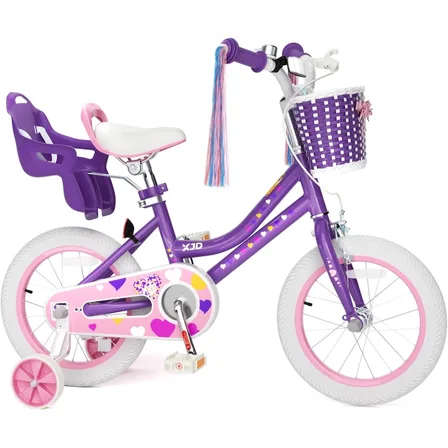
Purple XJD Girls' Bike with Doll Seat & Basket
For girls 71–122 cm tall (about ages 3–7), this XJD girls' bike in Purple pairs …$75.99
$99.99 -

Blue XJD Girls Bike with Training Wheels – 12/14/16 Inch
If you're shopping for a first pedal bike for a daughter roughly 3 to 8 years ol…$149
$169 -

XJD Boys 12/14/16" Training Wheel Bike – Blue
The XJD Boys Bike in Blue is a training wheel bike for riders 71–122 cm tall—rou…$169
$199