

How tall is a 20 inch bike
A 20-inch bike has wheels about 20 inches in nominal diameter; it is not necessarily 20 inches tall overall. For fit, measure the child, not the bike label.
What “20 inch” actually measures
The size describes the wheel category rather than the bicycle’s height from the floor to the saddle or handlebars. Overall height varies with the frame, tires, saddle position and handlebar arrangement, so the wheel label cannot tell you the bicycle’s exact standing height.
If you need the physical height of a particular assembled bike for storage or transport, check its exact product manual or measure it from the floor to its highest point. Do not estimate that dimension from the 20-inch wheel label.
Who a 20-inch bike may fit
XBikes uses a 20-inch bike as a starting point for riders ages 7–12 and 48–60 inches (122–152 cm) tall. Height is more useful than age, but neither replaces trying the bicycle. Children of the same height can have different leg lengths, reach and confidence.
Do not move a child to a 20-inch bike simply because they fall within the age range or because you want room for growth. The American Academy of Pediatrics advises having the child try the bicycle and avoiding an oversized purchase for future growth.
Measure the rider before comparing bikes
- Standing height: Have the child stand straight without shoes against a wall. Measure from the floor to the top of the head.
- Inseam: With feet slightly apart, measure from the floor to the crotch. Use a firm, level book against the body to make the endpoint easier to identify.
- Reach and control: On the actual bicycle, check whether the child can hold the handlebars naturally, steer without stretching and operate the brakes comfortably.
- Confidence: Notice whether the rider can start, stop and balance without appearing tense or losing control.
Compare the measured standing height with the 48–60-inch starting range, then use the inseam and an actual test to confirm fit. If the height falls near either boundary, compare the neighboring wheel size rather than relying on age.
Perform the fit check on the bicycle
Have the child straddle the top tube with both feet planted securely on the ground. There should be usable space between the child and the bicycle rather than contact with the frame. Next, seat the child and confirm that the handlebars and brake controls are within comfortable reach.
A bicycle is too large if the rider cannot stand over it appropriately, must stretch to steer, cannot reach or operate the brakes reliably, or feels unable to stop and dismount under control. A bike may be too small if the riding position is cramped even after adjustments permitted by its manual.
Use only the adjustment range and assembly directions in the exact product manual. If correct setup, compatibility or assembly is uncertain, ask a qualified bicycle mechanic rather than improvising a procedure.
How the supplied 20-inch option helps
The Girls' Training Wheel Bike by XJD, 12–20 Inch Wheels – Blue is listed in the Training Wheel Bikes category with 12 Inch, 14 Inch, 16 Inch and 20 Inch SKU labels. Its 20 Inch option makes it directly relevant to this question, while the smaller labels can help a parent recognize that wheel sizes are distinct choices, not interchangeable fits. Select the exact SKU only after checking the individual rider.

The catalog facts do not provide the bicycle’s overall assembled height, frame geometry, brake type or adjustment limits. Consult the manual for those product-specific details; the presence of a 20 Inch SKU alone does not prove that it fits a particular child.
Make the final size decision
- Start with the child’s measured height: 48–60 inches (122–152 cm) is the XBikes starting range for 20-inch wheels.
- Confirm inseam clearance, natural reach, effective brake operation and present riding confidence on the actual bike.
- Reject an oversized bike even if the child may grow into it later.
- Use the exact manual or a qualified bicycle mechanic for setup questions not answered by the catalog.
Before riding, add a properly fitting bicycle helmet. U.S. Consumer Product Safety Commission guidance says it should sit level and its straps should be used according to the helmet manufacturer’s instructions.
Choose the 20-inch size only when the child falls near its height range and passes the hands-on stand-over, reach, braking and confidence checks today.
Bikes for your next adventure
-
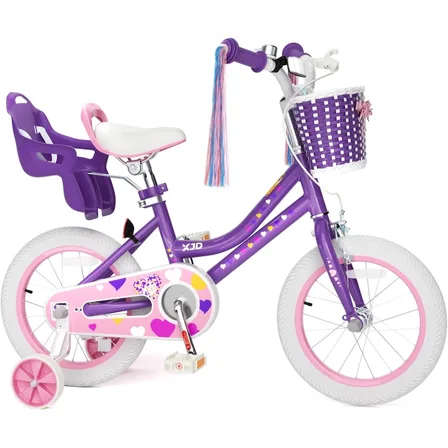
Purple XJD Girls' Bike with Doll Seat & Basket
For girls 71–122 cm tall (about ages 3–7), this XJD girls' bike in Purple pairs …$75.99
$99.99 -

Blue XJD Girls Bike with Training Wheels – 12/14/16 Inch
If you're shopping for a first pedal bike for a daughter roughly 3 to 8 years ol…$149
$169 -

XJD Boys 12/14/16" Training Wheel Bike – Blue
The XJD Boys Bike in Blue is a training wheel bike for riders 71–122 cm tall—rou…$169
$199