

How tall is a 24 inch bike
A 24-inch bike does not have one fixed overall height: “24 inch” identifies its wheel size. XBikes uses it as a starting point for riders 54–64 inches (137–163 cm) tall, typically ages 10–14, but the child must still try the bike and demonstrate comfortable stand-over, reach and brake control.
What the 24-inch measurement actually means
The label describes the bicycle’s wheel-size class, not the distance from the ground to the saddle, handlebars or top tube. Those dimensions vary with frame design and adjustment, so wheel size alone cannot tell you exactly how tall the complete bicycle will be.
If you need the bike’s physical height for storage or transport, measure the assembled bicycle from the floor to its highest point. That practical measurement is separate from deciding whether the bicycle fits its rider.
Measure the child before comparing sizes
Measure standing height without shoes, with the child upright against a wall. Then measure inseam: have the child stand naturally and measure from the floor to the crotch, using a firm book held level to represent the contact point of a saddle.
Compare measured height with the XBikes starting point first. For a 24-inch bike, that is 54–64 inches (137–163 cm). Age 10–14 is only a secondary clue because children of the same age can differ greatly in proportions, reach and confidence.
| Wheel size | XBikes rider-height starting point | Age starting point |
|---|---|---|
| 20 Inch | 48–60 in / 122–152 cm | 7–12 |
| 24 Inch | 54–64 in / 137–163 cm | 10–14 |
| 26 Inch | Over 60 in / 153 cm | Youth and adults |
The overlapping height ranges are a reason to perform a fit check, not permission to treat neighboring wheel sizes as equivalent.
Check the fit on the actual bicycle
Have the child try the exact bicycle rather than relying only on its label. While standing astride it, the rider should be able to manage the bicycle and clear the top tube comfortably. Seated, the child should reach the handlebars without an awkward stretch or cramped posture.
Ask the rider to operate each brake control confidently while maintaining a secure grip. Also observe whether starting, stopping, steering and getting on or off feel controlled. Current confidence matters: a technically reachable bicycle can still be too demanding for a hesitant rider.
Do not buy an oversized bicycle simply to allow room for growth. If stand-over, reach or braking is uncertain, compare another size or ask a qualified bicycle mechanic to assess the fit.
How the supplied 24-inch options help
All three supplied catalog options include a 24 Inch SKU label, so they provide relevant bicycles on which to perform the measurements and in-person checks above. Their neighboring size labels also help a parent identify which exact variant is being compared; they do not prove that every listed size will fit the same child.
 Pink XJD Beach Cruiser Bike, 24"/26", U-Brake
Available in 24 Inch and 26 Inch labels. Its 24 Inch variant directly matches the requested wheel size, while the 26 Inch option requires a separate size and fit assessment.
 XJD Kids Beach Cruiser Bicycle, Rear Rack & V-Brakes, Mint Green
Available with 20 Inch, 24 Inch and 26 Inch labels, making it relevant for comparing adjacent wheel-size choices when measured rider height falls within overlapping XBikes starting ranges.
 XJD Pink Beach Cruiser for Girls – Rear Rack & V-Brake
Offers 20 Inch, 24 Inch and 26 Inch labels. The 24 Inch option is relevant to the title, but selection still depends on individual stand-over, reach and brake control.
Pink XJD Beach Cruiser Bike, 24"/26", U-Brake is offered with 24 Inch and 26 Inch labels. The 24 Inch variant matches the wheel size in the question; the 26 Inch variant is a different size and should be judged against its own starting point and an individual fit check.
XJD Kids Beach Cruiser Bicycle, Rear Rack & V-Brakes, Mint Green has 20 Inch, 24 Inch and 26 Inch labels. That range makes it useful for comparing adjacent wheel-size options when the rider’s measured height falls within overlapping starting ranges.
XJD Pink Beach Cruiser for Girls – Rear Rack & V-Brake likewise has 20 Inch, 24 Inch and 26 Inch labels. Select the 24 Inch option only when the child’s measurements and actual control support it; the wording in a catalog title is not independent evidence of fit.
Do the final safety and setup checks
Use a properly fitting bicycle helmet that sits level, with its straps adjusted according to the helmet manufacturer’s instructions. A helmet does not correct a poorly fitting bicycle, so confirm both separately.
For assembly, adjustment limits, maintenance, compatibility, load limits or torque settings, follow the manual for the exact product and variant. If the instructions are missing or the setup is uncertain, use a qualified bicycle mechanic rather than improvising.
Your next decision
- Measure the child’s standing height and inseam.
- Use 54–64 inches (137–163 cm) as the 24-inch starting range, with age only as a secondary reference.
- Confirm comfortable stand-over, handlebar reach, brake operation and controlled riding on the exact bicycle.
- If any check fails, do not size up for growth; compare the appropriate neighboring size and repeat the fit test.
A 24-inch label answers the wheel-size question, but the child’s measurements and control answer the buying question.
Bikes for your next adventure
-
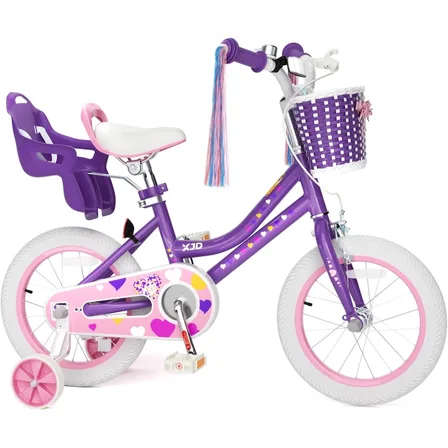
Purple XJD Girls' Bike with Doll Seat & Basket
For girls 71–122 cm tall (about ages 3–7), this XJD girls' bike in Purple pairs …$75.99
$99.99 -

Blue XJD Girls Bike with Training Wheels – 12/14/16 Inch
If you're shopping for a first pedal bike for a daughter roughly 3 to 8 years ol…$149
$169 -

XJD Boys 12/14/16" Training Wheel Bike – Blue
The XJD Boys Bike in Blue is a training wheel bike for riders 71–122 cm tall—rou…$169
$199