

How tall should you be for a 18 inch bike
An 18-inch bike generally suits a child 43–52 inches (109–132 cm) tall, often ages 5–9, but measured fit and control decide.
Start with height, then confirm the individual fit
Measure the child barefoot, standing straight against a wall, from the floor to the top of the head. Compare that result with the XBikes 18-inch starting range: 43–52 inches (109–132 cm). Age can help narrow the search, but it should not override the rider’s measurements or ability.
Next, measure inseam. With the child barefoot, place a book firmly between the legs to imitate a saddle, keep it level, and measure from the floor to the top edge. Because frame geometry and saddle adjustment differ between bicycles, do not convert this measurement into a wheel size by itself. Compare it with the stand-over and saddle information in the exact bicycle’s manual.
What to check on the actual 18-inch bike
Have the child try the complete bicycle before deciding. An 18-inch wheel label does not guarantee that every 18-inch model has the same frame height, reach or riding position.
- Stand-over: The child should be able to straddle the bicycle securely and manage it without being forced onto tiptoes. Follow the model’s manual for its required clearance.
- Starting and stopping: The rider should be able to get on, set off and stop without the bicycle pulling them off balance.
- Reach: Hands should reach the handlebar comfortably without an extreme stretch, locked elbows or difficulty steering.
- Brake control: If the bicycle has hand controls, the child must be able to reach and operate them reliably. Confirm the exact setup in the product manual.
- Confidence: A nervous or inexperienced rider may need a more manageable fit even when height falls inside the suggested range.
Do not buy an oversized bicycle merely to leave growing room. If the child cannot control it now, the nominal future value does not make the present fit appropriate.
When 16 or 20 inches may be the better comparison
| Wheel size | XBikes height starting point | Age starting point |
|---|---|---|
| 16 Inch | 40–48 in / 102–122 cm | 4–7 |
| 18 Inch | 43–52 in / 109–132 cm | 5–9 |
| 20 Inch | 48–60 in / 122–152 cm | 7–12 |
The ranges overlap, so a child near 43–48 inches may need to compare 16- and 18-inch bicycles in person. A rider near 48–52 inches may need to compare 18 and 20 inches. Choose according to stand-over, reach, brake use and current confidence—not the largest wheel the child can barely manage.
If height falls below 43 inches, an 18-inch bicycle is outside the XBikes starting range. If it is above 52 inches, begin by considering the 20-inch range, while still checking the individual bicycle. A child within 43–52 inches still needs the complete fit test.
How the supplied XBikes products help with this decision
Neither supplied catalog option has a verified 18-inch SKU. They are useful only as nearest-size comparison points: both provide verified 12-, 14- and 16-inch labels, so the 16-inch versions can help a family compare a smaller size against a separate 18-inch candidate. They are not substitutes for an 18-inch bicycle.
 XJD Girls Bike for Kids Ages 3-8, 12/14/16 Inch with Training Wheels – Purple
A verified 16-inch option for comparison with an 18-inch candidate; its other supplied labels are 12 and 14 Inch. The age wording in its title is a catalog label, not individual fit evidence.
 XJD Light Purple Girls Bike with Basket, Training Wheels, 12/14/16/20 Inch
Its supplied available labels are 12, 14 and 16 Inch, making the 16-inch version a smaller comparison point only. No verified 18-inch SKU is supplied, despite other sizing wording in the exact title.
XJD Girls Bike for Kids Ages 3-8, 12/14/16 Inch with Training Wheels – Purple is categorized as a Training Wheel Bike and has supplied SKU labels of 12 Inch, 14 Inch and 16 Inch. The “Ages 3-8” wording is part of its catalog title, not evidence that it fits a particular child.
XJD Light Purple Girls Bike with Basket, Training Wheels, 12/14/16/20 Inch is also categorized as a Training Wheel Bike. Although its exact catalog title includes “20 Inch,” the supplied available SKU labels are 12 Inch, 14 Inch and 16 Inch. Only those supplied labels should guide this comparison.
For a child who fits and controls a 16-inch version comfortably, compare that experience directly with the stand-over, reach and handling of the intended 18-inch bicycle. If the 16-inch option already feels difficult to control, moving up solely for growth would be the wrong next step.
Complete the check before riding
Confirm assembly, adjustments, maintenance and component operation using the manual for the exact bicycle. If anything is unclear, use a qualified bicycle mechanic rather than guessing at compatibility, settings or torque.
Add a properly fitting bicycle helmet. It should sit level, and its straps should be adjusted according to the helmet manufacturer’s instructions. The final decision is simple: consider an 18-inch bike at 43–52 inches tall, but buy it only when the child can straddle, reach, steer, brake, start and stop with confidence.
Bikes for your next adventure
-
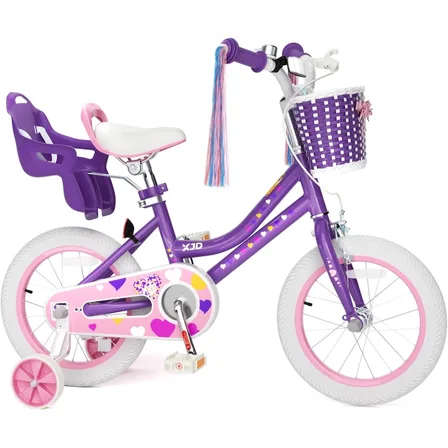
Purple XJD Girls' Bike with Doll Seat & Basket
For girls 71–122 cm tall (about ages 3–7), this XJD girls' bike in Purple pairs …$75.99
$99.99 -

Blue XJD Girls Bike with Training Wheels – 12/14/16 Inch
If you're shopping for a first pedal bike for a daughter roughly 3 to 8 years ol…$149
$169 -

XJD Boys 12/14/16" Training Wheel Bike – Blue
The XJD Boys Bike in Blue is a training wheel bike for riders 71–122 cm tall—rou…$169
$199