

How to bike with toddler
To bike with a toddler, first decide whether the child will ride their own bicycle or travel as a passenger. Measure the child, check real-world fit and control, then practise in a traffic-free area with a properly fitted helmet.
Choose the correct kind of ride
If your toddler will be a passenger, you need a purpose-built child seat, trailer or other child-carrying system that is compatible with the adult bicycle. None of the supplied products is passenger-carrying equipment. Follow the carrier and bicycle manuals for compatibility, installation, load limits and maintenance, or ask a qualified bicycle mechanic.
If the child will ride, the three catalog options below are small bicycles offered in 12, 14 and 16 Inch SKU labels. They provide useful size and style comparison points for a toddler who is developmentally ready to pedal, steer, stop and follow simple instructions, but the label alone cannot establish fit.
 XJD Light Purple Girls Bike with Basket, Training Wheels, 12/14/16/20 Inch
A Training Wheel Bike offered in supplied 12, 14 and 16 Inch SKU labels; compare those sizes against the toddler’s measured height, inseam, reach and control.
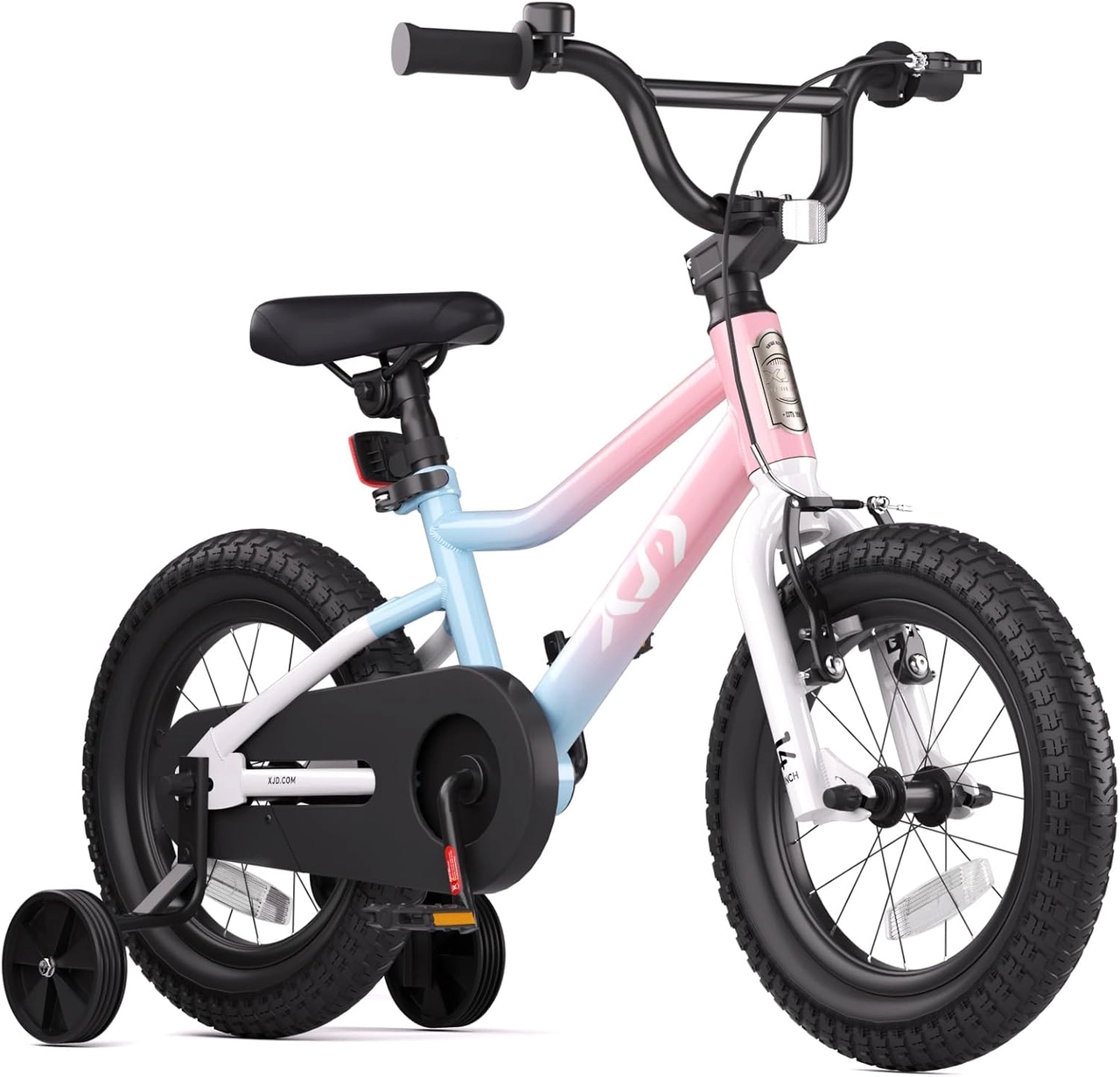 XJD Girls BMX Bike 12/14/16 Inch with Training Wheels – Pink Blue
A Kids’ BMX Bike with training wheels in its title and supplied 12, 14 and 16 Inch SKU labels; relevant when the toddler will ride rather than travel as a passenger.
 XJD Boys & Girls BMX Bike with Training Wheels, 12/14/16" – Blue
A Kids’ BMX Bike whose title states training wheels, with supplied 12, 14 and 16 Inch SKU labels; use it as a fit-check option for an independently riding child.
Measure before comparing wheel sizes
Measure the child’s height without shoes. Also measure inseam from the floor to the crotch while the child stands upright. Use height to identify a starting wheel size, then have the child try the actual bicycle. Age overlaps considerably, so it should never override measurements or observed control.
| Wheel size | XBikes starting age | Rider height |
|---|---|---|
| 12 Inch | 3–4 | 34–40 in / 86–102 cm |
| 14 Inch | 3–6 | 37–45 in / 94–114 cm |
| 16 Inch | 4–7 | 40–48 in / 102–122 cm |
These ranges overlap intentionally. A three-year-old measuring 38 inches, for example, falls within both the 12 Inch and 14 Inch starting ranges. That means the next step is trying both sizes—not automatically choosing the larger one.
Check fit on the actual bicycle
Have the child sit, stand over and handle each candidate bicycle. Do not buy an oversized model merely to leave room for growth. Confirm all of the following before choosing:
- The child can stand over the bicycle with stable footing rather than being forced onto tiptoes.
- The seated position permits comfortable pedalling without excessive stretching or cramped knees.
- The handlebars are within easy reach without the child leaning or locking their arms.
- The child can steer smoothly, look ahead and keep the bicycle under control.
- The child can reach and operate the bicycle’s braking controls reliably.
- The selected size suits the child’s current confidence, not just height or age.
If the child cannot perform these checks comfortably, reject that bicycle or size even when the chart appears to match. Consult the exact product manual or a qualified bicycle mechanic for assembly, adjustment, torque and maintenance procedures.
Compare the supplied XBikes options
XJD Light Purple Girls Bike with Basket, Training Wheels, 12/14/16/20 Inch is categorized as a Training Wheel Bike. Although its title mentions four sizes, the supplied available SKU labels are 12 Inch, 14 Inch and 16 Inch.
XJD Girls BMX Bike 12/14/16 Inch with Training Wheels – Pink Blue and XJD Boys & Girls BMX Bike with Training Wheels, 12/14/16" – Blue are categorized as Kids’ BMX Bikes. Both also have supplied available SKU labels of 12 Inch, 14 Inch and 16 Inch.
For this decision, their verified common ground is the same three available size labels and the presence of training wheels stated in each exact title. Their verified differences are catalog category, title wording and color wording. No supplied facts establish weight, frame material, brake type, geometry or component quality, so compare those details only in the exact manuals or verified product information.
Prepare for the first rides
Use a bicycle helmet made for cycling. It must fit the child properly, sit level and have its straps adjusted according to the helmet manufacturer’s instructions. An adult should check the fit before every ride.
- Begin in a flat, open area away from traffic, driveways, obstacles and crowds.
- Let the child practise getting on and off before moving.
- Work separately on looking ahead, steering, pedalling and stopping.
- Stay close enough to intervene while allowing the child to control the bicycle.
- End the session when attention, coordination or confidence begins to fade.
Training wheels can support early pedalling practice, but their presence does not correct an oversized or poorly fitting bicycle. Before riding, follow the bicycle’s manual for assembly and inspection; use a qualified mechanic if anything is unclear.
Make the decision
For a toddler riding independently, measure height and inseam today, shortlist only the matching 12, 14 or 16 Inch starting sizes, and arrange an individual fit check. Choose only when the child can stand over, reach, steer and brake with control. For carrying a toddler as a passenger, skip these three bicycles and select a compatible child-carrying system instead.
Bikes for your next adventure
-

Kids Bike Helmet by XJD for Boys & Girls – Black, Blue, Green, Pink, Purple
The XJD Kids Bike Helmet covers a wide 2-to-8-year age range thanks to two head-…$59.99
-

Kids Bike Helmet by XJD for Girls – Pink
The XJD Kids Bike Helmet in Pink is a lightweight multi-sport helmet for girls r…$59.99
$99 -

XJD Kids Bike for Girls – Pink, 12/14/16/20 Inch with Training Wheels
The XJD Kids Bike for Girls in Pink is a training-wheel bike built to carry your…$139
$159