

How to buy a bike for a 6 year old
To buy a bike for a 6 year old, measure the child first, then compare 14, 16 and 18 Inch starting points. Choose only after checking stand-over, reach, brake control and confidence on the actual bike.
Measure before choosing a wheel size
Age narrows the search, but it does not determine fit. Measure the child's standing height without shoes, with their back against a wall. Then measure inseam from the floor to the crotch while the child stands upright. Record both measurements in inches or centimetres.
Use height to identify likely wheel sizes, then use inseam, reach and control to make the final decision. Frame shapes and riding positions can differ even when two bicycles have the same wheel label, so a chart cannot replace trying the bike.
Compare the likely sizes for a 6 year old
| Wheel size | XBikes starting point | What it means at age 6 |
|---|---|---|
| 12 Inch | Ages 3–4; 34–40 in / 86–102 cm | Usually below the age starting point; consider only if the measured height and individual fit support it. |
| 14 Inch | Ages 3–6; 37–45 in / 94–114 cm | May suit a shorter 6 year old who can comfortably control the bicycle. |
| 16 Inch | Ages 4–7; 40–48 in / 102–122 cm | A common starting range to investigate, subject to the full fit check. |
| 18 Inch | Ages 5–9; 43–52 in / 109–132 cm | Worth comparing for a child whose measured height falls in this range. |
| 20 Inch | Ages 7–12; 48–60 in / 122–152 cm | Consider only when the child meets the height range and handles the bike confidently; do not size up merely for growth. |
If the child falls within two overlapping ranges, try both sizes. Prefer the bicycle they can mount, balance, steer, stop and restart with greater control—not automatically the larger one.
Perform the fit and control check
Have the child try the bicycle while wearing ordinary riding shoes. Check that they can stand over it comfortably, reach the handlebars without stretching, turn the bars without losing their riding position and operate the brakes reliably. Their hands should reach the controls naturally, without an awkward grip.
Also observe confidence. A bicycle that technically matches the height chart can still be unsuitable if the child appears tense, cannot manage its size or struggles to start and stop. Do not buy an oversized bike on the assumption that the child will grow into it; immediate control matters more than extra growing room.
Decide whether training wheels are relevant
Training wheels may be relevant if the child is not yet ready to balance independently or already rides confidently with that setup. They are not automatically necessary because the rider is six. Consider the child's present balance, starting and stopping skills, and willingness to practise.
The supplied catalog options are useful when a training-wheel bicycle is appropriate because they let you compare 12, 14 and 16 Inch labels, plus one 20 Inch option. They do not include an 18 Inch choice, and their size labels still require the measurements and hands-on checks above.
 Light Pink XJD Girls' Bicycle with Basket & Training Wheels
Available in 12, 14, 16 and 20 Inch labels with training wheels and a basket named in the title. For a 6 year old, select only through measured height and an individual fit check.
 Blue XJD Girls Bike with Training Wheels – 12/14/16 Inch
A training-wheel option offered in 12, 14 and 16 Inch labels. Its 14 or 16 Inch versions may be relevant to a 6 year old when the supplied height ranges and hands-on control checks agree.
 XJD Boys 12/14/16" Training Wheel Bike – Blue
A blue training-wheel bicycle offered in 12, 14 and 16 Inch labels. The title's gender wording is not fit evidence; use measured height, inseam, reach, brake control and confidence to choose.
Compare the three catalog options
Light Pink XJD Girls' Bicycle with Basket & Training Wheels is listed in 12, 14, 16 and 20 Inch sizes. It offers the broadest wheel-label selection of these three and is the only supplied option with both a basket named in the title and a 20 Inch label. For a 6 year old, compare its 14 and 16 Inch versions first when height supports them. Its 20 Inch version is relevant only from 48 in / 122 cm and after a successful fit check.
Blue XJD Girls Bike with Training Wheels – 12/14/16 Inch is available in 12, 14 and 16 Inch labels. XJD Boys 12/14/16" Training Wheel Bike – Blue has the same supplied size-label range. Between these two, the catalog facts establish differences in exact title and naming, but do not provide geometry, component or performance differences. Choose the size through fit rather than the gender wording or colour wording in the titles.
None of these products supplies an 18 Inch option in the provided catalog facts. If the child's measurements and trial indicate that 18 Inch gives better control than 16 or 20 Inch, these particular products are not the right match.
Complete the purchase decision
- Write down the child's height and inseam.
- Shortlist every wheel size whose XBikes height range includes that measurement.
- Have the child try the shortlisted sizes and compare stand-over room, reach, steering, braking and confidence.
- Choose training wheels only if they match the child's current riding stage.
- Fit a bicycle helmet so it sits level and secure its straps according to the helmet manufacturer's instructions.
For assembly, adjustments, maintenance, compatibility, load limits and torque, follow the exact product manual or ask a qualified bicycle mechanic; no product-specific instructions are supplied here. Buy the size your 6 year old can control now, even when a larger model appears to offer more room for future growth.
Bikes for your next adventure
-

Kids Bike Helmet by XJD for Boys & Girls – Black, Blue, Green, Pink, Purple
The XJD Kids Bike Helmet covers a wide 2-to-8-year age range thanks to two head-…$59.99
-

Blue XJD Kids Bike Helmet for Boys & Girls
The Blue XJD Kids Bike Helmet is a lightweight, adjustable multi-sport helmet fo…$59.99
$99 -
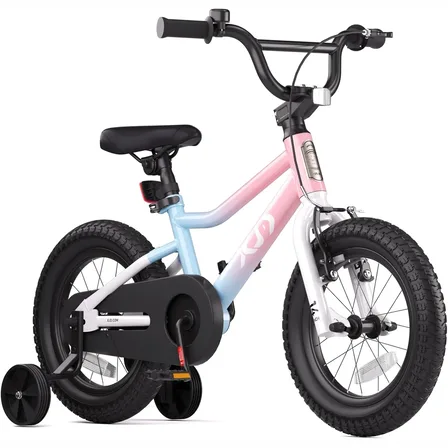
XJD Girls BMX Bike 12/14/16 Inch with Training Wheels – Pink Blue
The XJD Girls BMX Bike in Pink/Blue is built as a first pedal bike for kids roug…$99.99
$119.99