

How to buy bikes for young kids
To buy a bike for a young child, measure the child’s height and inseam, shortlist a wheel size, then check stand-over clearance, reach, brakes and confidence in person. Never choose an oversized bicycle simply to allow room for growth.
Measure the rider before shopping
Start with the child’s current height, measured without shoes against a wall. Then measure inseam from the floor to the crotch while the child stands naturally. Record both measurements rather than relying on age, clothing size or an estimate from several months ago.
Height helps you shortlist wheel sizes. Inseam helps you judge whether the child can stand over the bicycle comfortably and get on and off without struggling. The final fit still depends on the bicycle’s individual geometry, so measurements narrow the search rather than guarantee a match.
Use wheel size as a starting point
| Wheel size | Starting age | Rider height |
|---|---|---|
| 12 Inch | 3–4 | 34–40 in / 86–102 cm |
| 14 Inch | 3–6 | 37–45 in / 94–114 cm |
| 16 Inch | 4–7 | 40–48 in / 102–122 cm |
| 18 Inch | 5–9 | 43–52 in / 109–132 cm |
| 20 Inch | 7–12 | 48–60 in / 122–152 cm |
| 24 Inch | 10–14 | 54–64 in / 137–163 cm |
| 26 Inch | Youth and adults | Over 60 in / 153 cm |
Where ranges overlap, prioritize measured height, inseam, reach, brake control and present confidence—not age alone. A child near a boundary may need to try both adjacent sizes. Buying the larger option for future growth can make starting, stopping and steering harder now.
Check the bicycle with the child
Have the child try the exact bicycle whenever possible. Clothing and footwear should be similar to what they will use while riding. Observe the whole sequence rather than judging fit from a seated pose.
- Stand-over: The child should be able to straddle the bicycle and remain stable, with practical clearance rather than pressure from the frame.
- Mounting and starting: They should be able to get on, establish balance and begin moving without the bicycle feeling unwieldy.
- Reach: Hands should reach the controls without an extreme stretch, locked elbows or a forced posture.
- Brake control: The child must be able to reach and operate the provided brakes reliably. Check the exact bicycle rather than assuming all models of one wheel size fit alike.
- Stopping and dismounting: Ask the child to demonstrate a controlled stop and get off without panic or loss of balance.
If any of these checks fail, try another size or bicycle. Adjustments, assembly, compatibility and torque must follow the exact product manual; use a qualified bicycle mechanic when the correct setup is uncertain.
Compare the supplied XBikes options
The supplied catalog choices are relevant when measurements point to a 12, 14 or 16 Inch bicycle. Black XJD Kids' BMX Bicycle with Training Wheels is categorized as a Kids' BMX Bike and offers those three size labels. Pink Girls' 12/14/16" Bike by XJD – Basket & Doll Seat is categorized as a Training Wheel Bike and offers the same three size labels.
These particular options help because parents can compare the same available size labels across two different catalog categories, then make the decision through an individual fit check rather than choosing from the title or appearance alone.
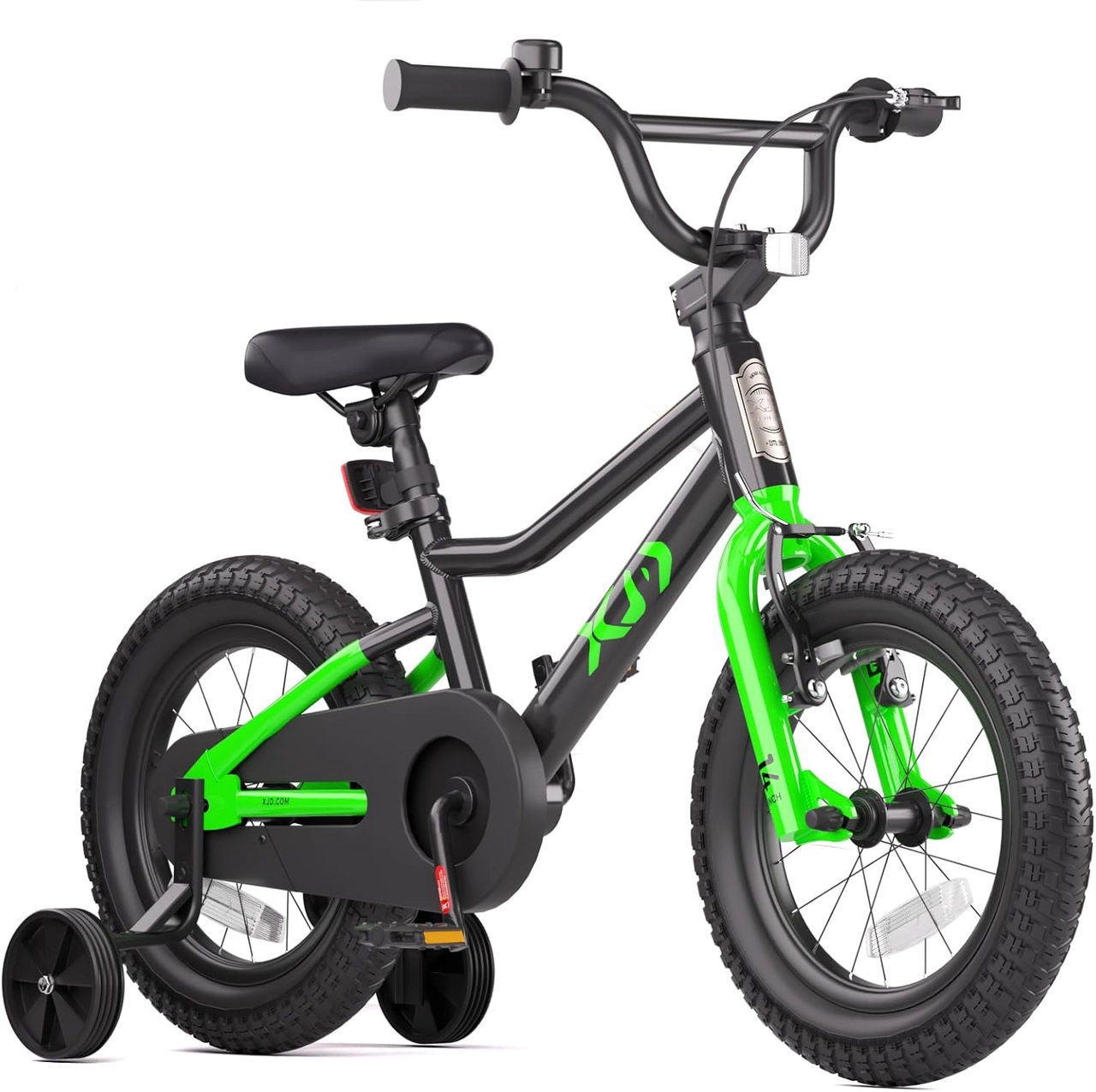 Black XJD Kids' BMX Bicycle with Training Wheels
Relevant when an individual fit check supports a 12, 14 or 16 Inch bike. This Kids' BMX Bikes catalog option includes training wheels in its exact title, but size, reach and brake control still need checking.
 Pink Girls' 12/14/16" Bike by XJD – Basket & Doll Seat
A Training Wheel Bikes option available in 12, 14 and 16 Inch labels. Its basket and doll seat appear in the exact catalog title; choose it only after confirming the child’s measurements and control.
Neither supplied product is relevant if the rider’s measurements and trial indicate an 18 Inch or larger bicycle. Conversely, a 12, 14 or 16 Inch label does not prove that either model fits: confirm stand-over, reach, brake operation and confidence on the exact selected size. Any descriptive wording in a product title is a catalog label, not independent fit evidence.
Plan for the child’s current riding stage
Consider what the child can do today. A new or cautious rider may need more time to demonstrate controlled starting, steering and stopping than a confident rider of the same height. Training wheels appearing in the supplied product information may be relevant to the family’s chosen learning approach, but they do not correct a poor frame fit or unreachable controls.
Compare only features you can verify from the listing and manual. For assembly, maintenance, load limits, component compatibility and torque, follow the exact product manual or ask a qualified bicycle mechanic. Do not improvise settings or assume that instructions transfer between models.
Complete the purchase safely
Include a properly fitting bicycle helmet in the purchase plan. It should sit level and use its straps according to the helmet manufacturer’s instructions. Recheck the fit on the child rather than selecting solely from an age label.
- Measure current height and inseam.
- Use the XBikes ranges to shortlist a wheel size.
- Try the exact bicycle and check stand-over, reach, brake control, starting and stopping.
- Reject an oversized or hard-to-control option, even if it promises more growing room.
- Follow the product and helmet manuals, arranging qualified mechanical help when needed.
Buy only when the child can control the correctly shortlisted bicycle now; if the fit check is inconclusive, postpone the decision or compare another size rather than guessing.
Bikes for your next adventure
-

Kids Bike Helmet by XJD for Boys & Girls – Black, Blue, Green, Pink, Purple
The XJD Kids Bike Helmet covers a wide 2-to-8-year age range thanks to two head-…$59.99
-

Blue XJD Kids Bike Helmet for Boys & Girls
The Blue XJD Kids Bike Helmet is a lightweight, adjustable multi-sport helmet fo…$59.99
$99 -

XJD Girls BMX Bike 12/14/16 Inch with Training Wheels – Pink Blue
The XJD Girls BMX Bike in Pink/Blue is built as a first pedal bike for kids roug…$99.99
$119.99