

How to carry 5 year old on bike
To carry a 5-year-old on a bike, use a child-passenger seat, trailer or cargo bike that explicitly permits the child’s measured weight and size; do not place the child on the handlebar, top tube or an ordinary rear rack. If you mean choosing a bike for the child to ride, measure height and inseam and check fit in person.
First decide whether the child will ride or be a passenger
A five-year-old may be ready to pedal independently, yet age alone does not answer the fit question. If the child will be a passenger, the adult bicycle and carrier must form an approved, compatible system. Check the carrier and bicycle manuals for child-size limits, total load limits, mounting requirements and compatible bicycle types.
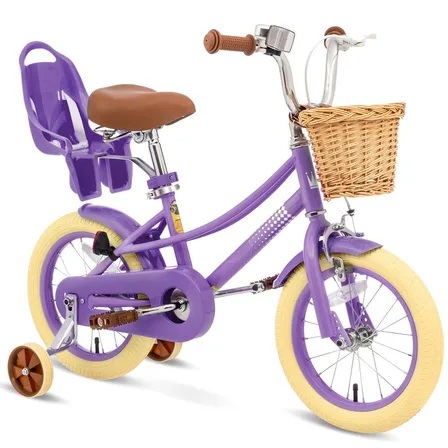
The supplied XBikes product is a child’s bicycle, not a documented passenger carrier. It is relevant when “carry” means helping a five-year-old move to independent riding. No supplied catalog fact establishes that it can carry a child as a passenger on another bicycle.
If the child will be a passenger
Measure the child’s current weight and seated size, then compare both with the exact carrier manual. Also confirm that the adult bicycle permits that carrier and combined load. Because no passenger-seat, trailer or cargo-bike specifications were supplied here, a safe compatibility or load-limit claim cannot be made from appearance alone.
- Use every provided restraint and foot-retention feature exactly as its manufacturer directs.
- Keep clothing, laces, fingers and feet away from wheels and other moving parts.
- Check the mount before each trip and stop if anything shifts, loosens or interferes with steering or braking.
- Have a qualified bicycle mechanic assess installation when the manuals do not clearly confirm compatibility.
Carry the child only after both manuals confirm the setup. Remember that a passenger changes balance, turning and stopping, so practise mounting, starting, braking and dismounting away from traffic before riding with the child.
If the five-year-old will ride independently
Measure standing height without shoes. Measure inseam from the floor to the crotch while the child stands straight with feet slightly apart. Use height to identify a starting wheel size, then have the child try the actual bicycle; frame geometry can differ even when wheel labels match.
| Wheel size | XBikes starting range | Meaning at age five |
|---|---|---|
| 12 Inch | Ages 3–4; 34–40 in / 86–102 cm | Usually below the age starting point; consider only if measured height and actual fit support it. |
| 14 Inch | Ages 3–6; 37–45 in / 94–114 cm | A possible starting point within the age range. |
| 16 Inch | Ages 4–7; 40–48 in / 102–122 cm | Another possible starting point within the age range. |
| 18 Inch | Ages 5–9; 43–52 in / 109–132 cm | Relevant for taller riders, subject to a complete fit check. |
These ranges overlap, so never select by birthday alone or buy oversized for growth. Height narrows the comparison; inseam, reach, brake control and confidence decide whether the specific bike works now.
Perform the fit check
Have the child stand over the bicycle and confirm comfortable clearance rather than contact with the frame. Seated, the child should reach the handlebar without stretching, turn it while remaining balanced, and operate the brakes reliably with their hands. They should be able to start, stop and put a foot down with control.
Compare adjacent sizes when height falls in an overlap. Reject a bike if the child cannot manage its stand-over height, reach or brakes, even when the chart includes their age or height. Training wheels may support early practice, but they do not correct a frame that is too large or controls that are out of reach.
How the supplied XBikes option helps
The XJD Light Purple Girls Bike with Basket, Training Wheels, 12/14/16/20 Inch is categorized as a Training Wheel Bike, with supplied available SKU labels of 12 Inch, 14 Inch and 16 Inch. Those three labeled options let you compare nearby starting sizes for many five-year-olds, but only the child’s measurements and hands-on control can identify a suitable fit.

The 14 Inch and 16 Inch labels are the most directly age-relevant comparison points under the supplied chart. The 12 Inch label may be relevant for a shorter child whose measured height falls within 34–40 in / 86–102 cm, despite its ages 3–4 starting range. Although “20 Inch” appears in the exact product title, 20 Inch is not among the supplied available SKU labels, so do not assume it is selectable. The XBikes 20 Inch starting point is ages 7–12 and 48–60 in / 122–152 cm, making it an unsuitable age-only shortcut for a typical five-year-old.
Helmet and final decision
Use a bicycle helmet that fits properly, sits level and has straps adjusted according to its manufacturer’s instructions. A helmet is necessary whether the child rides independently or uses a passenger system, but it does not make an incompatible carrier or oversized bicycle appropriate.
Your next step is specific: for passenger travel, record weight and seated size and verify both manuals before buying or riding; for independent riding, record height and inseam, compare 14 Inch and 16 Inch first when the chart supports them, and choose only the bicycle the child can stand over, reach, brake and control confidently today.
Bikes for your next adventure
-

XJD Kids Bike for Girls – Pink, 12/14/16/20 Inch with Training Wheels
The XJD Kids Bike for Girls in Pink is a training-wheel bike built to carry your…$139
$159 -

XJD Boys 12/14/16" Training Wheel Bike – Blue
The XJD Boys Bike in Blue is a training wheel bike for riders 71–122 cm tall—rou…$169
$199 -
XJD Girls' Bike with Training Wheels, 12/14/16/20 Inch – Purple
The XJD girls' bike with training wheels in Purple is built to grow with your ri…$139
$159