

How to carry a baby on a bicycle
To carry a baby on a bicycle, use a purpose-built child seat, trailer or cargo-bike restraint that explicitly fits your bicycle and child.
Start with the child, not the carrier
First confirm that your baby is developmentally ready for the specific passenger system. Read its minimum passenger requirements and ask your pediatrician if you are uncertain about head and neck control, posture or readiness. Local laws may also restrict where or when a baby may ride.
Do not substitute a basket, doll seat, improvised cushion, sling or adult backpack for an approved child-passenger system. A baby must be held by the restraint exactly as its manufacturer directs.
Measure and compare before buying
Record the baby's current height and weight, then compare both with the carrier manual. Check the permitted passenger position and any developmental requirements as well. For the bicycle, identify its exact model, frame size, wheel size, rack model if present, and mounting points.
Compare those details with the carrier's bicycle-compatibility list. Also verify the carrier's load limit, mounting hardware, clearance requirements and approved installation position. None of those specifications can be assumed from appearance alone. If a manual does not explicitly confirm compatibility, contact the manufacturer or ask a qualified bicycle mechanic.
Choose the right carrying format
Mounted child seat
A front-, rear- or rack-mounted child seat keeps the passenger attached to the bicycle. Confirm that the exact mounting method is approved for both the seat and bicycle. After installation, check that steering, pedalling, braking and wheel movement remain unobstructed.
Bicycle trailer
A trailer places the baby behind the bicycle. Verify that its hitch fits the exact bicycle and that the trailer permits a passenger of your baby's size and developmental stage. Follow its manual for restraints, covers, visibility equipment and any required accessories.
Cargo bicycle
A cargo bicycle may carry children only when its designated passenger area, restraint and accessories support that use. Follow the bicycle and accessory manuals for passenger limits and configuration; do not infer capacity from the available space.
Install and practise before carrying the baby
- Follow the exact product manual for assembly, attachment, compatibility, load limits and torque settings.
- Have a qualified bicycle mechanic inspect the installation if any instruction, fastener or mounting point is unclear.
- Check tires, brakes, steering and all carrier attachments before every ride.
- Practise mounting, dismounting, starting, stopping and turning without the baby, using permitted ballast if the carrier manual provides a procedure.
- Plan a short first ride on a quiet, smooth route and avoid abrupt manoeuvres.
Added passenger weight changes balance, stopping and handling. Never leave a baby unattended in a carrier or on a bicycle, particularly while the bicycle is supported only by a kickstand.
Fit the restraint and helmet correctly
Secure every harness, buckle, foot restraint and protective component according to the carrier instructions. Clothing and straps must not hang near wheels, spokes, chains or other moving parts. Recheck the fit as the baby grows and whenever clothing thickness changes.
A bicycle helmet must be the correct size, sit level and use its straps according to the helmet manufacturer's instructions. Confirm with the passenger-system manual and applicable local rules when a helmet is required, and ensure the helmet does not force the baby's head into an unsuitable position.
How the supplied kids' bikes relate
The Black XJD Kids' BMX Bicycle with Training Wheels and the Pink Girls' 12/14/16" Bike by XJD – Basket & Doll Seat are children's bicycles offered in 12 Inch, 14 Inch and 16 Inch sizes. They can help families compare a future stage when a child rides independently, but the supplied facts do not identify either as a baby-carrying bicycle or compatible with a child seat or trailer. The doll seat named on the pink model is not evidence of suitability for carrying a baby.
 Black XJD Kids' BMX Bicycle with Training Wheels
Available in 12 Inch, 14 Inch and 16 Inch sizes for a later independent-riding comparison; the supplied facts do not establish baby-seat, trailer or passenger compatibility.
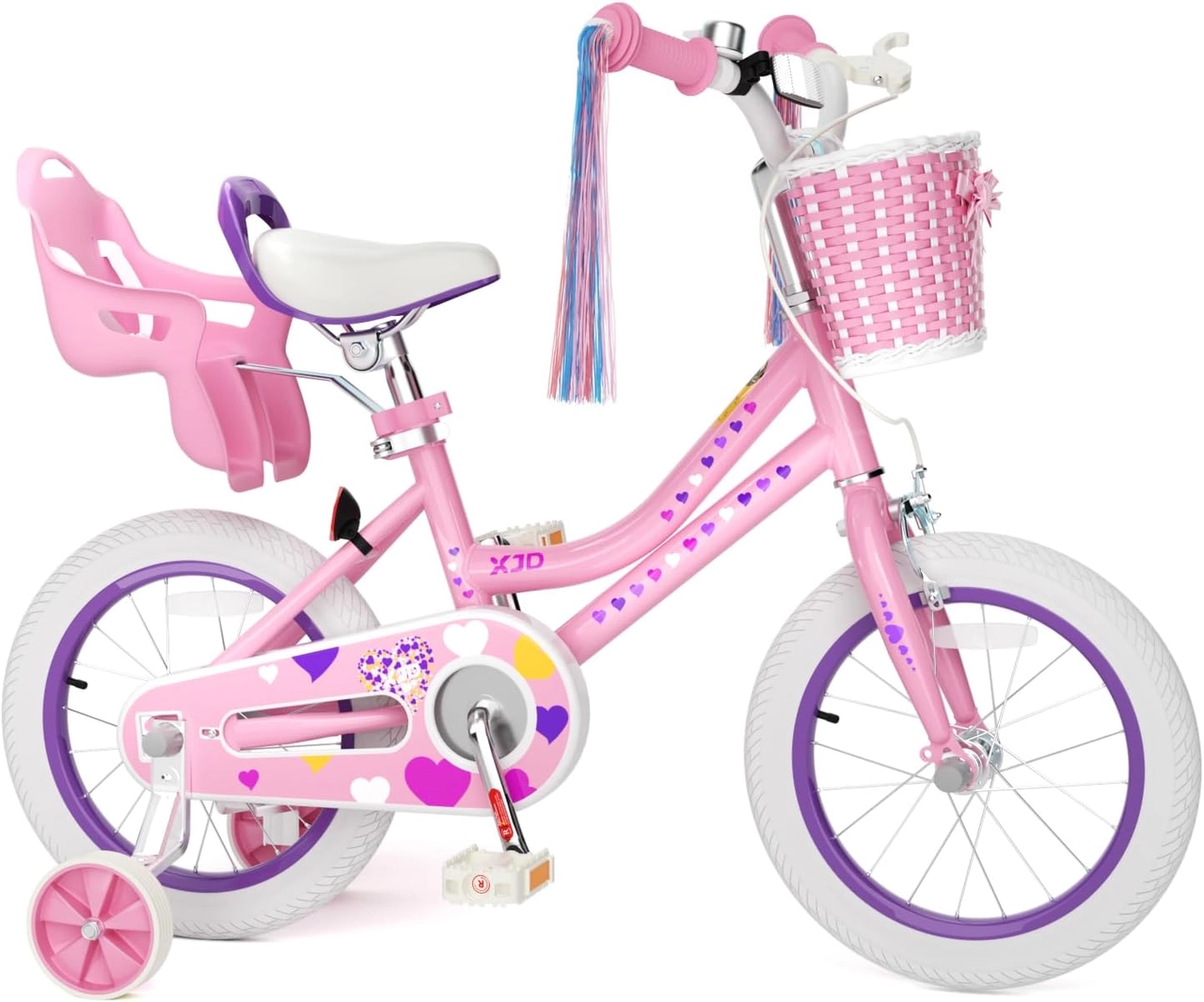 Pink Girls' 12/14/16" Bike by XJD – Basket & Doll Seat
A 12 Inch, 14 Inch or 16 Inch children's bicycle for later riding comparison. Its catalog-named doll seat must not be treated as equipment for carrying a baby.
For later independent riding, XBikes uses these starting points: 12 Inch for 34–40 in (86–102 cm), generally ages 3–4; 14 Inch for 37–45 in (94–114 cm), generally ages 3–6; and 16 Inch for 40–48 in (102–122 cm), generally ages 4–7. These ranges overlap, so measure the rider and check inseam, stand-over clearance, reach, brake control and confidence. Have the child try the bicycle, and never choose an oversized bicycle merely for growth.
Make the final go-or-no-go decision
Carry your baby only when the passenger system explicitly accepts the baby's measurements and developmental stage, the manufacturer confirms compatibility with the exact bicycle, the restraint fits correctly, and the installed bicycle remains controllable. If any one of those checks is unresolved, postpone the ride and take the bicycle, carrier and manuals to a qualified mechanic; the two listed kids' bikes are comparison options for later independent riding, not verified baby carriers.
Bikes for your next adventure
-

XJD Kids Bike for Girls – Pink, 12/14/16/20 Inch with Training Wheels
The XJD Kids Bike for Girls in Pink is a training-wheel bike built to carry your…$139
$159 -

XJD Boys 12/14/16" Training Wheel Bike – Blue
The XJD Boys Bike in Blue is a training wheel bike for riders 71–122 cm tall—rou…$169
$199 -
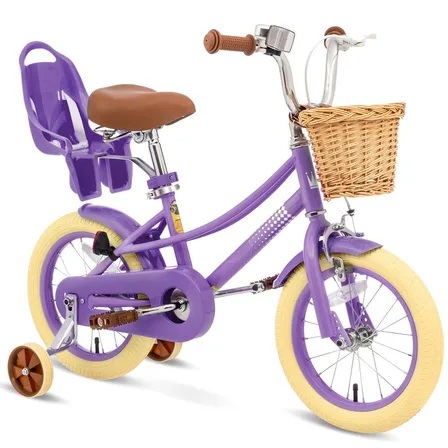
XJD Girls' Bike with Training Wheels, 12/14/16/20 Inch – Purple
The XJD girls' bike with training wheels in Purple is built to grow with your ri…$139
$159