

How to learn bicycle kids
To help a child learn to ride a bicycle, measure the child first, choose a bike they can stand over and control, then practise balance before pedalling.
Measure the child before choosing a bicycle
Start with the rider’s current height and inseam, measured while wearing the shoes they will use for riding. Height identifies a likely wheel-size range; inseam helps you check whether the child can stand over the bicycle without the frame obstructing them.
Age is only a starting point. The child must try the actual bicycle. Check that they can mount and dismount comfortably, reach the handlebar without stretching, turn it while remaining balanced, and operate the brakes with their hands in a normal riding position. Do not buy an oversized bicycle merely to allow room for growth.
Compare the measurement with these starting points
| Wheel size | Age starting point | Rider height |
|---|---|---|
| 12 Inch | 3–4 | 34–40 in / 86–102 cm |
| 14 Inch | 3–6 | 37–45 in / 94–114 cm |
| 16 Inch | 4–7 | 40–48 in / 102–122 cm |
| 18 Inch | 5–9 | 43–52 in / 109–132 cm |
| 20 Inch | 7–12 | 48–60 in / 122–152 cm |
| 24 Inch | 10–14 | 54–64 in / 137–163 cm |
| 26 Inch | Youth and adults | Over 60 in / 153 cm |
Where ranges overlap, compare the real fit rather than automatically choosing the larger wheel. Prioritize measured height, inseam clearance, reach, brake control and the child’s present confidence.
Teach balance before adding pedalling
- Choose the practice area: use a flat, open place away from traffic, obstacles and steep slopes.
- Check basic control: ask the child to mount, look ahead, steer, stop and dismount while you remain close.
- Practise balance: let the child move slowly and learn to coast while keeping eyes forward. Use the bicycle only in a configuration permitted by its manual; do not improvise component removal.
- Add pedalling: once coasting and stopping are controlled, practise starting with one pedal positioned for a confident first push.
- Build gradually: repeat short starts, straight runs, gentle turns and controlled stops. Introduce more complex surroundings only after these actions are consistent.
Support the child rather than pulling the handlebar, which can take steering control away from them. Keep sessions short enough that fatigue and frustration do not replace attention.
Confirm brakes, helmet and bicycle condition
Before every practice, confirm that the child can reach and operate the brakes without shifting their hands into an awkward position. Follow the exact bicycle manual for assembly, adjustments, maintenance, compatibility, load limits and torque. If anything is unclear or does not operate correctly, use a qualified bicycle mechanic.
A bicycle helmet must fit properly, sit level and have its straps adjusted according to the helmet manufacturer’s instructions. A helmet does not correct a poorly fitting bicycle or make an unsuitable practice area appropriate.
When the supplied cruiser bicycles are relevant
The supplied options help answer the sizing decision for taller or older beginners because they provide 24-inch and 26-inch comparison choices. They are not substitutes for the smaller wheel sizes indicated for shorter children, and each still requires an individual stand-over, reach and brake-control check.
 XJD 24-Inch Green Beach Cruiser Bike with U-Brake
A 24- or 26-inch beach cruiser comparison for learners whose measured height fits those starting ranges. Available labels include Green / 24 Inch, Pink / 24 Inch and Pink / 26 Inch; verify stand-over, reach and U-brake control.
 Pink XJD Beach Cruiser Bike, 24"/26", U-Brake
This pink beach cruiser offers 24 Inch and 26 Inch labels and specifies a U-brake. It is relevant only when the learner’s measured height and individual fit support one of those sizes.
XJD 24-Inch Green Beach Cruiser Bike with U-Brake is a beach cruiser offered as Green / 24 Inch, Pink / 24 Inch and Pink / 26 Inch. Its 24-inch versions align with the 54–64 in / 137–163 cm starting range; the 26-inch version is a starting point for riders over 60 in / 153 cm.
Pink XJD Beach Cruiser Bike, 24"/26", U-Brake is another beach cruiser with 24 Inch and 26 Inch SKU labels. Compare it by the child’s measured fit and preferred available size label—not by assuming that either wheel size will suit every learner.
Both catalog titles specify a U-brake. That fact does not replace a hands-on check that the child can comfortably reach, apply and release the brake controls. No smaller size is supplied here, so these products are comparison points only when the child’s measurements place them near the 24-inch or 26-inch ranges.
Make the go-or-wait decision
Proceed only when the child can stand over the bicycle, reach the handlebar and brakes, steer, stop and dismount without struggling. If the bicycle feels large, brake reach is uncertain or confidence drops, wait or compare a smaller wheel size. The next useful step is simple: record height and inseam, identify the starting size above, and arrange a supervised fit check before the first riding lesson.
Bikes for your next adventure
-

Black XJD Kids Bike for Boys – 12, 14 & 16 Inch Sizes
For a son between roughly 3 and 8 years old, the XJD Kids Bike in Black covers t…$169
$199 -

Blue XJD Girls Bike with Training Wheels – 12/14/16 Inch
If you're shopping for a first pedal bike for a daughter roughly 3 to 8 years ol…$149
$169 -
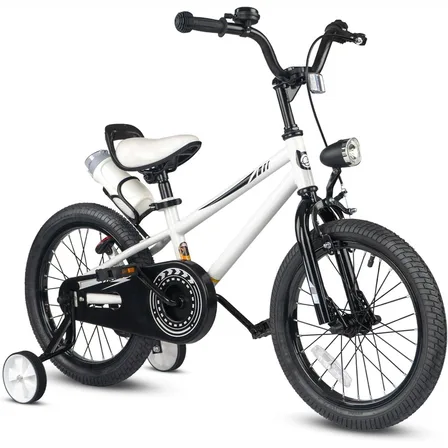
XJD Kids' Training Wheel Bike for Boys & Girls, 12/14/16 Inch – White
The XJD kids' training wheel bike in White is made for riders ages 3–8 (roughly …$169
$199