

How to put an infant in a bike trailer
Put an infant in a bike trailer only when the trailer manual permits it and the child meets every stated age, size, posture and support requirement.
Check whether your infant is ready
Begin with the exact trailer model, not a general age recommendation. Read its manual for the minimum passenger requirements, approved seating position, required inserts, harness use and any restrictions on cycling versus strolling. An infant seat, car seat, sling, cushion or homemade support is not automatically suitable just because it fits inside the cabin.
Observe whether your child can maintain the head and body position required by the manual throughout a ride. If the child slumps, tilts sideways, cannot hold the head as required or is below any stated limit, do not ride yet. Ask the child’s pediatrician if readiness is uncertain, especially for a premature infant or a child with medical or developmental needs.
Measure and compare before loading
Measure the infant’s current weight and seated height using the method specified by the trailer maker. Compare those measurements with the manual’s minimum and maximum passenger limits, seat configuration and available headroom. Also check the combined passenger-and-cargo load against the stated capacity. Do not estimate or substitute a limit from another trailer.
- Passenger fit: The child must fall within every limit and sit in the designated passenger position.
- Harness fit: Straps must route over the body exactly as shown, without being twisted, loose or obstructed by bulky clothing.
- Head clearance: Confirm the required clearance above and around the head, including any helmet if the manual requires one.
- Bike compatibility: Verify that the towing bicycle, axle, hitch and any adapter are approved for that trailer.
If a specification, load limit, compatibility rule or assembly detail is missing, consult the exact product manual or a qualified bicycle mechanic rather than improvising.
Set up the trailer exactly as directed
- Assemble the trailer and hitch according to its manual. Use every specified retention device and safety strap.
- Inspect the frame, wheels, tires, hitch, fasteners, fabric enclosure and harness before loading the child.
- Place the infant in the designated seat and orientation. Use only accessories explicitly approved for that trailer and riding mode.
- Fasten and adjust the complete restraint system according to the maker’s instructions. Recheck posture, strap routing and head clearance.
- Secure cargo in its assigned area so it cannot shift toward the passenger or interfere with the wheels.
Never alter the harness, drill the frame or create an adapter to make incompatible equipment connect. Follow the manual for maintenance and torque values; use a qualified bicycle mechanic when the hitch or towing-bike setup is unclear.
Make the first outing a controlled check
Before carrying the infant, pull the empty trailer in a traffic-free area. Learn how the added width and length affect starting, turning and stopping. Then make the first passenger outing short and calm on a smooth route, using the trailer’s weather and debris protection as instructed.
Stop promptly if the child’s posture changes, the harness loosens, a wheel or hitch behaves unexpectedly, or the infant becomes distressed. Recheck the full connection and passenger fit after the initial minutes. Avoid adding loose blankets, toys or bags where they could obstruct the child or moving parts.
Use helmet guidance correctly
Follow the trailer manual and applicable local requirements about helmet use while riding. When a helmet is required, use a bicycle helmet that fits properly, sits level and has straps adjusted according to its manufacturer’s instructions, consistent with U.S. Consumer Product Safety Commission guidance. Do not use an ill-fitting helmet to satisfy a checkbox, and do not let it force the infant’s head into an unsupported position.
Why the supplied bicycle is only a comparison point
The supplied catalog item, XJD Kids Beach Cruiser Bicycle, Rear Rack & V-Brakes, Mint Green, is a bicycle offered with 20 Inch, 24 Inch and 26 Inch SKU labels; it is not identified in the supplied facts as a bike trailer or infant carrier. Those sizes help distinguish a later child-rider fit decision from today’s infant-trailer decision. Under XBikes starting points, 20 Inch corresponds to 48–60 in / 122–152 cm, 24 Inch to 54–64 in / 137–163 cm, and 26 Inch to youth and adults over 60 in / 153 cm. Individual height, inseam, reach, brake control and confidence still take priority over age alone.
Because the title asks about carrying an infant in a trailer rather than choosing a bicycle wheel size, this product is only a catalog comparison point, not a trailer substitute. Its rear rack and V-brakes do not establish trailer compatibility, passenger capacity or hitch approval. Check the trailer and bicycle manuals or ask a qualified bicycle mechanic before pairing any towing bicycle with a trailer.

Make the go-or-wait decision
Ride only if the infant meets every manual requirement, maintains the required posture, fits the complete harness, has proper head clearance, and the trailer-hitch-bicycle combination is explicitly compatible and correctly assembled. If any answer is missing or any fit is doubtful, wait and resolve it with the manufacturer’s instructions, the child’s pediatrician or a qualified bicycle mechanic before putting the infant in the trailer.
Bikes for your next adventure
-

Kids Bike Helmet by XJD for Girls – Pink
The XJD Kids Bike Helmet in Pink is a lightweight multi-sport helmet for girls r…$59.99
$99 -

Blue XJD Kids Bike Helmet for Boys & Girls
The Blue XJD Kids Bike Helmet is a lightweight, adjustable multi-sport helmet fo…$59.99
$99 -
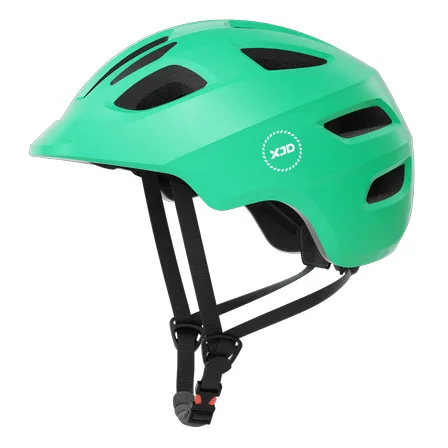
Green XJD Kids Bike Helmet for Boys & Girls
The Green XJD Kids Bike Helmet is a lightweight multi-sport helmet for toddlers …$59.99
$99