

How to ride with 2 kids on a bike
To ride with two kids, use a setup explicitly designed to carry both children and approved for your bicycle, the adult rider and the total load. Do not improvise by adding seats or cargo space. If the children will ride their own bikes, fit each child individually and choose a route that matches the least confident rider.
First decide how the two children will travel
There are two different versions of this ride: one adult bicycle carries both children, or the children pedal separately with an adult. Make that decision before comparing wheel sizes or accessories.
For carrying two children, consult the bicycle and child-carrier manuals together. Confirm that the bicycle permits the exact carrier arrangement, that every component is mutually compatible, and that no stated load limit is exceeded. If any manual is missing, unclear or contradictory, ask a qualified bicycle mechanic to inspect the complete setup.
For independent riding, assess each child separately. One child may need a different wheel size, stopping distance or level of adult assistance from the other.
What to measure and compare
- For a carrying setup: compare the bicycle, rack or mounting points, carrier compatibility, the weight of both children, and the total loaded weight against every applicable manual.
- For each independent rider: measure standing height and inseam, then check stand-over clearance, reach to the handlebar, access to the brakes and the ability to start, steer and stop confidently.
- For the adult: check that the loaded bicycle can be held upright, mounted, steered and stopped under control before entering traffic or a busy path.
Never choose an oversized child’s bike merely to allow room for growth. A child should try the bicycle; age is only a starting point, while measured fit and control decide whether it works now.
XBikes wheel-size starting points
| Wheel size | Starting age | Rider height |
|---|---|---|
| 12 Inch | 3–4 | 34–40 in / 86–102 cm |
| 14 Inch | 3–6 | 37–45 in / 94–114 cm |
| 16 Inch | 4–7 | 40–48 in / 102–122 cm |
| 18 Inch | 5–9 | 43–52 in / 109–132 cm |
| 20 Inch | 7–12 | 48–60 in / 122–152 cm |
| 24 Inch | 10–14 | 54–64 in / 137–163 cm |
| 26 Inch | Youth and adults | Over 60 in / 153 cm |
Use the table to narrow the candidates, not to complete the fit decision. Where height bands overlap, compare both sizes in person when possible. Favor the bicycle on which the child has suitable stand-over clearance, a comfortable reach, reliable brake control and greater present confidence.
Where the supplied bikes fit this decision
The Black XJD Kids' BMX Bicycle with Training Wheels is a Kids' BMX Bikes option offered in 12 Inch, 14 Inch and 16 Inch labels. The Pink Girls' 12/14/16" Bike by XJD – Basket & Doll Seat is a Training Wheel Bikes option with the same three available size labels. These particular catalog options help when one or both children will pedal independently and their measured fit falls within the relevant starting ranges.
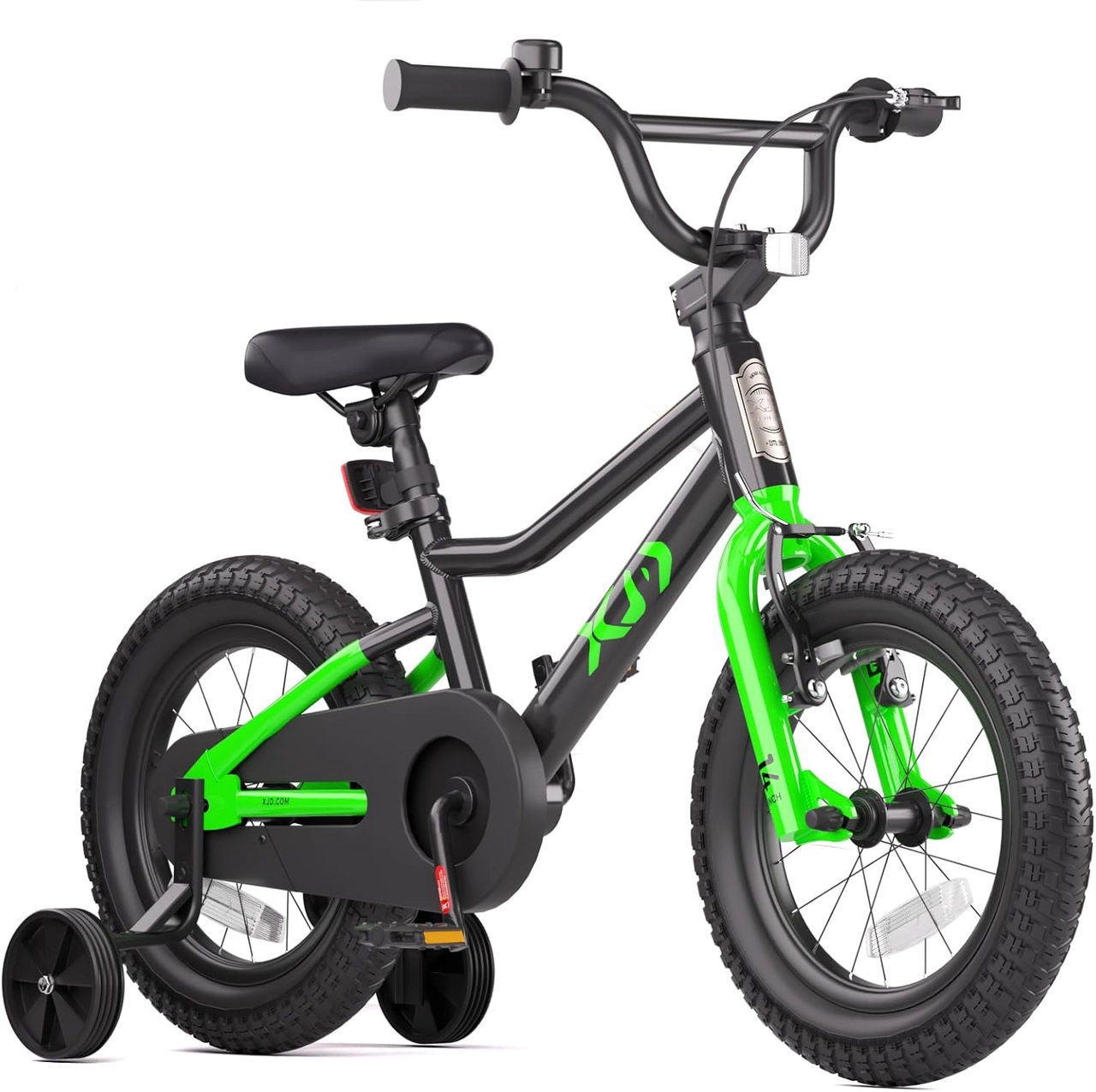 Black XJD Kids' BMX Bicycle with Training Wheels
Relevant when a child will ride independently: this Kids' BMX Bikes model has 12 Inch, 14 Inch and 16 Inch options plus training wheels. Confirm the child’s measured fit and control.
 Pink Girls' 12/14/16" Bike by XJD – Basket & Doll Seat
An independent-riding comparison in the Training Wheel Bikes category, available in 12 Inch, 14 Inch and 16 Inch labels. Its title also identifies a basket and doll seat; verify individual fit.
Because both products stop at 16 Inch, neither is a substitute for a child who fits an 18 Inch, 20 Inch, 24 Inch or 26 Inch bicycle. They are also not evidence of a way to carry two children on one adult bicycle. Compare their available size labels child by child, then verify actual fit, controls and confidence rather than assuming siblings need matching bikes.
Prepare before the first shared ride
- Read the exact manuals for every bicycle, carrier and attachment. Follow their assembly, maintenance, compatibility, load-limit and torque instructions.
- Have a qualified bicycle mechanic resolve uncertain assembly or compatibility and inspect anything you cannot verify.
- Fit a bicycle helmet to every rider and passenger. Each helmet should sit level and use its straps according to the helmet manufacturer’s instructions.
- Practise in a traffic-free area. For a loaded bicycle, rehearse mounting, balancing, turning and controlled stops. For independent riders, check starting, straight-line control, turning, braking and response to the adult’s instructions.
- Choose the first route for the less confident child or for the handling limits of the loaded bicycle. Keep it short enough to stop before fatigue reduces control.
Make the go-or-no-go decision
Ride only when the exact two-child arrangement is permitted by every relevant manual, the load remains within stated limits, helmets fit, and the adult can control the bicycle. If the children ride separately, proceed only after both have individually suitable bikes and can start, steer and stop for the planned setting. Otherwise, change the setup, choose a calmer practice area or postpone the ride.
Bikes for your next adventure
-

Kids Bike Helmet by XJD for Boys & Girls – Black, Blue, Green, Pink, Purple
The XJD Kids Bike Helmet covers a wide 2-to-8-year age range thanks to two head-…$59.99
-

Kids Bike Helmet by XJD for Girls – Pink
The XJD Kids Bike Helmet in Pink is a lightweight multi-sport helmet for girls r…$59.99
$99 -

XJD Kids Bike for Girls – Pink, 12/14/16/20 Inch with Training Wheels
The XJD Kids Bike for Girls in Pink is a training-wheel bike built to carry your…$139
$159