

How to tell what size child bike tire you have
Find your child’s bike tire size on the tire sidewall, then match the complete marking—not just the wheel-inch number. Look for a label such as 16 x 1.75 and, ideally, an ISO size such as 47-305.
Read the tire sidewall first
Rotate the wheel slowly and inspect both sides of the tire. The size may be molded into the rubber rather than printed, so clean away dirt and use light from the side to reveal raised characters.
An inch-format marking normally gives the nominal wheel size followed by tire width. For example, on 16 x 1.75, 16 is the named wheel-size class and 1.75 is the approximate tire width. Record every number, decimal, multiplication sign and unit exactly as shown.
You may also find an ISO or ETRTO-style marking with two numbers separated by a hyphen. In 47-305, the first number is the approximate inflated tire width in millimetres, while the second is the rim’s bead-seat diameter. That second number is particularly useful because inch labels can describe more than one incompatible rim diameter.
What to compare when buying a replacement
- Match the bead-seat diameter: If an ISO marking is available, the replacement tire’s second ISO number must match the existing tire or rim.
- Check the width: Start with the current tire’s width. A different width may interfere with the rim, fork, frame, brakes or guards even when the diameter matches.
- Check the complete format: Do not assume every tire carrying the same first inch number will fit.
- Confirm the tube: If replacing the inner tube too, choose one whose stated diameter and width range include the tire’s complete size. Match the valve style to the rim opening and existing setup.
Do not use the outside diameter of an inflated tire as the purchasing size. Tread depth, pressure and tire width change that measurement, and a nominal “16-inch” tire is not necessarily 16 inches across.
If the marking is missing or unreadable
First inspect the rim and the old inner tube for a readable size marking. Photograph any partial markings before removing parts. If you can identify an ISO diameter but not the width, measure the inflated tire across its widest point as a starting reference, then check available clearance on both sides and above the tire.
If no reliable diameter marking remains, take the wheel or old tire to a qualified bicycle mechanic. Measuring the rim’s bead-seat diameter accurately is more demanding than measuring its outer edge. Do not force on a tire that seems close: a near match is not an equivalent size. Follow the bicycle, wheel and tire manuals for compatibility, inflation, installation and maintenance details.
Tire size is not the same as bicycle fit
A sidewall number identifies tire and rim compatibility; it does not prove that the bicycle fits the child. If you are also checking whether the whole bike is appropriately sized, use measured rider height as the starting point and have the child try the bicycle.
| Wheel size | XBikes starting point |
|---|---|
| 12 Inch | Ages 3–4; 34–40 in / 86–102 cm |
| 14 Inch | Ages 3–6; 37–45 in / 94–114 cm |
| 16 Inch | Ages 4–7; 40–48 in / 102–122 cm |
| 18 Inch | Ages 5–9; 43–52 in / 109–132 cm |
| 20 Inch | Ages 7–12; 48–60 in / 122–152 cm |
| 24 Inch | Ages 10–14; 54–64 in / 137–163 cm |
| 26 Inch | Youth and adults over 60 in / 153 cm |
These are starting points, not a substitute for an individual fit check. Prioritize the child’s measured height, inseam, reach, ability to operate the brakes and current confidence over age alone. Check stand-over clearance and control, and do not choose an oversized bicycle merely to allow room for growth.
How the catalog examples help
The Pink 12/14/16/20" XJD Girls Bike with Training Wheels & Basket provides 12 Inch, 14 Inch, 16 Inch and 20 Inch SKU labels, making it useful for comparing how several named wheel-size classes appear in the catalog. The Blue XJD Freestyle BMX Bike, 20-Inch – No Pegs supplies a separate 20-inch catalog reference. These labels help identify size classes, but they do not establish replacement-tire compatibility; verify the actual sidewall or ISO marking.
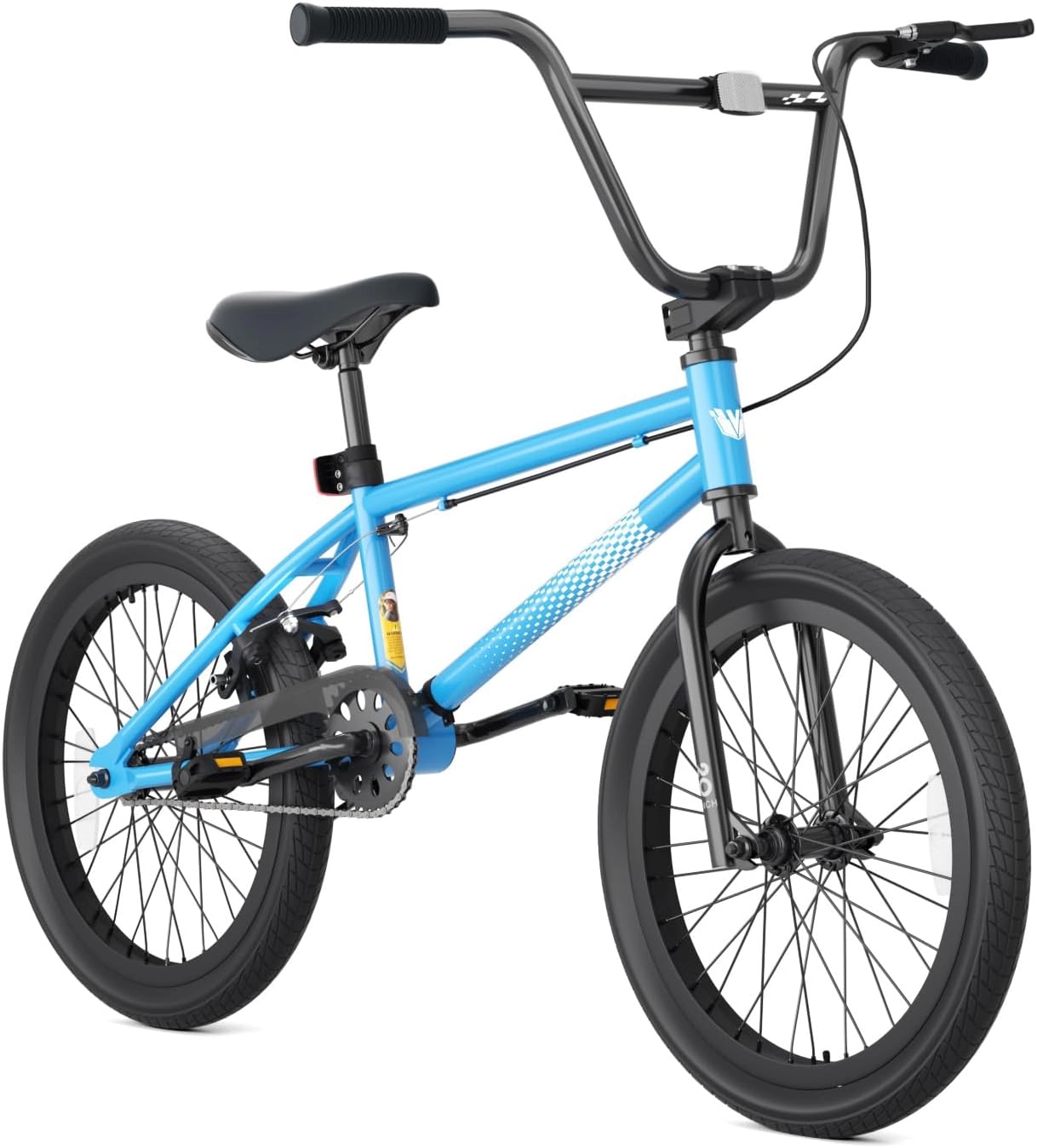 Blue XJD Freestyle BMX Bike, 20-Inch – No Pegs
A 20-inch kids’ BMX catalog reference that can help identify the named wheel-size class, but the actual tire sidewall or ISO marking must determine replacement compatibility.
 Pink 12/14/16/20" XJD Girls Bike with Training Wheels & Basket
Its supplied 12 Inch, 14 Inch, 16 Inch and 20 Inch SKU labels provide useful catalog comparison points; confirm the complete sidewall and ISO size before choosing any replacement tire.
If your tire is 18, 24 or 26 Inch—or carries any ISO diameter not established by these catalog labels—the products shown are comparison points, not substitutes for that size. Never replace one wheel-size class with another on the assumption that it is close enough.
Your next step
Write down the tire’s full inch marking and ISO marking, photograph them, and compare the replacement’s diameter and width information before ordering. When any number conflicts or clearance is uncertain, stop and have a qualified bicycle mechanic identify the rim and compatible tire. After the bicycle is ready, ensure the child’s helmet fits properly, sits level and has straps adjusted according to its manufacturer’s instructions.
Bikes for your next adventure
-

Kids Bike Helmet by XJD for Boys & Girls – Black, Blue, Green, Pink, Purple
The XJD Kids Bike Helmet covers a wide 2-to-8-year age range thanks to two head-…$59.99
-

Kids Bike Helmet by XJD for Girls – Pink
The XJD Kids Bike Helmet in Pink is a lightweight multi-sport helmet for girls r…$59.99
$99 -

XJD Kids Bike for Girls – Pink, 12/14/16/20 Inch with Training Wheels
The XJD Kids Bike for Girls in Pink is a training-wheel bike built to carry your…$139
$159