

How would you teach your child to ride a bike
Teach your child to ride a bike by checking fit first, then practicing balance, braking, starting and steering in a quiet, open area.
Measure before the first lesson
Measure your child’s standing height and inseam while they are wearing the shoes they will ride in. Use height to identify a starting wheel size, but have the child try the actual bicycle before deciding. Age overlaps between sizes and should never override the rider’s measurements, reach or present confidence.
| Wheel size | XBikes starting age | Rider height |
|---|---|---|
| 12 Inch | 3–4 | 34–40 in / 86–102 cm |
| 14 Inch | 3–6 | 37–45 in / 94–114 cm |
| 16 Inch | 4–7 | 40–48 in / 102–122 cm |
| 18 Inch | 5–9 | 43–52 in / 109–132 cm |
| 20 Inch | 7–12 | 48–60 in / 122–152 cm |
| 24 Inch | 10–14 | 54–64 in / 137–163 cm |
| 26 Inch | Youth and adults | Over 60 in / 153 cm |
These ranges narrow the search; they do not prove fit. Do not buy an oversized bicycle for future growth. With the child on the bicycle, check that there is comfortable stand-over clearance, the riding position does not force an awkward reach, and the child can steer and operate the brakes without stretching or losing control.
Prepare the child and bicycle
Choose a flat, quiet space away from traffic, parked vehicles, slopes and obstacles. Dress the child in secure footwear and clothing that cannot catch in moving parts. A bicycle helmet should fit properly, sit level and have its straps adjusted according to the helmet manufacturer’s instructions.
Before riding, follow the exact bicycle manual for assembly, adjustment and maintenance. If anything is unclear, loose or difficult to operate, use a qualified bicycle mechanic rather than improvising a procedure or torque setting.
Teach one skill at a time
- Balance: Let the child become comfortable sitting on the bicycle, looking ahead and keeping it upright. Work in short attempts, and stay close enough to help without pulling the handlebars.
- Braking: Before adding speed, have the child practice stopping on command. Confirm that the controls are within reach and that the child can use them deliberately while maintaining direction.
- Starting: Help the child position the bicycle, look forward and begin with a controlled push. Repeat starts separately so a hesitant launch does not become the hardest part of every lap.
- Steering: Use a wide, simple path. Ask the rider to look where they want to go rather than down at the front wheel.
- Independent riding: Reduce physical support only when the child can balance, stop and steer reliably. End the session before fatigue turns practice into frustration.
Decide whether training wheels help
Training wheels can give a cautious beginner support while learning starts, pedaling, steering and brake use. They are less useful when the immediate goal is developing two-wheel balance. Treat them as a temporary teaching aid, observe whether they help the child gain control, and move toward unsupported balance when confidence and coordination allow.
The supplied catalog options are relevant when a child’s individual fit check points to 12, 14 or 16 inches and a training-wheel bicycle suits the teaching approach. They let you compare the same three supplied size labels across two models without assuming that a title alone establishes fit.
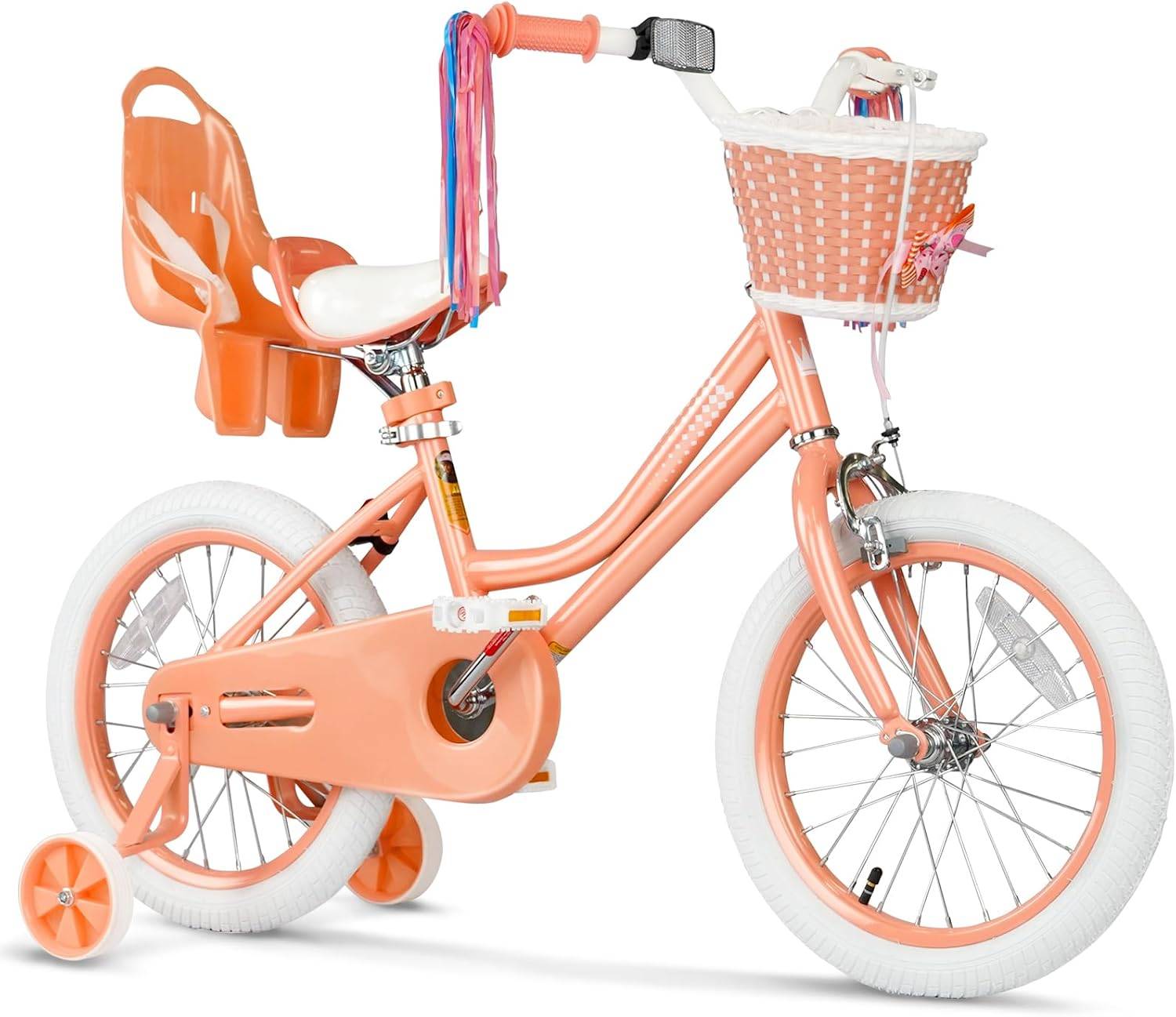 Girls 12/14/16 Inch Kids Bike by XJD with Training Wheels – Peach
A training-wheel bicycle offered in supplied 12 Inch, 14 Inch and 16 Inch SKU labels; relevant when measurement and an individual fit check support one of those sizes.
 XJD Light Purple Girls Bike with Basket, Training Wheels, 12/14/16/20 Inch
A training-wheel bicycle with a basket and supplied 12 Inch, 14 Inch and 16 Inch SKU labels. Its title mentions 20 Inch, but 20 Inch is not among the supplied available labels.
Compare the two relevant catalog options
Girls 12/14/16 Inch Kids Bike by XJD with Training Wheels – Peach is categorized as a training-wheel bike and has supplied 12 Inch, 14 Inch and 16 Inch SKU labels.
XJD Light Purple Girls Bike with Basket, Training Wheels, 12/14/16/20 Inch is also categorized as a training-wheel bike. Although its exact catalog title includes 20 Inch, the supplied available SKU labels are only 12 Inch, 14 Inch and 16 Inch. Do not assume a 20 Inch option is selectable without verifying the current product page.
Compare the models only after identifying the child’s likely size range and completing an actual fit check. The supplied facts do not establish differences in brakes, weight, materials, load limits or assembly, so consult the exact product manual or a qualified bicycle mechanic for those details.
Know when to pause or change course
Pause if the child cannot stand over the bicycle comfortably, must strain to reach the controls, cannot brake on command, or becomes too anxious to listen and look ahead. Recheck fit and return to the last controlled skill. A smaller practice step is more productive than pushing through fear.
If the fit check indicates 18, 20, 24 or 26 inches, neither supplied product is an appropriate size match based on its available SKU labels. Select a bicycle in the measured rider’s starting range, verify stand-over, reach and brake control in person, then begin with balance and stopping before asking for a full independent ride.
Bikes for your next adventure
-

Kids Bike Helmet by XJD for Boys & Girls – Black, Blue, Green, Pink, Purple
The XJD Kids Bike Helmet covers a wide 2-to-8-year age range thanks to two head-…$59.99
-

Kids Bike Helmet by XJD for Girls – Pink
The XJD Kids Bike Helmet in Pink is a lightweight multi-sport helmet for girls r…$59.99
$99 -

XJD Kids Bike for Girls – Pink, 12/14/16/20 Inch with Training Wheels
The XJD Kids Bike for Girls in Pink is a training-wheel bike built to carry your…$139
$159