

How young can a child learn to ride a bike
Most children can start learning to ride at about age 3, provided they fit a 12-inch bike and can steer, stop and follow simple directions.
Age gives you a starting point, not the answer
For the youngest riders, XBikes lists a 12-inch wheel as a starting point for ages 3–4 and heights 34–40 inches (86–102 cm). That means age 3 is a reasonable earliest reference, but it is not a deadline or proof that a child is ready. Some children need more time, while others can begin practicing balance and control at that age.
Readiness is visible: the child willingly gets on, looks ahead, holds the handlebar without struggling, and can understand “stop.” Confidence also matters. A correctly sized bicycle will not help if the child is frightened or cannot concentrate on a short practice session.
Measure before choosing a wheel size
Measure the child’s standing height without shoes. Also measure the inseam from the floor to the crotch, using a book held level between the legs. Compare height with the XBikes starting points below, then confirm the fit on the actual bicycle.
| Wheel size | Age starting point | Rider height |
|---|---|---|
| 12 Inch | 3–4 | 34–40 in / 86–102 cm |
| 14 Inch | 3–6 | 37–45 in / 94–114 cm |
| 16 Inch | 4–7 | 40–48 in / 102–122 cm |
| 18 Inch | 5–9 | 43–52 in / 109–132 cm |
| 20 Inch | 7–12 | 48–60 in / 122–152 cm |
| 24 Inch | 10–14 | 54–64 in / 137–163 cm |
| 26 Inch | Youth and adults | Over 60 in / 153 cm |
Overlapping ranges are intentional starting points, not a reason to size up. Never buy an oversized bicycle merely so the child can grow into it.
Check the individual fit
Have the child try the bicycle. When standing over it, the child needs usable clearance rather than contact with the frame. Seated, they should reach the handlebar comfortably, steer without stretching, and operate the brakes with control. Their inseam, reach, brake control and current confidence take priority over the age column.
If the child cannot stand over the bicycle comfortably, turns the handlebar by leaning their whole body, or cannot reach and control the brakes, it is not a workable fit. Compare another size or ask a qualified bicycle mechanic for help. Follow the exact product manual for assembly, adjustments, maintenance, compatibility, load limits and torque.
How the supplied bicycles help with the decision
The supplied catalog choices provide concrete comparison points across 12-, 14-, 16-, 20-, 24- and 26-inch labels. The two training-wheel-equipped titles make the smallest listed sizes easy to compare, while the cruiser extends the comparison to taller riders. They are relevant only when the child’s measurements and hands-on fit support one of their available sizes.
 XJD Light Purple Girls Bike with Basket, Training Wheels, 12/14/16/20 Inch
Available in 12-, 14- and 16-inch SKU labels, this training-wheel bike includes the 12-inch size associated with XBikes’ youngest starting point, subject to an individual fit check.
 XJD Kids Beach Cruiser Bicycle, Rear Rack & V-Brakes, Mint Green
Its available 20-, 24- and 26-inch SKU labels make this beach cruiser relevant mainly for older or taller riders, not as a substitute for the smaller sizes commonly considered for first learning.
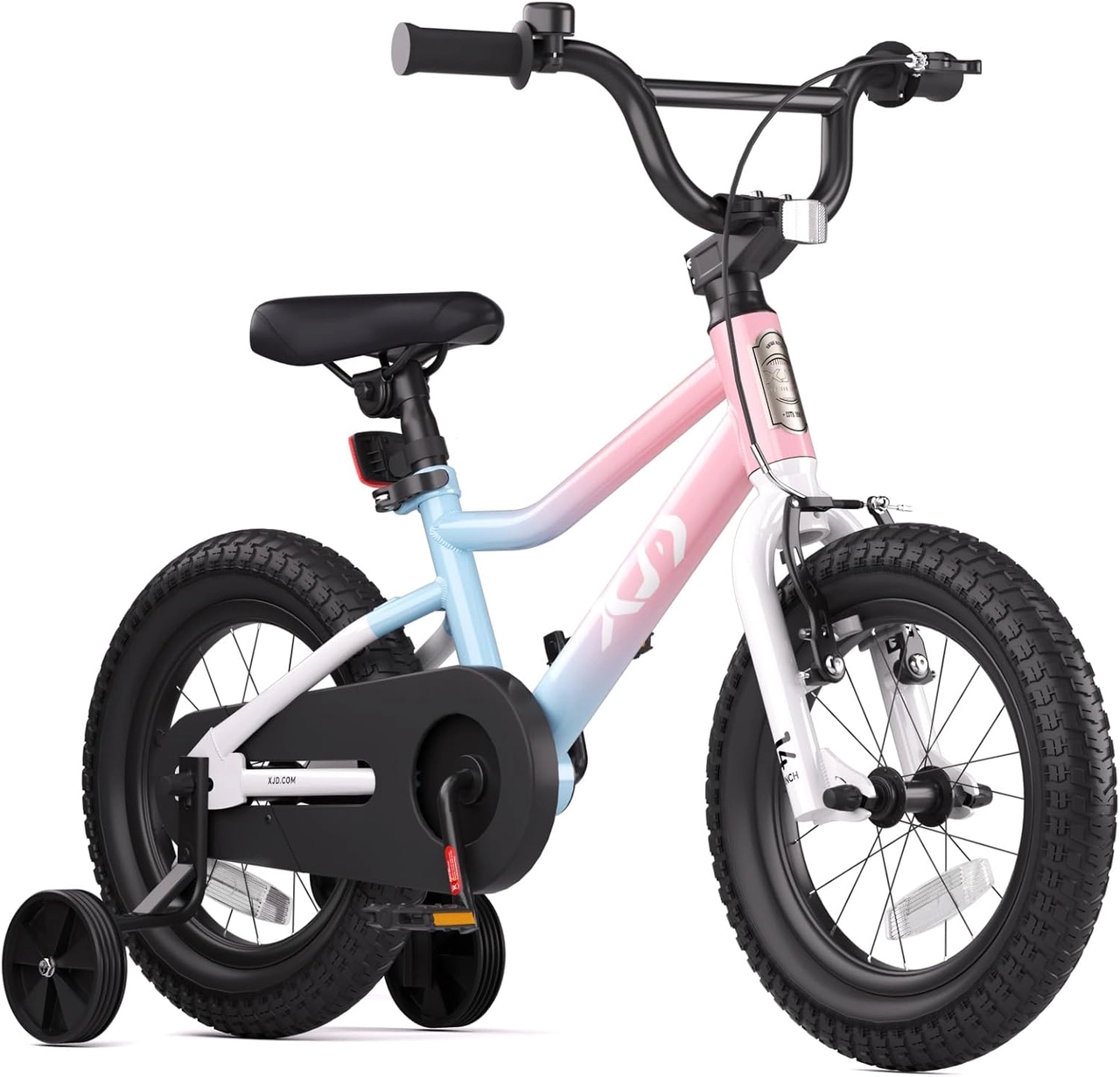 XJD Girls BMX Bike 12/14/16 Inch with Training Wheels – Pink Blue
This kids’ BMX bike has training wheels and available 12-, 14- and 16-inch SKU labels, giving younger learners several size comparison points while still requiring stand-over, reach and brake-control checks.
Options for a younger learner
The XJD Light Purple Girls Bike with Basket, Training Wheels, 12/14/16/20 Inch is listed in Training Wheel Bikes, with available 12-, 14- and 16-inch SKU labels. Its 12-inch option is the catalog match for the youngest XBikes starting point: ages 3–4 and heights 34–40 inches (86–102 cm). Compare the 14- or 16-inch labels only when the child’s measured height and actual fit support them.
The XJD Girls BMX Bike 12/14/16 Inch with Training Wheels – Pink Blue is listed in Kids’ BMX Bikes and also offers 12-, 14- and 16-inch SKU labels. It covers the same three smaller wheel-size starting points, so the decision still depends on stand-over clearance, reach, brake operation and confidence—not the styling or title.
Why the larger option is usually not for the youngest child
The XJD Kids Beach Cruiser Bicycle, Rear Rack & V-Brakes, Mint Green is listed in Beach Cruiser Bikes with 20-, 24- and 26-inch SKU labels. XBikes starts 20-inch sizing at ages 7–12 and heights 48–60 inches (122–152 cm), so this product is generally a comparison for an older or taller rider, not a substitute for a 12-, 14- or 16-inch bicycle.
Make the first practice sessions manageable
- Choose a level, open area away from traffic and obstacles.
- Use short sessions and practice looking ahead, steering and stopping before adding distance.
- Stay close enough to assist without pulling the handlebar away from the child.
- Stop when fatigue or frustration begins; control usually worsens before enthusiasm returns.
A bicycle helmet must fit properly, sit level and have its straps used according to the helmet manufacturer’s instructions. Recheck the fit whenever the helmet is adjusted or passed to another child.
Your decision today
If your child is around 3, first measure height and inseam. Consider a 12-inch option only if the child is within the 34–40-inch (86–102 cm) starting range and passes the stand-over, reach, brake-control and confidence checks. If any check fails, wait or compare a more suitable fit rather than choosing by birthday alone.
Bikes for your next adventure
-

Black XJD Kids Bike for Boys – 12, 14 & 16 Inch Sizes
For a son between roughly 3 and 8 years old, the XJD Kids Bike in Black covers t…$169
$199 -

Blue XJD Girls Bike with Training Wheels – 12/14/16 Inch
If you're shopping for a first pedal bike for a daughter roughly 3 to 8 years ol…$149
$169 -
XJD Kids' Training Wheel Bike for Boys & Girls, 12/14/16 Inch – White
The XJD kids' training wheel bike in White is made for riders ages 3–8 (roughly …$169
$199