

How young can kids learn to ride bike
Kids can begin learning to ride as young as age 3, using a correctly fitted 12-inch bike; readiness, measured fit, control and confidence matter more than age.
Start with readiness, not a birthday
The XBikes starting point for a 12-inch bicycle is ages 3–4 and a rider height of 34–40 inches (86–102 cm). That means age 3 can be a reasonable beginning, but it is not a deadline or a promise that every child is ready.
A child is ready to practise when they can follow simple directions, stay engaged, and control the bicycle without being overwhelmed. Hesitation is useful information. Short, calm sessions are more productive than pushing a frightened child to continue.
Age also becomes less useful where size ranges overlap. A child between ages 3 and 6, for example, might encounter both 12-inch and 14-inch starting points. Measure before deciding.
Measure before comparing wheel sizes
Measure the child’s height without shoes, standing straight against a wall. Measure inseam from the floor to the crotch using a firm book held level to represent the saddle area. Then have the child try the actual bicycle whenever possible.
Use the following XBikes figures only to identify sizes worth trying:
| Wheel size | Age starting point | Rider height |
|---|---|---|
| 12 Inch | 3–4 | 34–40 in / 86–102 cm |
| 14 Inch | 3–6 | 37–45 in / 94–114 cm |
| 16 Inch | 4–7 | 40–48 in / 102–122 cm |
| 18 Inch | 5–9 | 43–52 in / 109–132 cm |
| 20 Inch | 7–12 | 48–60 in / 122–152 cm |
| 24 Inch | 10–14 | 54–64 in / 137–163 cm |
| 26 Inch | Youth and adults | Over 60 in / 153 cm |
Overlapping ranges are comparison zones, not instructions to choose the larger wheel. The American Academy of Pediatrics advises having the child try the bike and avoiding an oversized bicycle bought for future growth.
What a successful fit check looks like
With an adult stabilizing the bicycle, check four things before treating any size as suitable:
- Stand-over: The child can straddle the bicycle without the frame preventing a stable stance.
- Reach: The child can hold the handlebar naturally rather than stretching, locking the elbows or leaning excessively.
- Brake control: The child can reach and operate the brake controls while maintaining a secure grip.
- Confidence: The child can start, steer, slow and stop without the bicycle feeling unmanageable.
If one of these checks fails, do not assume practice will correct a size mismatch. Compare another size or ask a qualified bicycle mechanic to assess the fit. Follow the exact product manual for assembly, adjustment, maintenance, compatibility and torque details.
How to make the first practice useful
Choose a flat area away from vehicles, obstacles and crowds. Begin with the basic actions the child must coordinate: supporting the bicycle, looking ahead, steering predictably, slowing and stopping. Keep an adult close enough to steady the child, but allow the child to report whether the reach or controls feel difficult.
Stop while the experience is still manageable. A child who becomes tired may lose control even when the bicycle fits. On the next session, repeat the fit and brake-reach check, especially if the saddle or controls have been adjusted.
A bicycle helmet must fit properly, sit level, and have its straps used according to the helmet manufacturer’s instructions, following U.S. Consumer Product Safety Commission guidance. A poorly positioned or loosely secured helmet should be corrected before riding begins.
When the supplied bicycle is relevant
The XJD Kids Beach Cruiser Bicycle, Rear Rack & V-Brakes, Mint Green is offered with 20 Inch, 24 Inch and 26 Inch labels. Those options help families compare later starting points after measuring a taller child: 20 inches corresponds to 48–60 inches, 24 inches to 54–64 inches, and 26 inches to riders over 60 inches.

This product is not a substitute for the 12-, 14-, 16- or 18-inch sizes that may fit a younger learner. Its 20-, 24- and 26-inch options should be considered only when the child’s measured height places them in the relevant starting range and the individual stand-over, reach, brake-control and confidence checks all succeed. The supplied rear-rack fact does not establish a load limit; consult the exact manual before carrying anything.
Decide what to do next
If the child is age 3 and measures 34–40 inches, begin by trying a 12-inch bicycle. At any other age or height, use the table to shortlist sizes, then let measured height, inseam, reach, brake operation and present confidence settle the choice. If the child cannot stand securely or control the brakes, pause and try a different fit rather than buying for growth.
Bikes for your next adventure
-

Black XJD Kids Bike for Boys – 12, 14 & 16 Inch Sizes
For a son between roughly 3 and 8 years old, the XJD Kids Bike in Black covers t…$169
$199 -

Blue XJD Girls Bike with Training Wheels – 12/14/16 Inch
If you're shopping for a first pedal bike for a daughter roughly 3 to 8 years ol…$149
$169 -
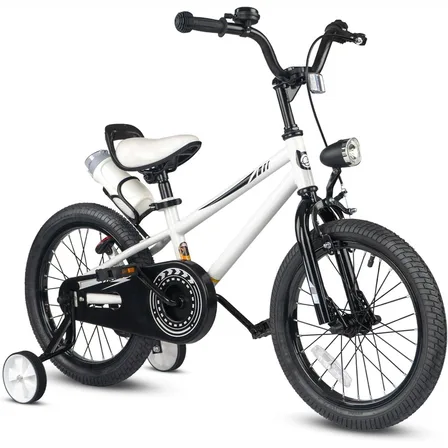
XJD Kids' Training Wheel Bike for Boys & Girls, 12/14/16 Inch – White
The XJD kids' training wheel bike in White is made for riders ages 3–8 (roughly …$169
$199