

How young can someone ride a bike without learning
No child has a guaranteed age at which they can ride a bike without learning. The youngest XBikes sizing starting point is age 3 for a 12-inch bike, but independent riding still requires an individual fit check, instruction and practice.
Age does not replace learning
“Without learning” can mean riding without previous practice, or riding without training wheels. In either case, age alone cannot show that a child is ready. A correctly sized bicycle can make learning manageable, but it does not remove the need to develop steering, braking, balance and awareness.
The practical answer is therefore not a single youngest age. Begin only when the child can understand simple directions, remain interested rather than frightened, and physically control a bicycle that fits. Confidence matters, but it must be matched by actual control.
Measure before choosing a wheel size
Measure the child’s standing height and inseam without shoes. Then compare those measurements with the starting points below. Height narrows the options; inseam, reach and control decide whether a particular bicycle actually works.
| Wheel size | Age starting point | Rider height |
|---|---|---|
| 12 Inch | 3–4 | 34–40 in / 86–102 cm |
| 14 Inch | 3–6 | 37–45 in / 94–114 cm |
| 16 Inch | 4–7 | 40–48 in / 102–122 cm |
| 18 Inch | 5–9 | 43–52 in / 109–132 cm |
| 20 Inch | 7–12 | 48–60 in / 122–152 cm |
| 24 Inch | 10–14 | 54–64 in / 137–163 cm |
| 26 Inch | Youth and adults over 60 in | Over 60 in / 153 cm |
These ranges overlap deliberately and are not permission to choose by age alone. Prioritize measured height, inseam, reach, brake control and current confidence. Following American Academy of Pediatrics guidance, have the child try the bicycle and do not buy an oversized model merely for future growth.
Perform the fit and control check
With an adult stabilizing the bicycle, check whether the child can stand over it comfortably rather than being forced onto tiptoes or against the frame. From the riding position, the child should reach the handlebar without an awkward stretch and turn it while remaining composed.
Next, confirm that the child can operate the bicycle’s braking controls reliably. Brake reach and control must be assessed on the exact bicycle; a height-table match cannot prove either one. If the child cannot mount, steer, stop or step down with control, choose another fit or postpone riding.
What training-wheel models can and cannot do
The XJD Girls BMX Bike 12/14/16 Inch with Training Wheels – Pink Blue and the XJD Boys & Girls BMX Bike with Training Wheels, 12/14/16" – Blue are both Kids' BMX Bikes offered in 12 Inch, 14 Inch and 16 Inch labels. They are relevant because their included training wheels provide catalog options for a young rider beginning with support across the three smallest supplied size ranges.
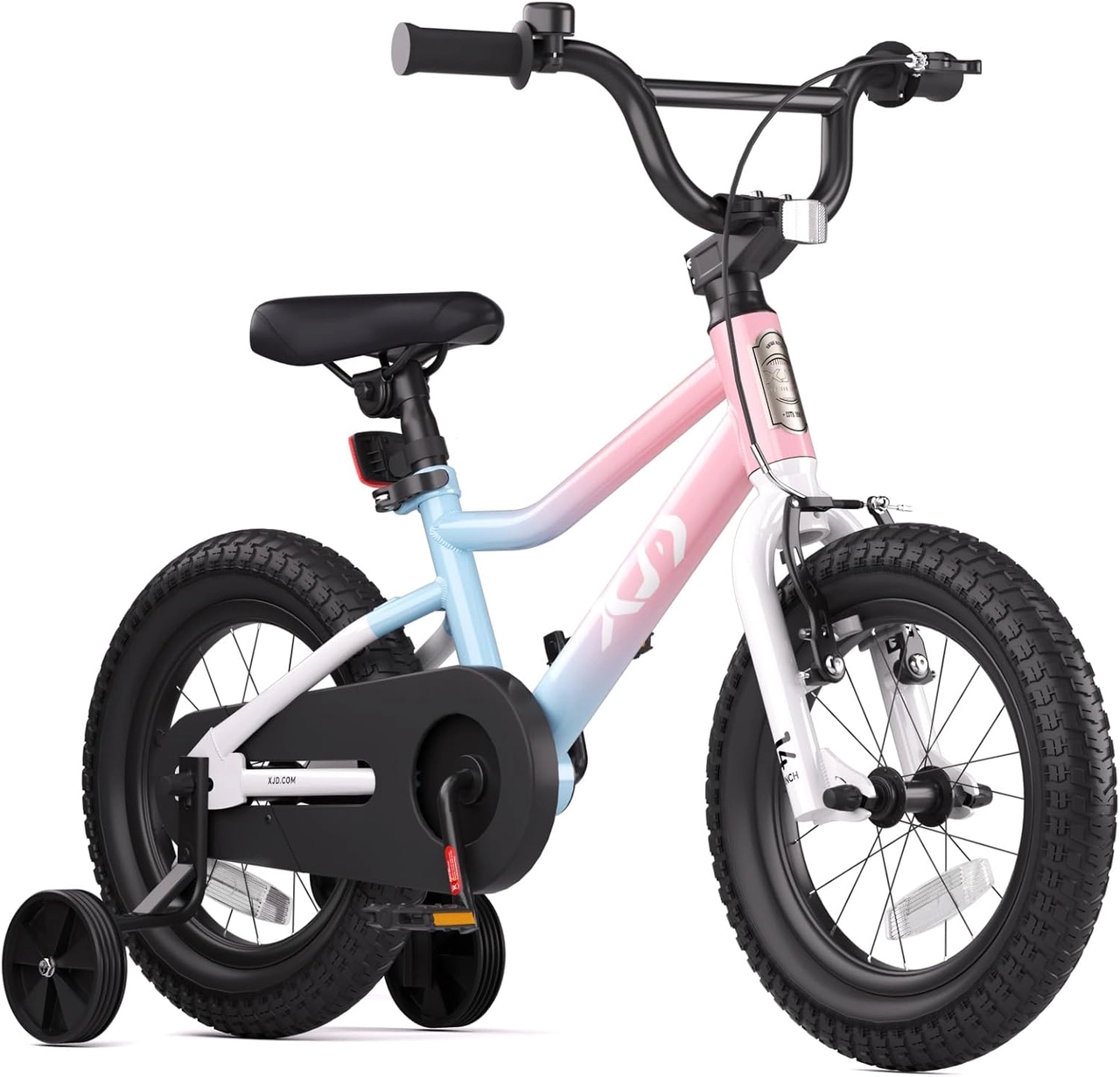 XJD Girls BMX Bike 12/14/16 Inch with Training Wheels – Pink Blue
A Kids' BMX Bike offered in 12, 14 and 16 Inch labels with training wheels. It is relevant as a supported-learning option only after height, inseam, reach and brake-control checks confirm the selected size.
 XJD Boys & Girls BMX Bike with Training Wheels, 12/14/16" – Blue
This Kids' BMX Bike includes training wheels and has 12, 14 and 16 Inch labels. Compare the selected wheel size against the supplied height starting points, then verify the child’s individual fit and control.
Compare these models first by the child’s measured fit and preferred listed option, not by the wording of either title. Their supplied catalog facts do not establish brake type, weight, material, load limit or certification, so those details should not be assumed.
Training wheels may support the bicycle while a child learns pedaling and steering, but they do not mean the child is riding “without learning,” nor do they prove readiness for unsupported balance. These products are relevant only if 12, 14 or 16 Inch is confirmed by an individual fit check. If the child needs 18 Inch or larger, they are smaller comparison points, not equivalent substitutes.
Set up the first ride safely
Use a quiet riding area away from traffic and other obvious hazards, with attentive adult supervision. A bicycle helmet must fit properly, sit level and have its straps adjusted according to the helmet manufacturer’s instructions, consistent with U.S. Consumer Product Safety Commission guidance.
Before use, follow the exact bicycle manual for assembly, adjustment, inspection, maintenance and any limits. If the instructions are missing, unclear or require work beyond the adult’s ability, use a qualified bicycle mechanic rather than improvising settings or torque values.
Make the age decision
For a child near age 3, treat a 12-inch bicycle only as the first sizing possibility—not proof that the child can ride. Measure height and inseam, arrange a real fit check, confirm comfortable stand-over, reach and braking, and observe willingness to learn. Proceed with close supervision only when all of those checks succeed; otherwise select a better-fitting option or wait.
Bikes for your next adventure
-

Kids Bike Helmet by XJD for Boys & Girls – Black, Blue, Green, Pink, Purple
The XJD Kids Bike Helmet covers a wide 2-to-8-year age range thanks to two head-…$59.99
-

Kids Bike Helmet by XJD for Girls – Pink
The XJD Kids Bike Helmet in Pink is a lightweight multi-sport helmet for girls r…$59.99
$99 -

XJD Kids Bike for Girls – Pink, 12/14/16/20 Inch with Training Wheels
The XJD Kids Bike for Girls in Pink is a training-wheel bike built to carry your…$139
$159