

How young can a baby ride in a bike seat
A baby should ride in a bicycle child seat only after sitting independently with reliable head and neck control and meeting the seat maker’s minimum requirements.
There is no single youngest age
Calendar age alone cannot determine readiness. A newborn or a baby who still needs support to remain upright should not ride in a bicycle-mounted child seat. The child must be able to maintain a stable seated position and control the head while wearing a properly fitted bicycle helmet.
Before the first ride, compare the child’s development and measurements with the exact child-seat manual. Check its minimum and maximum passenger limits, required body position, harness fit and helmet-clearance instructions. If the child was born prematurely, has delayed motor development or has a condition affecting posture or neck strength, ask the child’s pediatric clinician for individual advice.
What to measure and compare
Do not rely on an age printed in an advertisement. Measure the child as directed by the seat manufacturer, then make these comparisons:
- Independent sitting: The baby can remain upright without being propped up and can keep the head stable.
- Seat limits: The child satisfies every minimum requirement in the manual and does not exceed any stated limit.
- Harness position: The restraint can be adjusted to the child exactly as the instructions specify, without loose webbing or improvised padding.
- Helmet fit: The helmet sits level, fits properly and has its straps adjusted according to its manufacturer’s instructions.
- Helmet clearance: The seat does not force the helmet or head into an unsafe posture. Follow the seat manual’s positioning guidance.
- Bicycle compatibility: The bicycle, rack or frame and mounting system are explicitly compatible according to their manuals.
If any comparison fails, wait. A child being close to a stated threshold is not the same as meeting it.
Check the bicycle and installation
A suitable passenger does not make an unsuitable installation acceptable. Follow the exact manuals for the child seat, bicycle and any rack or adapter. Those documents—not a general article—control compatibility, load limits, assembly, maintenance and torque.
Have a qualified bicycle mechanic inspect the installation if any mounting point, fastener, rack rating or compatibility statement is unclear. Before each outing, confirm that the seat is secure, the restraint is correctly adjusted and nothing can contact a wheel or other moving part. Begin in a traffic-free area so the adult rider can become accustomed to the bicycle’s altered balance, starting and stopping.
Why the catalog bicycles are different
The supplied XBikes products are training-wheel bicycles intended for children riding their own bikes; they are not bicycle child seats and are not substitutes for carrying a baby. They help answer the title by showing the later, self-riding stage and by providing wheel-size comparison points for a child who has outgrown passenger-seat use.
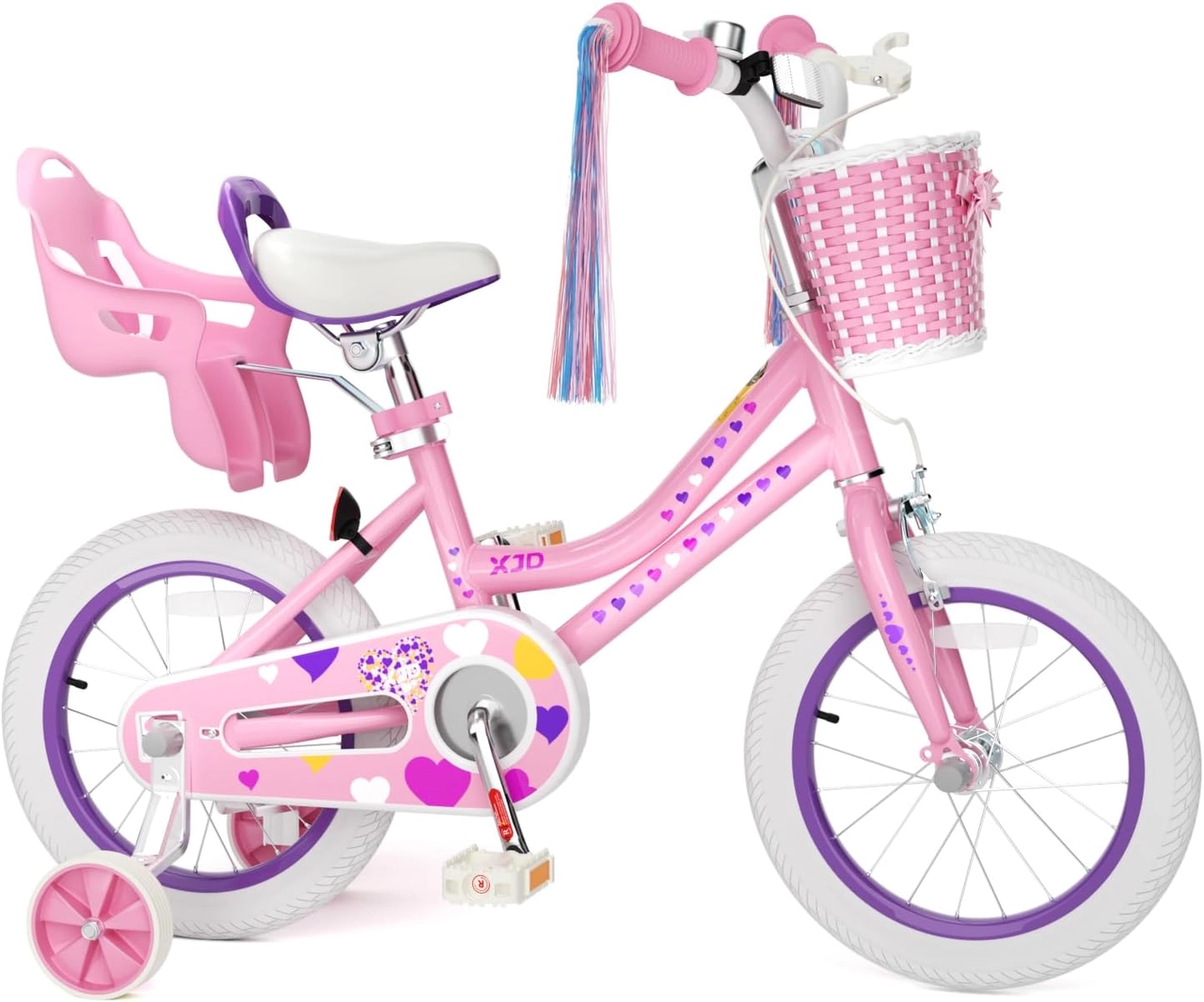 Pink Girls' 12/14/16" Bike by XJD – Basket & Doll Seat
A later-stage self-riding comparison offered in 12 Inch, 14 Inch and 16 Inch sizes. This training-wheel bicycle is not a baby passenger seat or a substitute for one.
 Light Pink XJD Girls' Bicycle with Basket & Training Wheels
This training-wheel bicycle comes in 12 Inch, 14 Inch, 16 Inch and 20 Inch options, making it useful for comparing future independent-rider sizes, not for carrying a baby.
 Blue XJD Girls Bike with Training Wheels – 12/14/16 Inch
Available in 12 Inch, 14 Inch and 16 Inch sizes, this training-wheel bicycle illustrates the independent-riding stage. It is not a bicycle-mounted child seat for a baby.
How the three options compare
Pink Girls' 12/14/16" Bike by XJD – Basket & Doll Seat is listed in 12 Inch, 14 Inch and 16 Inch sizes. Blue XJD Girls Bike with Training Wheels – 12/14/16 Inch offers the same three wheel-size labels. Light Pink XJD Girls' Bicycle with Basket & Training Wheels adds a 20 Inch option to 12 Inch, 14 Inch and 16 Inch.
These sizes do not indicate that a baby is ready for a passenger seat. For a future independent rider, use XBikes’ starting points: 12 Inch corresponds to ages 3–4 and heights of 34–40 in / 86–102 cm; 14 Inch to ages 3–6 and 37–45 in / 94–114 cm; 16 Inch to ages 4–7 and 40–48 in / 102–122 cm; and 20 Inch to ages 7–12 and 48–60 in / 122–152 cm.
Those ranges are starting points, not proof of fit. Measure height and inseam, then have the child try the bicycle. Check stand-over clearance, reach, brake control and current confidence. Do not select an oversized bicycle merely to allow room for growth.
Make the go-or-wait decision
Proceed only when the baby sits independently with stable head and neck control, wears a correctly fitted helmet, meets every requirement in the child-seat manual, and fits a verified bicycle-and-seat installation. Keep the ride short and controlled at first. If readiness, fit or compatibility is uncertain, do not ride yet; remeasure later and have the exact setup checked by a qualified bicycle mechanic.
Bikes for your next adventure
-

Kids Bike Helmet by XJD for Boys & Girls – Black, Blue, Green, Pink, Purple
The XJD Kids Bike Helmet covers a wide 2-to-8-year age range thanks to two head-…$59.99
-

Kids Bike Helmet by XJD for Girls – Pink
The XJD Kids Bike Helmet in Pink is a lightweight multi-sport helmet for girls r…$59.99
$99 -

XJD Kids Bike for Girls – Pink, 12/14/16/20 Inch with Training Wheels
The XJD Kids Bike for Girls in Pink is a training-wheel bike built to carry your…$139
$159