

Should i get a 26 or 28 inch bike
Choose a 26-inch bike if it gives the rider secure stand-over clearance, comfortable reach and confident control. Choose 28-inch only if an individual fit check shows it fits better; the larger label alone is not a reason to size up.
The direct comparison
For a rider deciding between 26 and 28 inches, body fit matters more than wheel diameter. The XBikes starting point places 26-inch bikes in the youth-and-adult range for riders over 60 inches (153 cm). No supplied XBikes age or height standard is available for 28-inch bikes, so do not infer a minimum height for that size.
A 28-inch wheel does not automatically mean a bike will feel too large, and a 26-inch wheel does not guarantee a good fit. Frame shape and dimensions affect where the rider stands, sits and reaches. Compare the actual bicycles rather than treating the wheel labels as complete sizing systems.
Measure before choosing
Measure the rider's height without shoes, standing straight against a wall. Then measure inseam from the floor to the crotch using a firm book held level to represent the saddle contact area. Use the height to identify a starting category and the inseam to evaluate clearance on each actual frame.
Record both measurements and take them to the product sizing information or a bicycle shop. Because only a 26-inch numerical starting point is supplied here, consult the exact manufacturer guidance for any 28-inch model rather than estimating from the wheel difference.
Try both bikes and check control
Have the rider try each candidate. The American Academy of Pediatrics advises against buying an oversized bicycle simply for a child to grow into. During the comparison, check all of the following:
- Stand-over: the rider can straddle the frame with practical clearance and without leaning the bike sharply.
- Reach: the handlebar is reachable without stretching, locking the elbows or shifting awkwardly forward.
- Brakes: the rider can comfortably reach and operate the brake controls supplied on that specific bike.
- Starting and stopping: the rider can set off, steer, slow down and stop without losing control.
- Confidence: the bike feels manageable during turns and low-speed riding, not merely acceptable while stationary.
If the 28-inch candidate compromises any of these checks while the 26-inch candidate does not, choose the 26-inch bike. If both fit, compare their intended use, riding position and manufacturer guidance. If neither fits, reject both and try another frame or wheel size.
How the XBikes size starting points apply
| Wheel size | XBikes starting point | Meaning for this decision |
|---|---|---|
| 24 Inch | Ages 10–14; 54–64 in / 137–163 cm | A comparison point if the rider is near the lower end of the 26-inch transition. |
| 26 Inch | Youth and adults over 60 in / 153 cm | A starting point only; confirm inseam, reach, brake control and confidence. |
| 28 Inch | No supplied numerical standard | Use the exact model's guidance and an individual fit check. |
Age is secondary to measured height and real control. A rider who meets a height starting point can still need a different frame because proportions, reach and confidence vary.
What the supplied product can show
The XJD Girls BMX Bike 12/14/16 Inch with Training Wheels – Pink Blue is available with 12 Inch, 14 Inch and 16 Inch SKU labels in the Kids' BMX Bikes category. Those sizes can illustrate how XBikes separates wheel-size options, but they are not 26- or 28-inch bikes. They are nearest-size catalog comparison points only, not substitutes for either size in the title.
These particular catalog options help clarify an important principle: select the exact size that matches the rider rather than assuming nearby wheel labels are interchangeable. They are relevant only if you are separately shopping for a smaller child's bike within the supplied 12-, 14- or 16-inch starting ranges.

For reference, XBikes starts 12 Inch at ages 3–4 and 34–40 inches (86–102 cm), 14 Inch at ages 3–6 and 37–45 inches (94–114 cm), and 16 Inch at ages 4–7 and 40–48 inches (102–122 cm). These ranges do not make that product relevant to a rider who needs 26 or 28 inches.
Complete the choice safely
Before riding, follow the exact bicycle manual for assembly, adjustment, maintenance, load limits, compatibility and torque. If any instruction is missing or the setup is uncertain, use a qualified bicycle mechanic rather than inventing a procedure.
Add a properly fitting bicycle helmet. It should sit level, and its straps should be adjusted according to the helmet manufacturer's instructions, consistent with U.S. Consumer Product Safety Commission guidance.
Your next step is simple: measure height and inseam, test the actual 26- and 28-inch candidates, and choose 26 unless the 28-inch bike independently passes every stand-over, reach, braking and confidence check.
Bikes for your next adventure
-
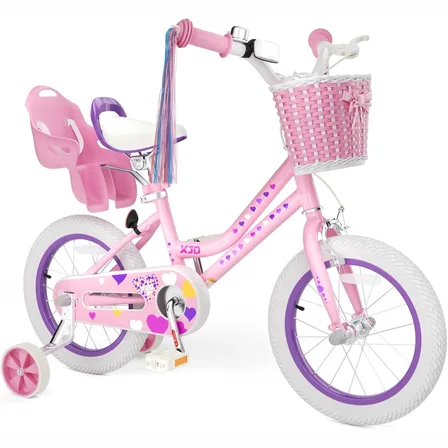
Light Pink XJD Girls' Bicycle with Basket & Training Wheels
The Light Pink XJD Girls' Bicycle with Basket & Training Wheels is a retro-style…$109.99
$129.99 -

XJD Boys 12/14/16" Training Wheel Bike – Blue
The XJD Boys Bike in Blue is a training wheel bike for riders 71–122 cm tall—rou…$169
$199 -
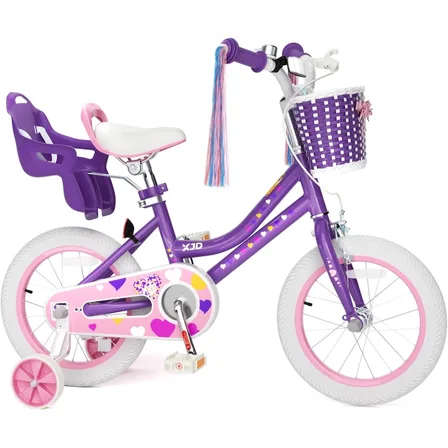
Purple XJD Girls' Bike with Doll Seat & Basket
For girls 71–122 cm tall (about ages 3–7), this XJD girls' bike in Purple pairs …$75.99
$99.99