

Should i let my 5 year old ride their bike
Yes—most 5-year-olds can ride a bike if the bike fits their measured body, they can control it confidently, and an adult provides a safe practice area and close supervision. Age alone does not decide readiness.
Measure before choosing a wheel size
Measure your child’s height without shoes, then check their inseam. Compare height with the XBikes starting points below, but use the inseam during an actual fit check: your child needs comfortable clearance when standing over the bicycle rather than being forced against the frame.
| Wheel size | Starting age | Rider height |
|---|---|---|
| 12 Inch | 3–4 | 34–40 in / 86–102 cm |
| 14 Inch | 3–6 | 37–45 in / 94–114 cm |
| 16 Inch | 4–7 | 40–48 in / 102–122 cm |
| 18 Inch | 5–9 | 43–52 in / 109–132 cm |
For a 5-year-old, the table creates several possible starting points because children of the same age vary considerably in height and proportions. A shorter rider might fall within the 14-inch range, while another might overlap the 16- or 18-inch ranges. Where ranges overlap, do not assume the larger wheel is automatically preferable.
Check the bike with your child on it
Have your child try the exact bicycle. Do not buy an oversized bike solely to leave growing room. Ask them to stand over it, sit in the riding position, place their hands naturally on the controls and turn the handlebar both ways.
- Stand-over: Check that they can stand comfortably and manage the bicycle without being trapped by its size.
- Reach: Their arms should not be stretched so far that steering becomes awkward.
- Brake control: They must be able to reach and operate the bicycle’s actual brakes. Follow its manual for the intended operation and adjustment.
- Handling: They should be able to start, steer, stop and put a foot down without panic or an adult holding the bike upright.
If any of these checks fail, that bicycle is not the right fit now, even when its wheel size appears in the age or height range.
Decide whether your 5-year-old is ready
A willing child who follows simple instructions and can look ahead, steer deliberately and stop on request may be ready for closely supervised practice. Begin in a flat, open area away from traffic, slopes, obstacles and other riders. Keep sessions short enough that fatigue does not erode control.
Pause and return to simpler practice if your child repeatedly freezes, cannot stop predictably, looks down instead of ahead, or becomes distressed. Training wheels can provide support on bicycles designed for them, but their presence does not replace correct fit, braking ability or supervision.
How the supplied bikes relate to this decision
The two catalog options offer 12 Inch, 14 Inch and 16 Inch choices, so they can help you compare sizes that may suit some 5-year-olds after measuring. They do not offer an 18 Inch option; if your child measures into that starting range and fits an 18-inch bicycle better, these smaller catalog sizes are comparison points, not equivalent substitutes.
 Black XJD Kids' BMX Bicycle with Training Wheels
Available in 12 Inch, 14 Inch and 16 Inch labels, this Kids' BMX Bikes option provides three size comparison points and includes training wheels in its catalog title. Confirm the child's individual fit and control before choosing.
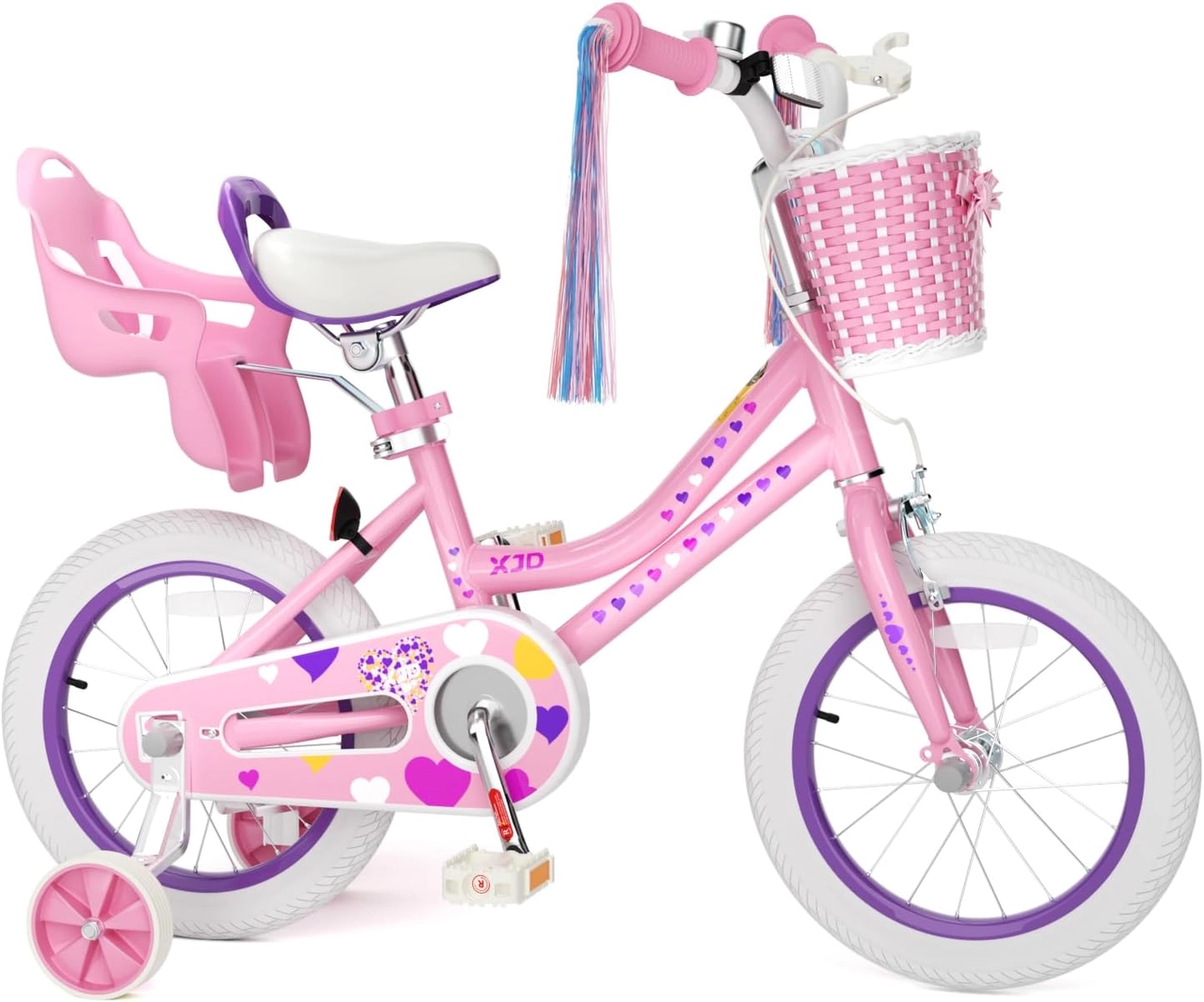 Pink Girls' 12/14/16" Bike by XJD – Basket & Doll Seat
This Training Wheel Bikes option is available in 12 Inch, 14 Inch and 16 Inch labels. Use those sizes as starting comparisons for a measured 5-year-old, then verify stand-over, reach, braking and confidence on the exact bicycle.
Black XJD Kids' BMX Bicycle with Training Wheels is listed under Kids' BMX Bikes and is available in 12 Inch, 14 Inch and 16 Inch labels. Pink Girls' 12/14/16" Bike by XJD – Basket & Doll Seat is listed under Training Wheel Bikes with the same three size labels. Those facts let you compare available size choices and catalog categories, but they do not establish individual fit.
Do not infer brake type, construction, load capacity, compatibility or setup instructions from either title. Consult the exact product manual for assembly, adjustment, maintenance and limits, or have a qualified bicycle mechanic inspect the bicycle.
Fit the helmet every time
Use a bicycle helmet that fits your child properly. It should sit level on the head, with its straps fitted according to the helmet manufacturer’s instructions. Replace guesswork with a fresh fit check each time: clothing, hair and strap movement can change how securely it sits.
A helmet does not make an unsuitable bike or riding area acceptable. Combine it with a correctly fitted bicycle, closed-toe footwear, active adult supervision and a practice space separated from vehicles.
What to do next
- Measure height and inseam.
- Use the table to identify a starting wheel size rather than choosing by age alone.
- Have your child try the exact bicycle and check stand-over clearance, reach, brake operation and confidence.
- Read the bicycle and helmet manuals before riding.
- Practice starting, steering and controlled stopping in a flat, traffic-free area.
Let your 5-year-old ride when the measured fit and hands-on control checks both succeed. If they cannot comfortably manage the bicycle and stop on command, choose a better-fitting option or wait and practise foundational skills before riding.
Bikes for your next adventure
-

Green XJD Toddler Bike Helmet with Adjustable Fit, XS (46–51 cm)
The XJD toddler bike helmet in Green is built for the youngest riders — the size…$20.39
$23.99 -

Kids Bike Helmet by XJD for Boys & Girls – Black, Blue, Green, Pink, Purple
The XJD Kids Bike Helmet covers a wide 2-to-8-year age range thanks to two head-…$59.99
-

Kids Bike Helmet by XJD for Girls – Pink
The XJD Kids Bike Helmet in Pink is a lightweight multi-sport helmet for girls r…$59.99
$99